Facts
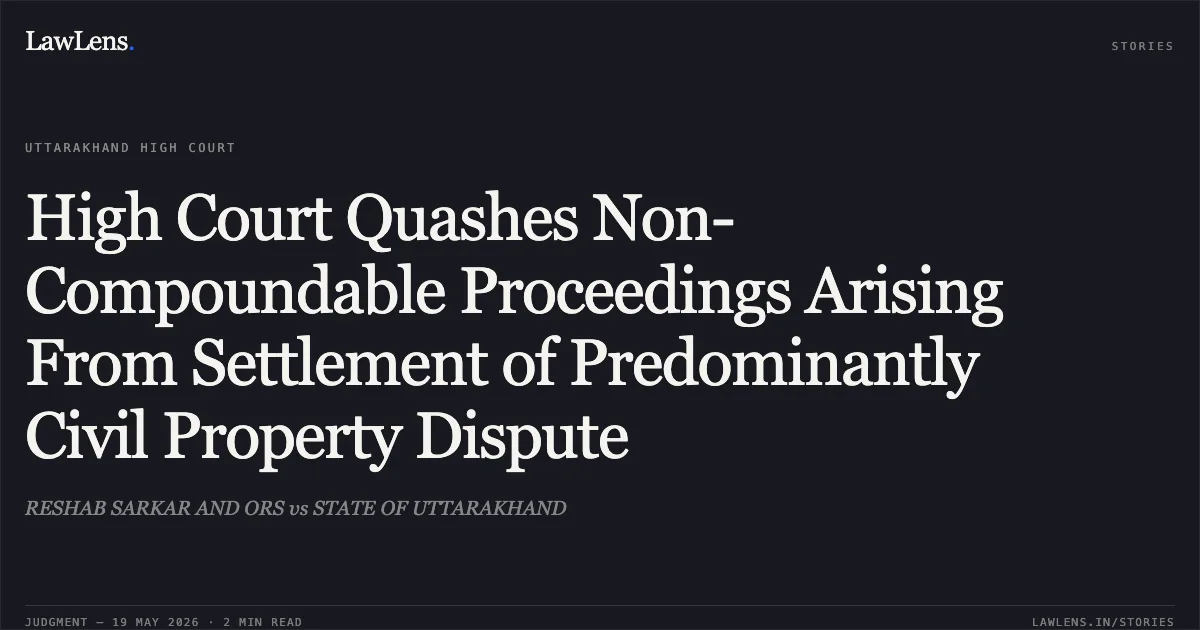
The applicants filed a C-528 application seeking to quash the charge-sheet and summoning order dated 22.09.2025 in Criminal Case No. 2066/2025.
Source reference: para. 4The case originated from an F.I.R. regarding a failed sale agreement where the complainant (Respondent No. 2) alleged that the applicants received consideration but refused to execute the sale deed.
Source reference: para. 5Following a charge-sheet and cognizance under Sections 115(2), 318(4), 324(2), 351(2), and 352 of the Bhartiya Nyaya Sanhita (B.N.S.), the matter was referred to mediation.
Source reference: para. 4, 6The parties reached an amicable settlement where the applicants paid ₹23,00,000/- via demand draft to the complainant in court as full and final settlement.
Source reference: para. 6, 8Issues
1. Whether the High Court, in exercise of its inherent powers under Section 482 Cr.P.C., can quash criminal proceedings in non-compoundable offences when the dispute is essentially private and civil in nature and has been settled by the parties?
Source reference: para. 12Law Applied
The court primarily applied Section 482 of the Code of Criminal Procedure (Cr.P.C.) regarding the inherent powers of the High Court to prevent abuse of the process of law.
Source reference: para. 12It relied on Gian Singh v. State of Punjab, which permits quashing non-compoundable offences if the dispute is overwhelmingly civil or contractual and the parties have settled.
Source reference: para. 13It further integrated the guidelines from Narinder Singh v. State of Punjab, requiring the court to assess if the continuation of proceedings would be futile.
Source reference: para. 13Parbatbhai Aahir v. State of Gujarat, which emphasizes exercising inherent powers to secure the ends of justice.
Source reference: para. 13Reasoning
The Court observed that the dispute was "predominantly civil in nature," arising from a contractual transaction regarding immovable property.
Source reference: para. 11Under Section 482 Cr.P.C., the Court noted that while the offences were technically non-compoundable under the B.N.S., the voluntary settlement between the parties—evidenced by the joint compounding application (I.A. No. 1/2026) and the payment of ₹23,00,000/- in court—rendered further prosecution redundant.
Source reference: para. 7-8, 11Applying the precedent in Gian Singh, the Court reasoned that because the complainant no longer wished to pursue the matter and the dispute was private, continuing the criminal trial would serve no useful purpose and would constitute an abuse of the judicial process.
Source reference: para. 11, 14Holding
The Court answered the issue in the affirmative, holding that the interests of justice and the private nature of the settled dispute warranted quashing the proceedings.
The court allowed the compounding application (I.A. No. 1 of 2026). Consequently, the C-528 application was allowed, and the charge-sheet, summoning order dated 22.09.2025, and all proceedings in Criminal Case No. 2066 of 2025 were quashed qua the applicants.
Source reference: para. 15, 16-17Acts & Sections Cited
6 provisions across 2 statutes referred to in this judgment. Each provision opens on LawLens.
Bharatiya Nyaya Sanhita, 20235
Code of Criminal Procedure, 19731
Original Court PDF
RESHAB SARKAR AND ORSvsSTATE OF UTTARAKHAND
Click to open original judgment
Original judgment, available to read, download and summarize on LawLens.in