Facts
On September 26, 2024, the complainant’s nine-year-old daughter was allegedly enticed into a car by the petitioner and taken away under the pretext of dropping her at her uncle’s house
Source reference: para 2The victim was later found near a temple, and an FIR (Crime No. 545/2024) was registered under Section 137(2) of the Bharatiya Nyaya Sanhita (BNS)
Source reference: para 2The petitioner moved the High Court under Section 528 of the BNSS (corresponding to Section 482 Cr.P.C.) for quashment of the FIR, contending that the case was falsely registered due to prior enmity involving his nephew
Source reference: para 3Conversely, the State and complainant noted that the victim supported the allegations in statements recorded under Sections 161 and 164 of the Cr.P.C. and that a charge-sheet had already been filed
Source reference: paras 4-5Issues
1. Whether the High Court, in the exercise of its inherent powers, should quash an FIR where the allegations and evidence collected during investigation prima facie disclose the commission of a cognizable offence.
Source reference: para 7 / para 112. Whether the plea of prior enmity and disputed questions of fact can be adjudicated by the High Court in a quashment petition or must be relegated to trial.
Source reference: para 5 / para 11Law Applied
The court primarily applied Section 137(2) of the BNS regarding kidnapping from lawful guardianship
Source reference: para 2It relied on the inherent powers of the High Court under Section 528 of the BNSS (formerly Section 482 Cr.P.C.) to prevent abuse of process
Source reference: para 7The court heavily applied the guidelines from State of Haryana v. Bhajan Lal and Neeharika Infrastructure (P) Ltd. v. State of Maharashtra, which dictate that quashing is an exception to be used sparingly in the "rarest of rare cases" only when no cognizable offence is disclosed
Source reference: para 8It further cited Teeja Devi v. State of Rajasthan, emphasizing that courts should not thwart investigations or conduct "mini-trials" at the threshold stage
Source reference: para 10Reasoning
The court reasoned that its jurisdiction under Section 528 BNSS is limited to examining whether the FIR, accepted in its entirety, fails to constitute an offence
Source reference: para 7It observed that the petitioner’s defense—specifically the claim of prior enmity—is a matter involving the appreciation of evidence which can only be determined during a trial
Source reference: para 5, 11The court found that because the FIR explicitly stated the petitioner took a minor child without the guardian's consent, and since the victim corroborated these facts in her Section 164 Cr.P.C. statement, the legal ingredients of Section 137(2) BNS were prima facie satisfied
Source reference: para 11-12Following the Neeharika principles, the court determined that it could not embark on an inquiry into the reliability or genuineness of the allegations at this preliminary stage
Source reference: para 8, 11Holding
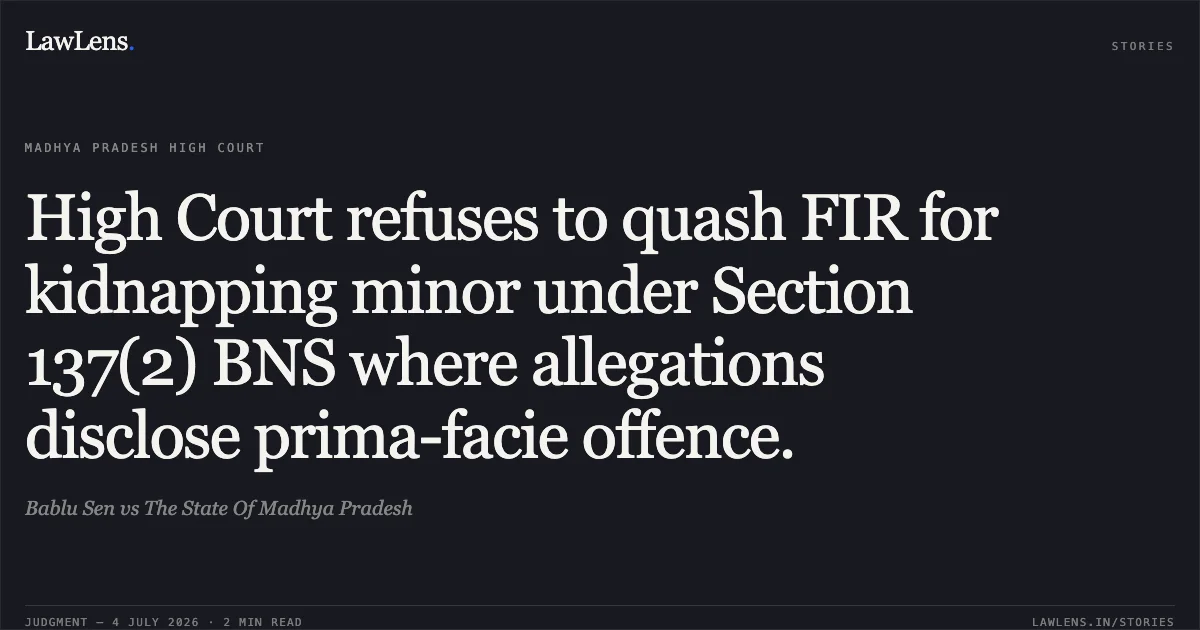
The court held that the allegations in the FIR and the material collected during the investigation disclose a prima facie case against the petitioner
It answered the issues by stating that inherent powers cannot be used to scuttle criminal proceedings when a cognizable offence is disclosed
Source reference: para 8.6, 13Consequently, the petition for quashment was dismissed as being devoid of merit
Source reference: para 14Acts & Sections Cited
8 provisions across 3 statutes referred to in this judgment. Each provision opens on LawLens.
Bharatiya Nyaya Sanhita, 20232
Code of Criminal Procedure, 19735
Bharatiya Nagarik Suraksha Sanhita, 20231
Original Court PDF
Bablu SenvsThe State Of Madhya Pradesh
Click to open original judgment
Original judgment, available to read, download and summarize on LawLens.in


![Subsequent exoneration does not retrospectively invalidate a finalized promotion select list.. UNNIKRISHNAN M vs M/o Environment And Forests. CAT - ['Ernakulam']. LawLens](/stories/thumbnails/subsequent-exoneration-does-not-retrospectively-invalidate-a-finalized-promotion-select-li-ce80a0e84f2f4887857271e8b4341c42.webp)