01Facts
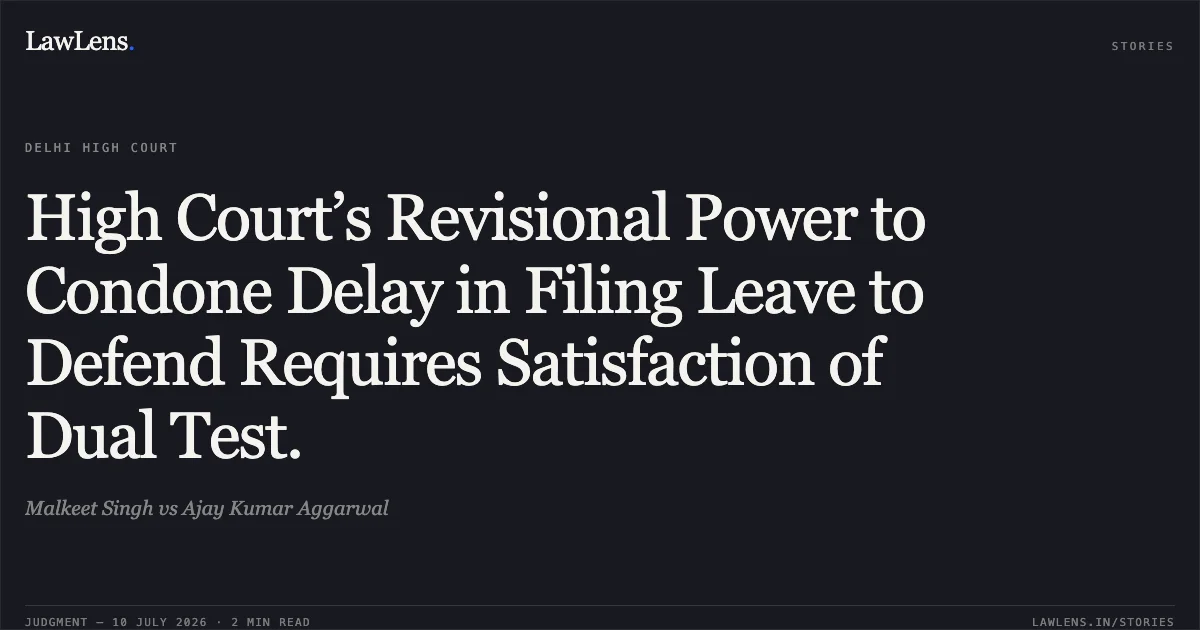
The Petitioner (tenant) sought to set aside an eviction order dated 04.04.2026 passed by the Additional Rent Controller (ARC) in No. RC ARC 221/2025.
p. 1The ARC declined to take the Petitioner’s Application for Leave to Defend (LTD Application) on record because it was filed with a delay of two days.
pp. 1-2The Petitioner claimed the delay occurred because he was searching for relevant documents to support the application.
p. 2 · ¶ 4The Petitioner approached the High Court under Section 25B(8) of the Delhi Rent Control Act (DRC Act) to condone the delay and remand the matter.
p. 202Issues
i.Whether the High Court, in the exercise of its revisional jurisdiction under Section 25B(8) of the DRC Act, can condone a delay in filing an Application for Leave to Defend.
pp. 2-3 · ¶ 6-7ii.Whether the Petitioner satisfied the "dual test" required to justify interference with an eviction order resulting from a late-filed LTD Application.
pp. 3-4 · ¶ 8-1003Law Applied
Section 25B(8) of the Delhi Rent Control Act, 1958, which governs the High Court's revisional powers in eviction matters.
p. 1Division Bench precedent in Directorate of Education & Anr. Vs. Mohd. Shamim & Ors. (2019), which established that while the Controller cannot condone delays, the High Court may interfere only if the tenant satisfies a "dual test": (i) demonstrating they were prevented from filing by reasons beyond their control, and (ii) making out a substantial case for consideration on merits.
p. 3 · ¶ 7Provisions in the judgment · 1 · Linked ones open on LawLens
Limitation Act, 1963 Section 5
04Reasoning
The Court noted that the jurisdiction to interfere with an eviction order following a failure to file an LTD application timely is strictly circumscribed.
p. 3 · ¶ 8It held that the two requirements of the "dual test" are cumulative; both must be satisfied for the Court to act.
p. 4 · ¶ 9In analyzing the first limb, the Court found the Petitioner’s excuse—time spent "tracing and collecting documents"—to be insufficient.
p. 4 · ¶ 10The Court reasoned that such an explanation does not constitute a "circumstance beyond the control of the Petitioner".
p. 4 · ¶ 11Since the Petitioner failed the foundational first limb of the test, the Court found no necessity to examine whether there was a "substantial case" on the merits.
p. 4 · ¶ 1205Holding
The Court held that there was no infirmity in the ARC’s order as the Petitioner failed to demonstrate that the delay was caused by circumstances beyond his control.
p. 4 · ¶ 13The Revision Petition and pending applications were dismissed.
p. 5 · ¶ 14Original Court PDF
Malkeet SinghvsAjay Kumar Aggarwal
Click to open original judgment
Original judgment, available to read, download and summarize on LawLens.in