Facts
The Respondent (Plaintiff) initially filed a trademark infringement suit for the mark "TULASI" before a Civil Court
Source reference: p.4Upon objection, the Plaintiff filed a memo estimating the "specified value" of the suit at above ₹3,00,000, leading the Civil Court to return the plaint for presentation before the Commercial Court under the Commercial Courts Act, 2015 (CC Act)
Source reference: para 3.1-3.2After the suit was registered as Comm.O.S.No.1093/2024 and the plaint amended to reflect the higher valuation, the Plaintiff filed I.A. No. 7 under Order VII Rule 10 CPC, claiming the value was actually below ₹3,00,000 and seeking a transfer back to the Civil Court
Source reference: para 3.3-3.4The Commercial Court allowed the application, relying on an order in a separate suit (Comm.O.S.No.1197/2024) where the Plaintiff's trademark was valued below the threshold
Source reference: para 4The Petitioner (Defendant) challenged this return of plaint under Article 227 of the Constitution
Source reference: p.3Issues
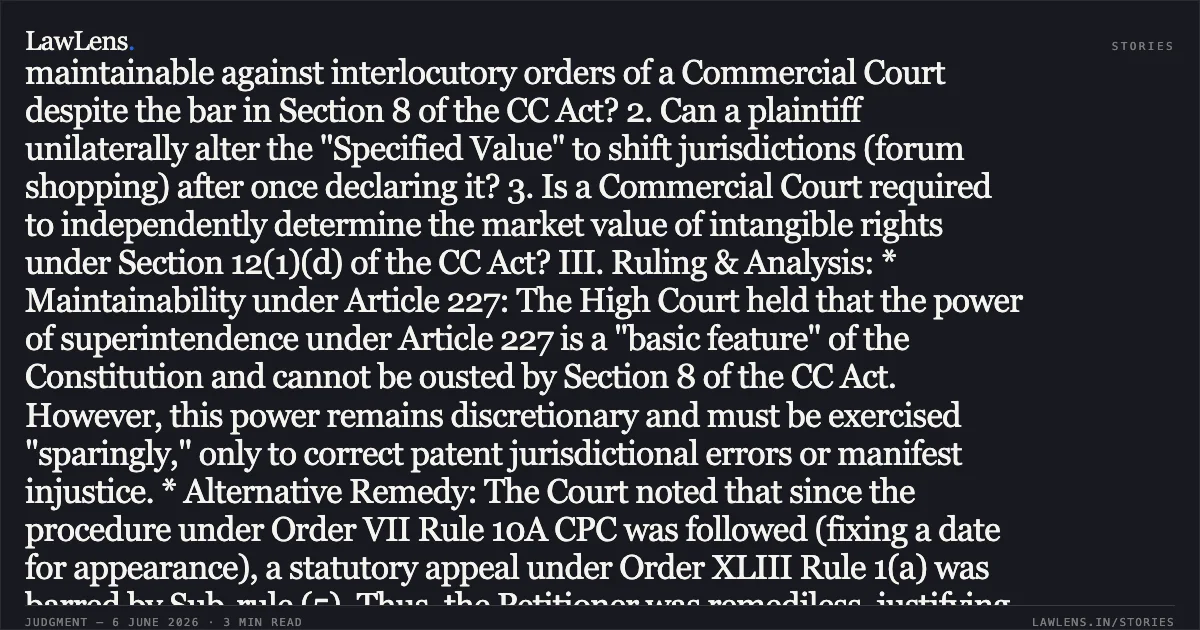
1. Whether the Impugned Order passed by the Commercial Court warrants interference under the supervisory jurisdiction of Article 227 of the Constitution
Source reference: para 11(i)2. Whether a Plaintiff, having once invoked Commercial Court jurisdiction by asserting a specific value, can subsequently seek return of the plaint by claiming a lower value
Source reference: para 11(iii)3. Whether the Commercial Court was justified in relying on an order from a different proceeding to determine pecuniary jurisdiction without an independent assessment of "specified value" under Section 12 of the CC Act
Source reference: para 11(iv)Law Applied
The court applied Section 2(1)(i) and Section 12(1)(d) of the Commercial Courts Act, 2015, which mandate that the "specified value" of intangible rights like trademarks must be the market value as "estimated by the plaintiff"
Source reference: para 28.1, 29Regarding Article 227, the court relied on L. Chandra Kumar v. Union of India and Surya Dev Rai v. Ram Chander Rai, establishing that supervisory jurisdiction is part of the "basic structure" and cannot be ousted by Section 8 of the CC Act, though it must be exercised sparingly to correct jurisdictional errors or manifest injustice
Source reference: para 12, 12.1, 16It also applied the principle from Pankaj Ravjibhai Patel v. SSS Pharmachem, holding that while a plaintiff is dominus litis, the court must scrutinize valuations to prevent forum shopping or mala fide under-valuation
Source reference: para 39Reasoning
The High Court observed that the Respondent/Plaintiff had taken contradictory stands regarding the suit's valuation to shift between forums
Source reference: para 31, 40The court found that the Commercial Court committed a jurisdictional error by failing to independently determine the "specified value" as required by Section 12(1)(d) of the CC Act
Source reference: para 40Instead of conducting a factual inquiry into the Plaintiff’s shifting estimations, the Commercial Court erroneously relied on an order from a different suit (Comm.O.S.No.1197/2024) which had itself incorrectly applied Section 12(1)(c) (immovable property) instead of Section 12(1)(d) (intangible rights)
Source reference: para 35, 41The High Court reasoned that while Section 8 of the CC Act bars civil revisions, it does not bar Article 227 petitions where a "stitch in time" is necessary to prevent a travesty of justice or procedural wandering
Source reference: para 16.1, 21Holding
The High Court allowed the writ petition and set aside the Impugned Order
The Court directed the Commercial Court to restore the proceedings and conduct a formal examination of the "specified value" in accordance with Section 12 of the CC Act
Source reference: para 42-43Furthermore, the Registry was directed to place the matter before the Chief Justice to consider creating a separate roster/procedure for Article 227 petitions arising from commercial disputes to ensure they align with the CC Act’s objective of speedy disposal
Source reference: para 22, 44Acts & Sections Cited
16 provisions across 4 statutes referred to in this judgment. Each provision opens on LawLens.
Commercial Courts Act, 20154
Code of Civil Procedure, 19086
Arbitration and Conciliation Act, 19965
KARNATAKA COURT-FEE AND SUITS VALUATION ACT, 1958.1
Original Court PDF
KANPUR FLOWERCYCLING PRIVATE LIMITEDvsM/S SARATHI INTERNATIONAL INC
Click to open original judgment
Original judgment, available to read, download and summarize on LawLens.in


![Subsequent exoneration does not retrospectively invalidate a finalized promotion select list.. UNNIKRISHNAN M vs M/o Environment And Forests. CAT - ['Ernakulam']. LawLens](/stories/thumbnails/subsequent-exoneration-does-not-retrospectively-invalidate-a-finalized-promotion-select-li-ce80a0e84f2f4887857271e8b4341c42.webp)