Facts
The Petitioner, an Electrical Operator in the Chennai Metropolitan Water Supply and Sewerage Board (CMWSSB), was subjected to disciplinary proceedings for allegedly running a water supply business through lorries registered in his wife’s name and misusing his office
Source reference: p. 3Following an enquiry report that proved the charges, the disciplinary authority imposed a punishment of withholding increments for five years with cumulative effect
Source reference: p. 4The Writ Court found the Petitioner guilty of misconduct for failing to disclose the purchase and use of the lorry but modified the quantum of punishment to withholding increments for two years with cumulative effect
Source reference: p. 4Both the employee and the Board filed intra-court appeals against this modification
Source reference: p. 4Issues
1. Whether the High Court, in the exercise of its powers of judicial review under Article 226, has the jurisdiction to modify the quantum of punishment imposed by a disciplinary authority
Source reference: p. 42. Whether the modification of punishment by the Writ Court was legally sustainable in the absence of extraordinary circumstances
Source reference: p. 5, 6Law Applied
The Court applied the principles of judicial review under Article 226 of the Constitution of India, emphasizing that the High Court’s role is to ensure the decision-making process complies with statutes and rules, rather than reviewing the decision itself
Source reference: p. 4-5It relied on the doctrine that the power to determine the quantum of punishment rests solely with the disciplinary and appellate authorities under the relevant Service Rules
Source reference: p. 5The "exception rule" was noted, specifying that courts should only interfere with punishment in "extraordinary and exceptional circumstances" where gross injustice is evident and remanding would cause further prejudice
Source reference: p. 5Reasoning
The Division Bench observed that the Writ Court had essentially usurped the powers of the disciplinary and appellate authorities by substituting its own judgment on the quantum of punishment for that of the competent authority
Source reference: p. 5The Court reasoned that judicial review cannot be expanded to include the routine modification of penalties, as the authority on the ground is better positioned to assess the nature of the misconduct
Source reference: p. 5While the Bench agreed with the Writ Court’s factual finding regarding the employee's misconduct (non-disclosure of the lorry purchase), it held that the correct legal procedure upon finding the punishment disproportionate—or when seeking modification—is to remit the matter back to the employer rather than the Court deciding the new penalty itself
Source reference: p. 5-6Holding
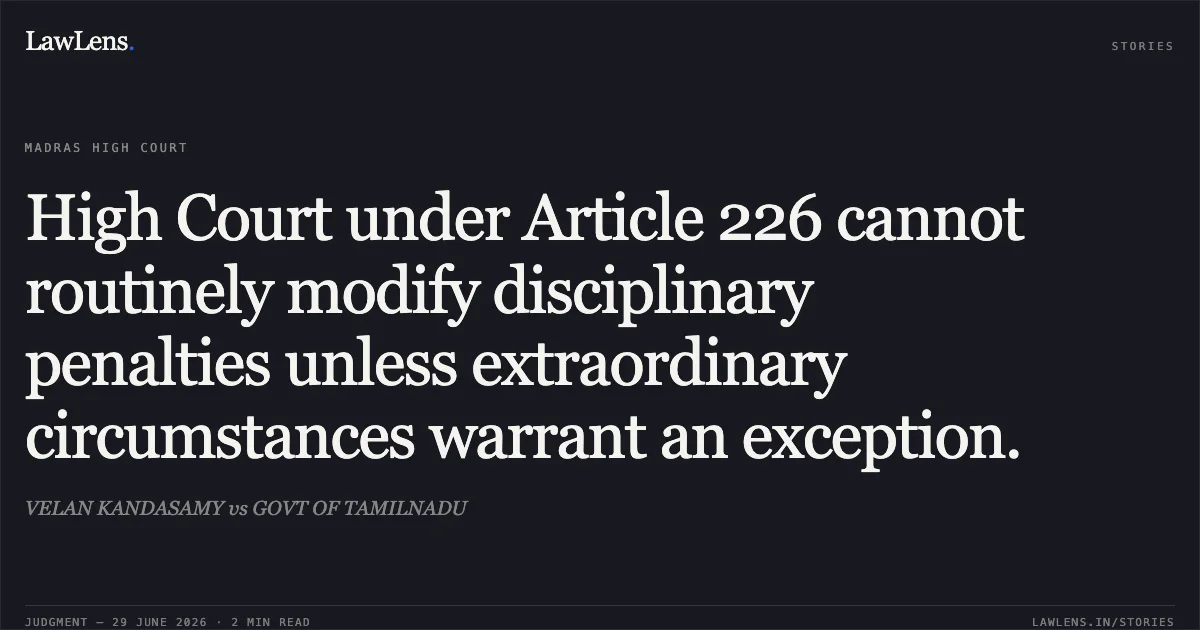
The Court held that the High Court cannot routinely modify punishments in writ proceedings
Consequently, the order of the Writ Court dated 29.10.2018 was set aside
Source reference: p. 6The Court remanded the matter back to the Board (CMWSSB) with directions to reconsider the quantum of punishment and pass a fresh order expeditiously
Source reference: p. 6Original Court PDF
VELAN KANDASAMYvsGOVT OF TAMILNADU
Click to open original judgment
Original judgment, available to read, download and summarize on LawLens.in


![Subsequent exoneration does not retrospectively invalidate a finalized promotion select list.. UNNIKRISHNAN M vs M/o Environment And Forests. CAT - ['Ernakulam']. LawLens](/stories/thumbnails/subsequent-exoneration-does-not-retrospectively-invalidate-a-finalized-promotion-select-li-ce80a0e84f2f4887857271e8b4341c42.webp)