Facts
Indian Pharmaceutical Alliance (“IPA”) filed a writ petition under Article 226 of the Constitution seeking uniform and effective enforcement of provisions concerning “spurious drugs” under Section 17B of the Drugs and Cosmetics Act, 1940 (“the Act”).
Source reference: p.1, para. 3IPA alleged that counterfeit drugs bearing the branding and trade dress of genuine manufacturers were being treated as non-actionable merely because seized samples passed limited or standard chemical analysis, in the absence of a uniform and binding Standard Operating Procedure (“SOP”).
Source reference: p.2, para. 4It sought directions requiring, inter alia, that violations under Section 17B be recorded in Form 13; authentic reference samples be obtained from genuine manufacturers; seized drugs be comparatively examined for physical, packaging, labelling, batch and trade-dress characteristics; and investigations and prosecutions be completed within prescribed timelines.
Source reference: pp.1–3, paras. 3–5IPA relied on Sections 20–25 of the Act and Rule 46 of the Drugs and Cosmetics Rules, 1945, contending that Form 13 was confined to laboratory analysis and did not address spuriousness or the true origin of the drug.
Source reference: pp.3–4, paras. 6–9Issues
1. Whether the High Court, in exercise of its jurisdiction under Article 226, could direct modification of Form 13 to require examination and recording of spuriousness under Section 17B of the Act, including verification of the drug’s true origin and manufacturer.
Source reference: p.5, para. 102. Whether the Court could mandate a uniform and binding SOP requiring State Drug Control Authorities to obtain genuine reference samples, conduct comparative physical and chemical examination, and undertake time-bound enforcement action in cases involving alleged spurious drugs.
Source reference: pp.2–4, paras. 4–93. Whether IPA should instead be granted liberty to approach the competent executive or regulatory authority by way of a detailed representation seeking the proposed reforms.
Source reference: p.5, paras. 11–12Law Applied
The Court considered Article 226 of the Constitution, which empowers the High Court to issue writs and appropriate directions but does not ordinarily authorise judicially imposed amendments to statutory or delegated legislative schemes.
Source reference: p.5, para. 10Section 17B of the Drugs and Cosmetics Act, 1940 defines spurious drugs.
Source reference: p.1, para. 3Sections 20 and 21 provide for Government Analysts and Drug Inspectors respectively, while Section 22 confers inspection, sampling and testing-related powers on Drug Inspectors; Section 23 prescribes the manner of exercising those powers.
Source reference: p.3, para. 6; p.4, para. 7Section 25 concerns the evidentiary status of the Government Analyst’s report, and Rule 46 of the Drugs and Cosmetics Rules, 1945 prescribes Form 13 as the relevant test report.
Source reference: p.4, paras. 7–8The Court applied the principle that alterations to the statutory or delegated rule-making framework, including modification of Form 13 to impose additional substantive requirements, fall within the domain of the Legislature or the competent rule-making authority rather than being directed by the Court under Article 226.
Source reference: p.5, para. 10Reasoning
The Court recognised the substance of IPA’s grievance—that existing Form 13 primarily records laboratory analysis and may not expressly address the broader question of spuriousness, including identity, origin, packaging and trade dress.
Source reference: p.4, paras. 8–9However, the relief sought would require changing the legal and regulatory framework governing Form 13 and imposing mandatory investigative requirements on Drug Inspectors and State authorities.
Source reference: p.5, para. 10Since such changes involve legislative or delegated rule-making, the Court held that it would not be appropriate to issue the requested mandatory directions while exercising writ jurisdiction under Article 226.
Source reference: p.5, para. 10The Court therefore declined to judicially amend Form 13 or prescribe the proposed SOP, while preserving IPA’s ability to pursue the matter before the competent authorities.
Source reference: p.5, paras. 11–12Holding
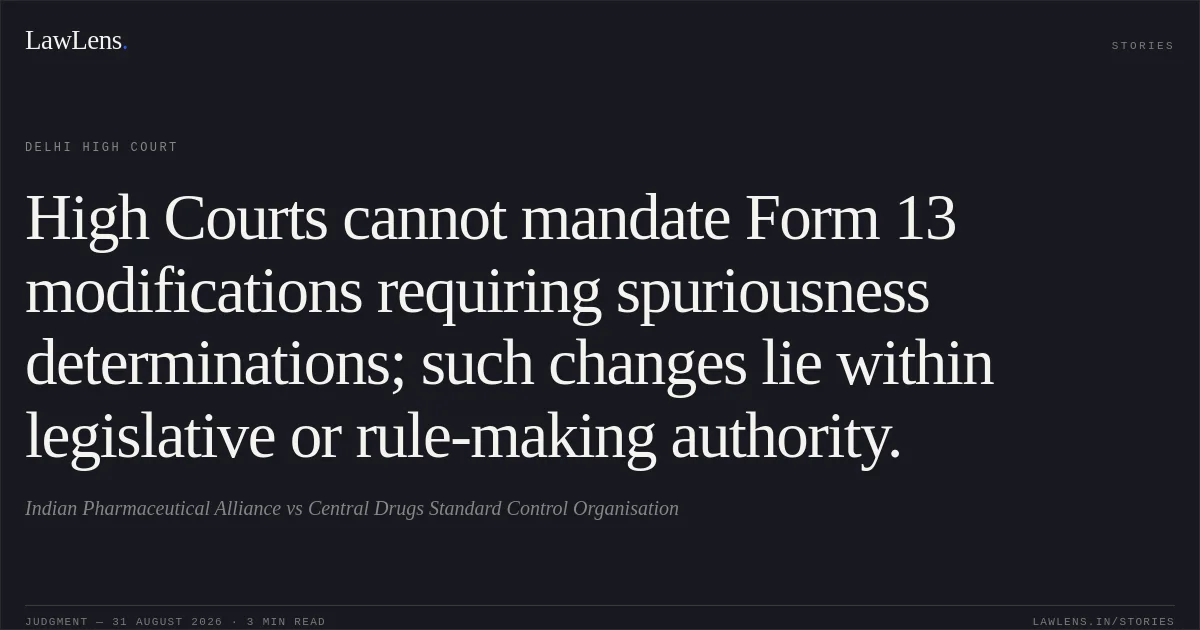
The Court held that it could not direct modification of Form 13 to incorporate an examination of spuriousness under Section 17B or require verification of the true origin and manufacturer of the drug, as those matters fall within the legislative or delegated rule-making domain.
IPA was granted liberty to submit a detailed representation to the Central Drugs Standard Control Organisation or any other competent authority.
Source reference: p.5, paras. 11–12The Court directed that any such representation be considered expeditiously and in accordance with law.
Source reference: p.5, paras. 11–12The writ petition and pending application were accordingly disposed of.
Source reference: p.5, para. 13Acts & Sections Cited
5 provisions across 1 statute referred to in this judgment. Each provision opens on LawLens.
Drugs and Cosmetics Act, 19405
Original Court PDF
Indian Pharmaceutical AlliancevsCentral Drugs Standard Control Organisation
Click to open original judgment
Original judgment, available to read, download and summarize on LawLens.in