Facts
Respondent No. 2’s company, M/s Aryavrat, obtained a road-construction contract from the Madhya Pradesh Road Development Corporation for approximately 43 kilometres and entered into a sub-contract with the petitioner’s company, M/s SCC Project Pvt. Ltd.
Source reference: p. 2; para. 3Under the agreement, mobilization advance was payable against a bank guarantee. Respondent No. 2 paid the petitioner ₹50 lakh as advance on 29 January 2013, but the petitioner allegedly neither commenced the work nor returned the amount.
Source reference: p. 2; para. 3An FIR was registered at Police Station Ratibad, Bhopal, in Crime No. 273/2018 for offences under Sections 420, 406, 409, 506, 507 read with Section 120-B IPC, alleging cheating, criminal breach of trust and intimidation.
Source reference: p. 1; para. 1After investigation, a charge-sheet was filed and charges were framed against the petitioner.
Source reference: p. 4; para. 4The petitioner accordingly sought quashing of the FIR and all consequential proceedings under Section 482 CrPC/Section 528 BNSS.
Source reference: p. 1; para. 1Issues
Whether the FIR and subsequent criminal proceedings disclosed a cognizable criminal offence or merely constituted a civil dispute arising from breach of contract, warranting quashing under the inherent jurisdiction of the High Court.
Source reference: pp. 5–6, 9–11; paras. 6–15Whether the High Court could examine the petitioner’s contractual defence, including the alleged non-payment of the agreed mobilization advance, at the stage of proceedings under Section 482 CrPC/Section 528 BNSS.
Source reference: pp. 2–3, 10–11; paras. 3, 13–15Whether the existence of a civil remedy, an arbitration clause, delay in lodging the FIR, or the petitioner’s denial of the allegations justified interference with the prosecution.
Source reference: pp. 2–5; paras. 3–4, 6–7Law Applied
The Court applied the inherent jurisdiction under Section 482 CrPC, corresponding to Section 528 BNSS, and the principles governing quashing of an FIR laid down in State of Haryana v. Bhajan Lal, 1992 Supp (1) SCC 335, and Neeharika Infrastructure (P) Ltd. v. State of Maharashtra, (2021) 19 SCC 401: investigation should not ordinarily be interdicted where the FIR discloses a cognizable offence, and quashing is an exceptional remedy to be exercised sparingly.
Source reference: pp. 6–10; para. 9Under Amit Kapoor v. Ramesh Chander, (2012) 9 SCC 460, the availability of a civil remedy does not bar criminal proceedings where the allegations also constitute an offence.
Source reference: p. 5; para. 6M/s Technofab Engineering Ltd. v. Bengal Mills Stores Supply Co., 2016 Criminal L.R. 887, recognises that a contractual dispute may be both civil and criminal, with the relevant test being whether the allegations disclose a criminal offence.
Source reference: p. 5; para. 7The Court also relied on Teeja Devi v. State of Rajasthan, (2014) 15 SCC 221, for the principle that the truth or falsity of allegations should ordinarily be determined after investigation and trial, and on Mohd. Akram Siddiqui v. State of Bihar, (2019) 13 SCC 350, holding that the accused’s defence and disputed documents should ordinarily not be evaluated while exercising Section 482 jurisdiction.
Source reference: p. 10; para. 13Reasoning
The Court found that the prosecution case was that the petitioner accepted ₹50 lakh pursuant to the sub-contract, promised to undertake the construction work, but neither commenced the work nor returned the advance.
Source reference: p. 5; para. 8These allegations, taken at face value, disclosed prima facie elements of criminal wrongdoing and could not be characterised as a purely civil breach merely because they arose from a commercial contract.
Source reference: pp. 5–6; paras. 6–8The petitioner’s arguments regarding the contractual entitlement to a larger mobilization advance, the arbitration clause, the absence of a civil suit or recovery notice, and the delay in lodging the FIR were treated as matters requiring appreciation of evidence and determination by the trial court.
Source reference: pp. 2–4, 11; paras. 3–4, 14–15Since investigation had been completed, a charge-sheet had been filed, and material was available connecting the petitioner with the alleged offences, the case did not fall within the exceptional categories warranting quashing under Bhajan Lal or Neeharika.
Source reference: pp. 9–11; paras. 12, 14–15The High Court therefore declined to assess the merits of the petitioner’s defence or undertake an appellate examination of the evidence under its inherent jurisdiction.
Source reference: p. 11; para. 15Holding
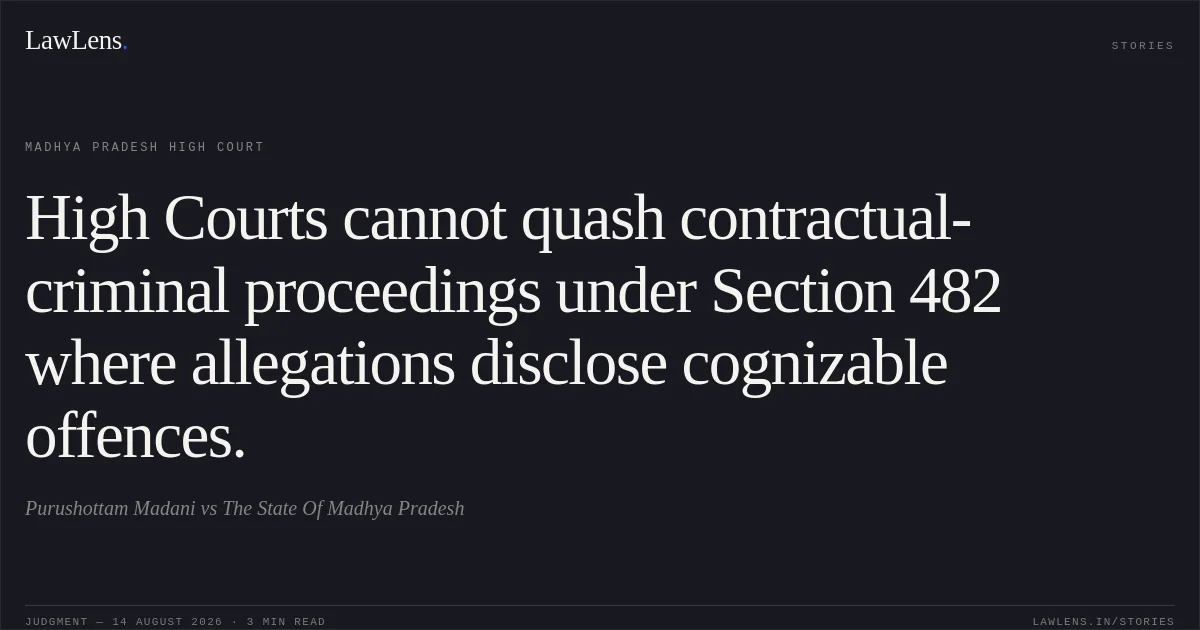
The Court held that the FIR and consequential proceedings could not be quashed because the allegations, prima facie, disclosed cognizable offences and the petitioner’s contractual defences raised disputed questions of fact.
Misc. Criminal Case No. 3936 of 2024 was dismissed as meritless.
Source reference: p. 12; paras. 16–17The Court clarified that its observations were confined to adjudication of the quashing petition and would not prejudice the trial, which was directed to proceed independently and in accordance with law.
Source reference: p. 12; paras. 16–17Acts & Sections Cited
9 provisions across 3 statutes referred to in this judgment. Each provision opens on LawLens.
Code of Criminal Procedure, 19733
Bharatiya Nagarik Suraksha Sanhita, 20231
Indian Penal Code, 18605
Original Court PDF
Purushottam MadanivsThe State Of Madhya Pradesh
Click to open original judgment
Original judgment, available to read, download and summarize on LawLens.in