Facts
The petitioner, Anita Verma, applied for allotment of a Hindustan Petroleum Corporation Limited (“HPCL”) retail dealership at Location No. 58, Nasurullahganj–Ladkui, District Sehore, pursuant to an advertisement issued by HPCL. Respondent No. 3, Vinita Parihar, was also an applicant, and HPCL issued a Letter of Intent in her favour after evaluating the competing applications.
Source reference: p.2, para. 2(a)The petitioner challenged the marks awarded to respondent No. 3, particularly in respect of her capacity to arrange finances through fixed and movable assets, and objected to the title and lease documents submitted for the proposed site. Her representation and written submissions before the Dealership Selection Complaint Redressal Forum were rejected.
Source reference: pp.1–2, paras. 1–2(a), 9The Chief Regional Manager thereafter communicated rejection of her complaint by order dated 23 August 2012, which was challenged under Article 226 of the Constitution.
Source reference: pp.1–2, paras. 1–2(a), 9During the pendency of the petition, HPCL approved reconstitution of the dealership pursuant to respondent No. 3’s request and executed a fresh dealership agreement dated 22 March 2024 in favour of respondent No. 4, Ishan Ali, proprietor of M/s Vindyavasini Filling Station.
Source reference: p.2, para. 2(b); p.7, para. 12Issues
Whether HPCL’s rejection of the petitioner’s complaint and its allocation of marks and dealership to respondent No. 3 were arbitrary, discriminatory, mala fide, or contrary to the norms contained in the dealership advertisement?
Source reference: pp.4–7, paras. 6–10Whether the lease and title documents submitted by respondent No. 3 were legally invalid under Section 168 of the Madhya Pradesh Land Revenue Code, 1959?
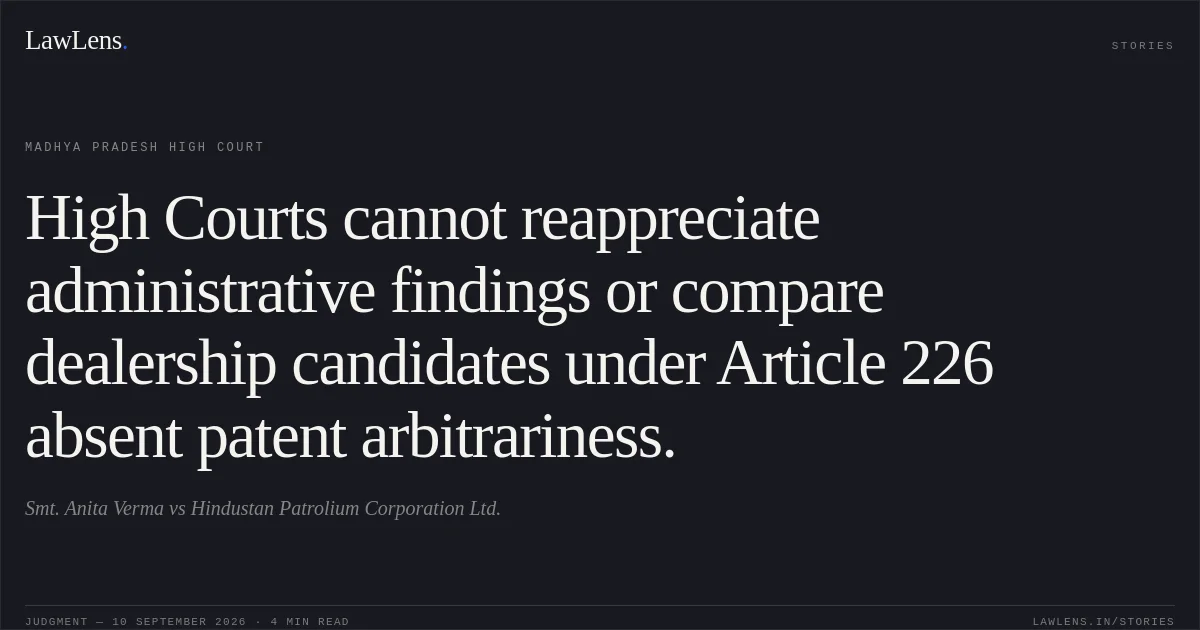
Source reference: pp.3, 6–7, paras. 4, 9–10Whether the High Court, exercising jurisdiction under Article 226, could reappreciate the evidence, recalculate the candidates’ marks, and substitute its assessment for that of the Complaint Redressal Forum?
Source reference: pp.5–7, paras. 8–10Whether the petitioner had locus to challenge the subsequent reconstitution of the dealership in favour of respondent No. 4?
Source reference: p.7, paras. 11–13Law Applied
The Court applied the principles governing judicial review of governmental contracts and dealership selections under Article 226.
Source reference: pp.4–5, para. 6Relying on Tata Cellular v. Union of India, as quoted in Directorate of Education v. Educomp Datamatics Ltd., (2004) 4 SCC 19, and Air India Ltd. v. Cochin International Airport Ltd., (2000) 2 SCC 617, the Court held that judicial review examines the decision-making process, not the commercial merits of the decision; interference is justified only for arbitrariness, mala fides, bias, discrimination, or Wednesbury unreasonableness.
Source reference: pp.4–5, para. 6The Court also relied on Monarch Infrastructure (P) Ltd. v. Commissioner, Ulhasnagar Municipal Corporation, (2000) 5 SCC 287, for the principle that the authority inviting applications is the best judge of the applicable terms and conditions.
Source reference: p.5, para. 6Under Sanjay Kumar Jha v. Prakash Chandra Chaudhary, (2019) 2 SCC 499, the High Court ordinarily cannot adjudicate disputed questions of fact, reappreciate evidence, or undertake a comparative assessment of candidates in writ jurisdiction; even where an apparent error exists, the usual course is remand to the competent authority.
Source reference: pp.5–6, para. 8Section 168 of the Madhya Pradesh Land Revenue Code, 1959 was considered in relation to restrictions on leases of agricultural land; the Court held that the statutory bar did not apply because the relevant land had been diverted for non-agricultural use.
Source reference: pp.3, 6–7, paras. 4, 9–10Reasoning
The Court found that the Complaint Redressal Forum had considered each objection raised by the petitioner and recorded detailed findings on the allocation of marks and the validity of respondent No. 3’s documents.
Source reference: p.6, para. 10The diversion order showed that the land covered by the lease had been converted for non-agricultural use; consequently, the objection based on Section 168 of the Madhya Pradesh Land Revenue Code was rejected.
Source reference: pp.3, 6–7, paras. 4, 10Applying the limited scope of judicial review, the Court held that it could not act as an appellate authority, reassess the evidence, or substitute its own evaluation of the candidates’ comparative merit.
Source reference: pp.5–7, paras. 8–10The petitioner failed to establish any arbitrariness, discrimination, mala fides, bias, or patent violation of the dealership norms in HPCL’s decision-making process.
Source reference: pp.5–7, paras. 8–10Since the petitioner failed to establish any right to the dealership against respondent No. 3, she also lacked locus to challenge the subsequent reconstitution agreement in favour of respondent No. 4.
Source reference: p.7, para. 13Holding
The High Court held that HPCL’s rejection of the petitioner’s complaint and allotment of the dealership to respondent No. 3 did not suffer from any manifest illegality, arbitrariness, mala fides, or procedural unfairness.
The Court further held that the petitioner could not challenge the subsequent reconstitution of the dealership in favour of respondent No. 4 because she had not established any entitlement to the dealership in the first place.
Source reference: pp.7–8, paras. 13–14The writ petition was consequently dismissed as meritless, and no relief was granted to the petitioner.
Source reference: p.8, para. 15Acts & Sections Cited
1 provisions across 1 statute referred to in this judgment. Each provision opens on LawLens.
MP Land Revenue Code 19591
Original Court PDF
Smt. Anita VermavsHindustan Patrolium Corporation Ltd.
Click to open original judgment
Original judgment, available to read, download and summarize on LawLens.in