Facts
The petitioner, appointed as an Officer Scale-I in 1984 and later promoted as a Scale-II Manager, was posted as Branch Manager at Narsinghkhedi Branch, Sehore.
Source reference: para. 20–22During his tenure from 26 April 2011 to 27 April 2013, he allegedly committed serious irregularities while sanctioning and disbursing 11 KCC loans and two agricultural loans, including failure to verify KYC documents, borrowers, guarantors, agricultural land, security documents and the intended utilisation of loan amounts.
Source reference: para. 20–22A departmental charge-sheet was issued in 2015. The petitioner submitted his reply, participated in the departmental enquiry, and was supplied the enquiry report before submitting his representation against it.
Source reference: para. 3, 12–13, 23The Disciplinary Authority imposed the penalty of dismissal from service by order dated 29 July 2016, along with the consequences of disqualification for future employment and forfeiture of gratuity and leave encashment under the applicable Regulations.
Source reference: para. 14, 24Issues
1. Whether the departmental enquiry and the consequential orders were vitiated by delay, vagueness of the charge-sheet, non-supply of documents or witnesses, or violation of the principles of natural justice?
Source reference: para. 6–8, 23, 25–262. Whether the penalties of dismissal, disqualification for future employment, and forfeiture of gratuity and leave encashment were authorised under the Central Madhya Pradesh Gramin Bank (Officers & Employees) Service Regulations, 2010?
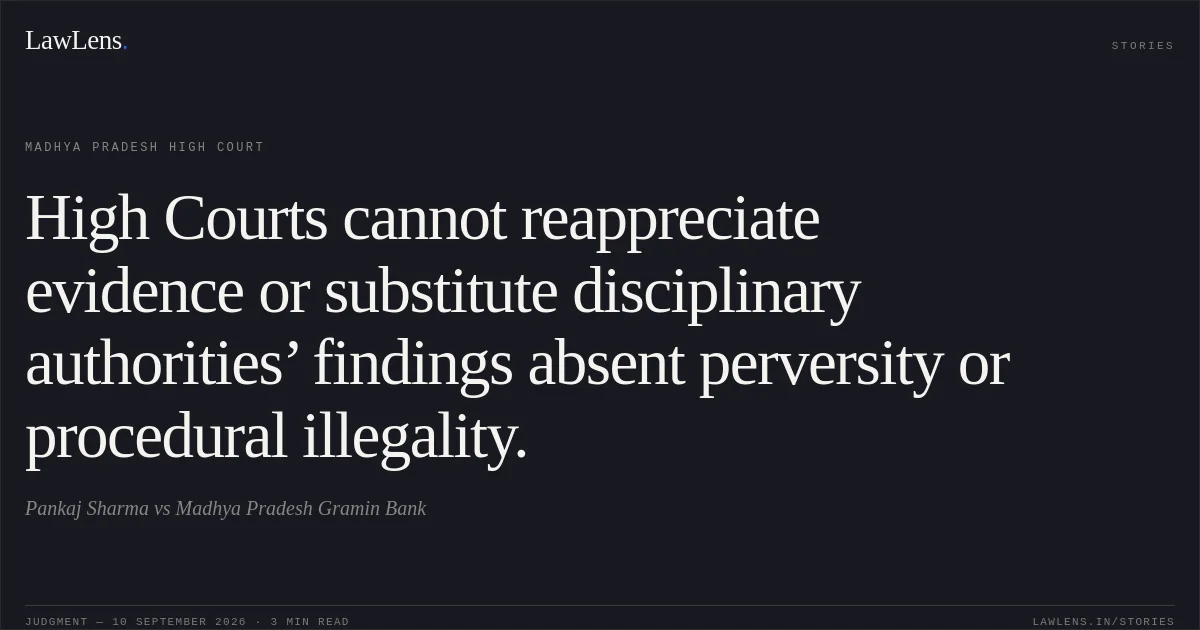
Source reference: para. 9, 243. Whether the High Court, in exercise of judicial review under Articles 226 and 227 of the Constitution, could reappreciate the evidence or interfere with concurrent findings of the Enquiry Officer, Disciplinary Authority and Appellate Authority?
Source reference: para. 27–284. Whether the punishment of dismissal was disproportionate to the misconduct proved against the petitioner?
Source reference: para. 8, 25Law Applied
The Court applied the principles governing limited judicial review of disciplinary proceedings under Articles 226 and 227 of the Constitution: the High Court does not act as an appellate authority and may interfere only for jurisdictional error, procedural illegality, violation of natural justice, perversity, findings based on no evidence, or manifest miscarriage of justice.
Source reference: para. 27Relying on Government of Andhra Pradesh v. Mohd. Nasrullah Khan, (2006) 2 SCC 373, the Court reiterated that judicial review is not an adjudication on merits through reappreciation of evidence.
Source reference: para. 27The Court further applied Regulations 39 and 72 of the Central Madhya Pradesh Gramin Bank (Officers & Employees) Service Regulations, 2010, holding that dismissal with disqualification for future employment and forfeiture of gratuity and leave encashment were penalties contemplated by the applicable regulatory framework.
Source reference: para. 24The Court also recognised that a Branch Manager has a heightened duty to comply with prescribed norms concerning KYC verification, borrower and guarantor identification, security verification, and loan sanction and disbursement.
Source reference: para. 25Reasoning
The Court found that the petitioner had been afforded adequate procedural safeguards: he received the charge-sheet, submitted his reply, participated in the enquiry, received the enquiry report, made a representation against it, and was heard in the departmental appeal.
Source reference: para. 23The findings concerning irregular verification of borrowers, guarantors, land records, security and utilisation of loan proceeds were based on relevant documentary and other evidence, and were concurrently recorded by the Enquiry Officer and the disciplinary authorities.
Source reference: para. 22–23, 28The Court therefore found no established violation of natural justice, prejudice, perversity, jurisdictional error or finding based on no evidence.
Source reference: para. 23, 28It rejected the objections based on delay, vagueness and disproportionality because the charges concerned serious lapses by a Branch Manager that exposed the Bank to substantial financial risk.
Source reference: para. 25The challenge to the punishment also failed because Regulations 39 and 72 expressly supported the penalties imposed.
Source reference: para. 24Applying the limited scope of judicial review, the Court declined to reassess the evidence or substitute its own view for that of the competent disciplinary authorities.
Source reference: para. 27–28Holding
The Court held that the departmental proceedings were procedurally valid, the charges were duly proved, and the petitioner had not demonstrated any violation of natural justice, perversity, jurisdictional error or other ground warranting judicial interference.
It further held that the penalties of dismissal, disqualification for future employment, forfeiture of gratuity and forfeiture of leave encashment were authorised under Regulations 39 and 72 of the 2010 Regulations.
Source reference: para. 24The writ petition was consequently dismissed, and no order as to costs was made.
Source reference: para. 29Original Court PDF
Pankaj SharmavsMadhya Pradesh Gramin Bank
Click to open original judgment
Original judgment, available to read, download and summarize on LawLens.in