Facts
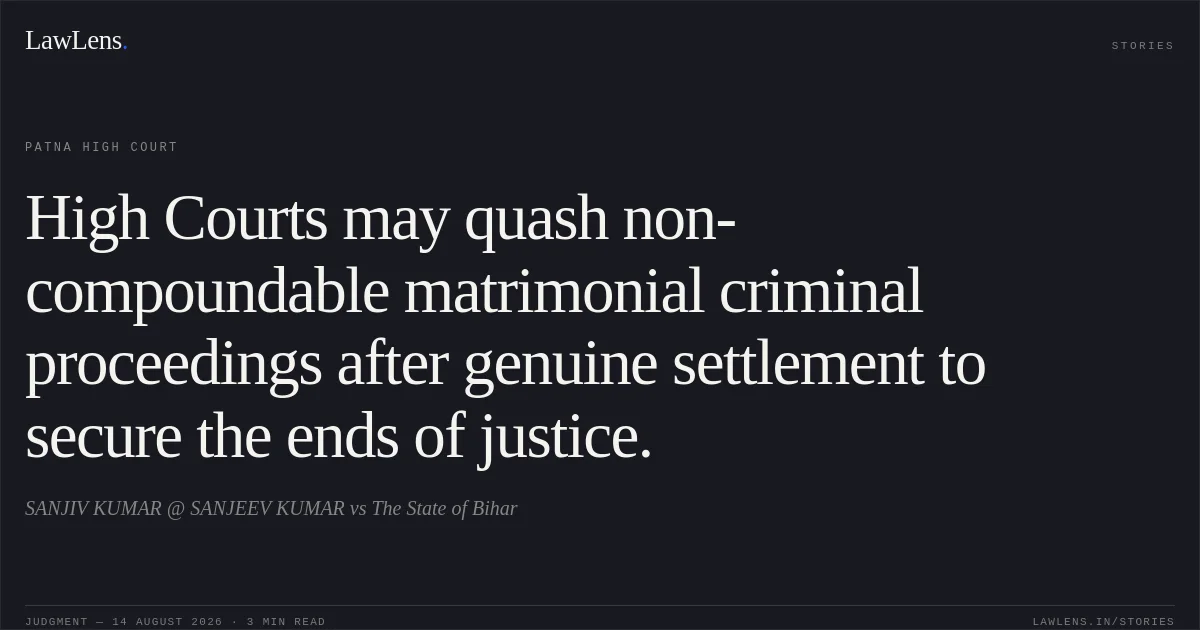
The petitioners— the husband, mother-in-law and brother-in-law of Opposite Party No. 2— sought quashing of the order dated 24 January 2022 passed by the Judicial Magistrate-I, Begusarai, in Complaint Case No. 353C of 2021.
Source reference: p.1, para. 2By that order, cognizance was taken for offences under Sections 323, 406 and 504 of the Indian Penal Code and Section 4 of the Dowry Prohibition Act.
Source reference: p.1, para. 2During the pendency of the proceedings, the parties amicably settled their matrimonial disputes and obtained a decree of divorce by mutual consent under Section 13B of the Hindu Marriage Act in Divorce Suit No. 06 of 2026.
Source reference: p.3, para. 5Their joint statement recorded that the present complaint case and another miscellaneous case had also been compromised voluntarily and without coercion or misrepresentation.
Source reference: p.3, para. 5Issues
Whether the High Court should exercise its inherent jurisdiction to quash the cognizance order and the criminal proceedings for offences under Sections 323, 406 and 504 IPC and Section 4 of the Dowry Prohibition Act in view of the parties’ subsequent amicable settlement and mutual-consent divorce.
Source reference: pp.4–6, paras. 7–11Whether continuation of the criminal prosecution, despite the settlement of the matrimonial dispute, would amount to an abuse of the process of the court and defeat the ends of justice.
Source reference: p.5, paras. 8–10Law Applied
The Court applied the inherent jurisdiction of the High Court to prevent abuse of the process of the court and to secure the ends of justice, particularly in matrimonial disputes that have been amicably resolved.
Source reference: pp.5–6, paras. 8–10Relying on Mange Ram v. State of Madhya Pradesh & Anr., 2025 INSC 962, the Court held that continuation of criminal proceedings arising from matrimonial discord may be quashed after a genuine compromise, even where the offences are non-compoundable, especially where family members have been implicated and continuation would be futile.
Source reference: p.4, para. 9It also relied on Naushey Ali v. State of U.P., (2025) 4 SCC 78, for the principle that, after an amicable settlement, continuation of the trial may constitute an abuse of process and that the settlement should be given effect to in the interests of justice.
Source reference: p.5, para. 9Reasoning
The Court verified the materials relating to the mutual-consent divorce, including the judgment, decree and the parties’ joint statement, and found that the parties had finally settled all claims and disputes, including the present criminal complaint.
Source reference: p.4, para. 7The voluntary and unconditional nature of the settlement, coupled with the dissolution of the marriage, demonstrated that the matrimonial dispute had come to an end.
Source reference: p.3, para. 5Applying the principles in Mange Ram and Naushey Ali, the Court held that continuing the prosecution after such settlement would serve no useful purpose and would unnecessarily perpetuate a domestic dispute that had already been resolved.
Source reference: pp.5–6, paras. 8–10It therefore concluded that continuation of the proceedings would amount to an abuse of the process of the court and that the inherent powers should be exercised to secure a peaceful and final resolution.
Source reference: pp.5–6, paras. 8–10Holding
The High Court answered the issues in favour of the petitioners.
It held that, in view of the genuine compromise and the mutual-consent divorce, there was no justification for continuing the criminal prosecution.
Source reference: p.6, para. 11Accordingly, the order dated 24 January 2022 taking cognizance in Complaint Case No. 353C of 2021, together with any consequential prosecution arising therefrom, was quashed and set aside.
Source reference: p.6, para. 11The criminal miscellaneous application was allowed.
Source reference: p.6, para. 12Acts & Sections Cited
5 provisions across 3 statutes referred to in this judgment. Each provision opens on LawLens.
Indian Penal Code, 18603
Dowry Prohibition Act, 19611
Hindu Marriage Act, 19551
Original Court PDF
SANJIV KUMAR @ SANJEEV KUMARvsThe State of Bihar
Click to open original judgment
Original judgment, available to read, download and summarize on LawLens.in