Facts
Respondent No. 2, Jagriti Agarwal, married Petitioner No. 1, Ankit Agarwal, on 05.02.2017; Petitioners Nos. 2 and 3 were her father-in-law and mother-in-law, respectively. She alleged harassment and cruelty in connection with dowry demands.
Source reference: para. 6An FIR was registered as Crime No. 49/2024 at Police Station Hatta, District Damoh, for offences under Sections 498-A read with Section 34 of the IPC and Sections 3/4 of the Dowry Prohibition Act. After investigation, a charge-sheet was filed and registered as RCT No. 125/2024 before the JMFC, Hatta.
Source reference: para. 7During the pendency of the petition under Section 482 CrPC seeking quashing of the criminal proceedings, the parties entered into an amicable settlement and filed a compromise application.
Source reference: paras. 5, 7-8The parties appeared before the Registrar (J-II), whose report recorded that the compromise was genuine and authentic and had been entered into voluntarily, without threat, inducement, or pressure.
Source reference: para. 9Respondent No. 2 stated that she did not wish to pursue the criminal proceedings.
Source reference: para. 12Issues
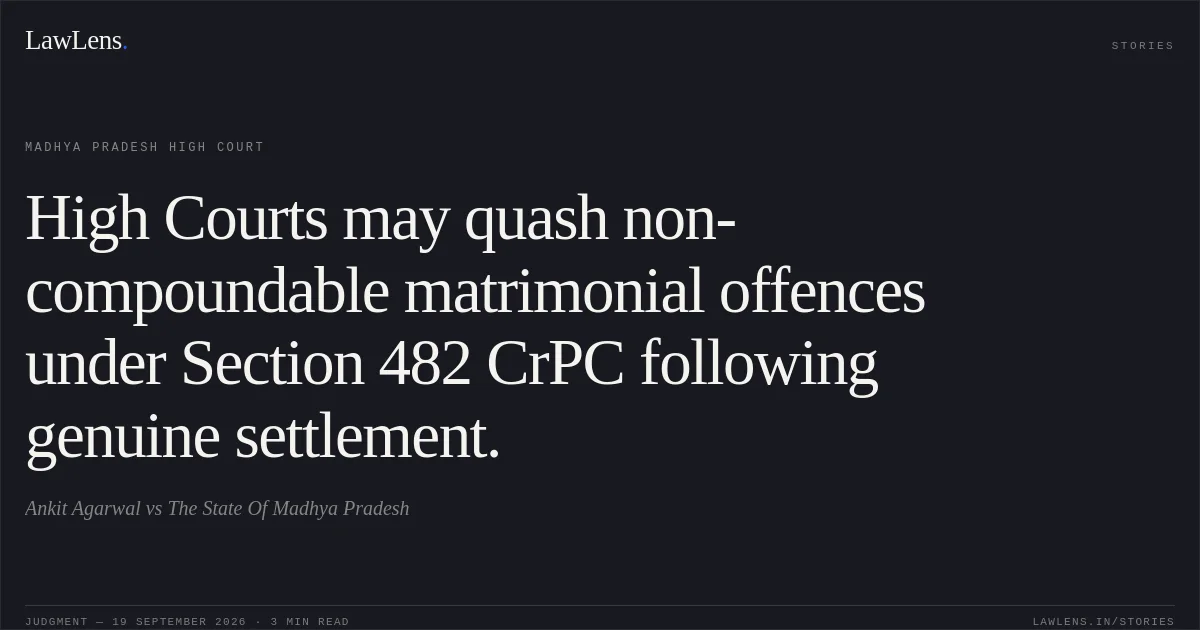
Whether the High Court could exercise its inherent jurisdiction under Section 482 CrPC to quash criminal proceedings for offences under Section 498-A read with Section 34 IPC and Sections 3/4 of the Dowry Prohibition Act on the basis of a genuine settlement between the parties in a matrimonial dispute?
Source reference: paras. 4, 12-15Whether the bar on compounding non-compoundable offences under Section 320 CrPC prevented the High Court from quashing the proceedings in exercise of its inherent powers?
Source reference: paras. 11-13Law Applied
The Court applied Section 482 CrPC, which confers wide inherent powers on the High Court to prevent abuse of the process of any court and secure the ends of justice.
Source reference: paras. 11, 13Relying on Jitendra Raghuwanshi v. Babita Raghuwanshi, B.S. Joshi v. State of Haryana, Gian Singh v. State of Punjab, and Narinder Singh v. State of Punjab, the Court held that Section 320 CrPC does not limit the High Court’s inherent power to quash criminal proceedings arising from private matrimonial disputes, even where the offences are non-compoundable.
Source reference: para. 13The Court must, however, consider the nature and gravity of the offence, the genuineness and voluntariness of the settlement, whether the dispute is predominantly private, and whether continuation of the prosecution would be oppressive, unjust, or an abuse of process.
Source reference: para. 13Heinous offences and offences having a serious societal impact ordinarily cannot be quashed merely on the basis of compromise, whereas matrimonial and dowry-related disputes may be quashed where the parties have completely settled their differences and the possibility of conviction is remote.
Source reference: para. 13Reasoning
The Court found that the proceedings arose from a matrimonial dispute involving allegations under Section 498-A IPC and the Dowry Prohibition Act, which were predominantly personal and private in character.
Source reference: paras. 6-7, 12Respondent No. 2 had voluntarily supported the compromise before the Registrar, expressly stated that she did not wish to pursue the prosecution, and the Registrar confirmed the compromise’s genuineness and authenticity.
Source reference: paras. 9, 12Applying the principles in Jitendra Raghuwanshi, Gian Singh, and Narinder Singh, the Court held that the non-compoundable nature of the offences did not prevent exercise of jurisdiction under Section 482 CrPC.
Source reference: para. 13Since the dispute had been amicably resolved and continuation of the criminal case would serve no useful purpose, quashing the proceedings was necessary to secure the ends of justice and prevent abuse of process.
Source reference: paras. 13-15Holding
The Court answered the issues in favour of the petitioners.
It allowed the petition under Section 482 CrPC and quashed the final report and all consequential criminal proceedings in RCT No. 125/2024 pending before the JMFC, Hatta, District Damoh, arising from Crime No. 49/2024, including the proceedings for offences under Section 498-A read with Section 34 IPC and Sections 3/4 of the Dowry Prohibition Act, on the basis of the compromise between the parties.
Source reference: para. 15The petition was accordingly disposed of.
Source reference: para. 16Acts & Sections Cited
7 provisions across 4 statutes referred to in this judgment. Each provision opens on LawLens.
Code of Criminal Procedure, 19732
Indian Penal Code, 18602
Bharatiya Nagarik Suraksha Sanhita, 20231
Original Court PDF
Ankit AgarwalvsThe State Of Madhya Pradesh
Click to open original judgment
Original judgment, available to read, download and summarize on LawLens.in