Facts
The marriage between petitioner no. 1 and respondent no. 2 was solemnised on 18 January 2020 but was never consummated; no child was born of the marriage.
Source reference: p. 2, para. 5Following respondent no. 2’s complaint, FIR No. 96/2023 was registered at PS Kirti Nagar under Sections 498A/406/34 IPC on 22 April 2023, and a chargesheet was filed on 25 January 2024.
Source reference: p. 2, para. 6The parties subsequently entered into an MoU dated 23 December 2025, agreeing to divorce by mutual consent and to cooperate in seeking quashing of the FIR. Petitioner no. 1 agreed to pay respondent no. 2 ₹22 lakh, and the jewellery was also to be returned.
Source reference: pp. 2–3, paras. 7–9The divorce was granted on 22 May 2026; the settlement sum was paid and the jewellery returned. Respondent no. 2 confirmed before the Court that she had received both and did not wish to pursue the matter.
Source reference: p. 3, paras. 11–12The State raised no objection to quashing.
Source reference: p. 3, para. 14Issues
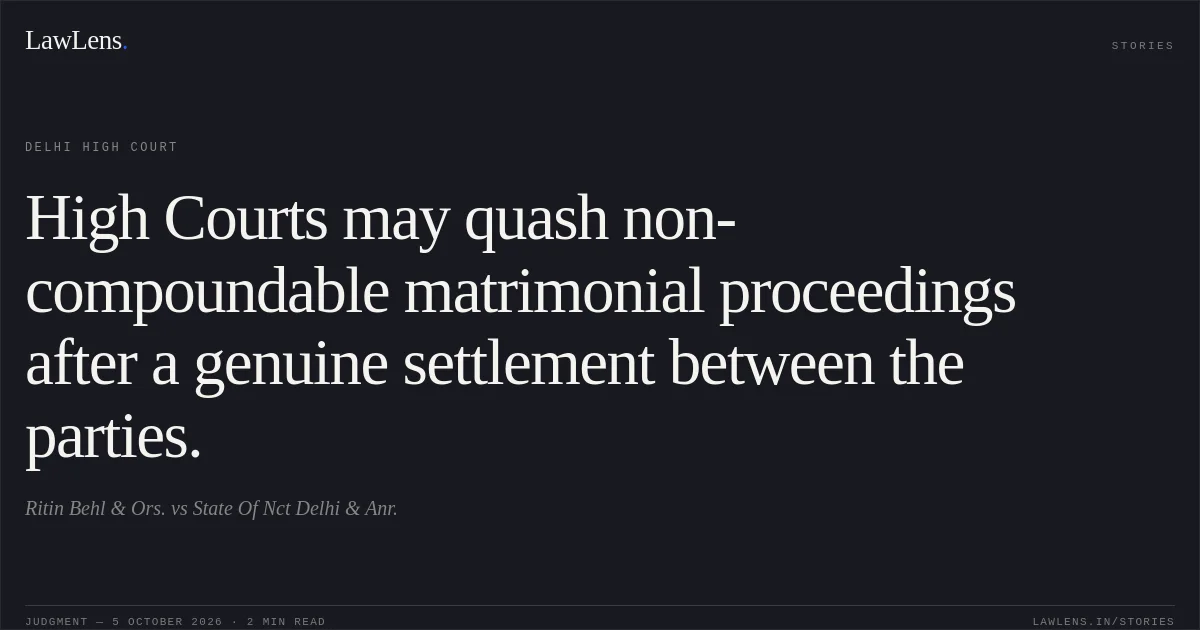
1. Whether the High Court could exercise its inherent jurisdiction under Section 528 BNSS/Section 482 CrPC to quash proceedings for non-compoundable matrimonial offences after the parties had settled their dispute.
Source reference: pp. 1, para. 1; pp. 3–4, paras. 15–172. Whether, in the circumstances of this case, the settlement warranted quashing the FIR and consequential proceedings.
Source reference: pp. 3–5, paras. 11–18Law Applied
Section 528 BNSS (formerly Section 482 CrPC) preserves the High Court’s inherent power to quash criminal proceedings to secure the ends of justice.
Source reference: pp. 3–4, paras. 16–17As stated in Jitendra Raghuvanshi and Others v. Babita Raghuvanshi and Another, (2013) 4 SCC 58, even where offences are non-compoundable, the High Court may quash proceedings arising from matrimonial disputes when the parties have amicably and voluntarily settled their differences; Section 320 CrPC is not a bar to that exercise of power in such circumstances.
Source reference: pp. 3–4, paras. 16–17The Court also noted that quashing is appropriate where no overriding public interest would be adversely affected.
Source reference: p. 4, para. 16Reasoning
The Court found that the matrimonial dispute had been fully settled: the parties had obtained a divorce, the agreed ₹22 lakh had been paid, and the jewellery had been returned.
Source reference: p. 3, para. 11Respondent no. 2 personally confirmed receipt of the settlement and her wish not to pursue the case, while the State did not oppose the petition.
Source reference: p. 3, paras. 12, 14Applying the principles in Jitendra Raghuvanshi, the Court concluded that the settled matrimonial dispute justified exercising its inherent jurisdiction to quash the non-compoundable offences.
Source reference: pp. 3–4, paras. 15–17Holding
The Court allowed the petition and quashed FIR No. 96/2023, registered at PS Kirti Nagar under Sections 498A/406/34 IPC, together with all consequential proceedings.
The petition and pending application were disposed of.
Source reference: p. 5, para. 19Acts & Sections Cited
5 provisions across 3 statutes referred to in this judgment. Each provision opens on LawLens.
Bharatiya Nagarik Suraksha Sanhita, 20231
Code of Criminal Procedure, 19732
Indian Penal Code, 18602
Original Court PDF
Ritin Behl & Ors.vsState Of Nct Delhi & Anr.
Click to open original judgment
Original judgment, available to read, download and summarize on LawLens.in