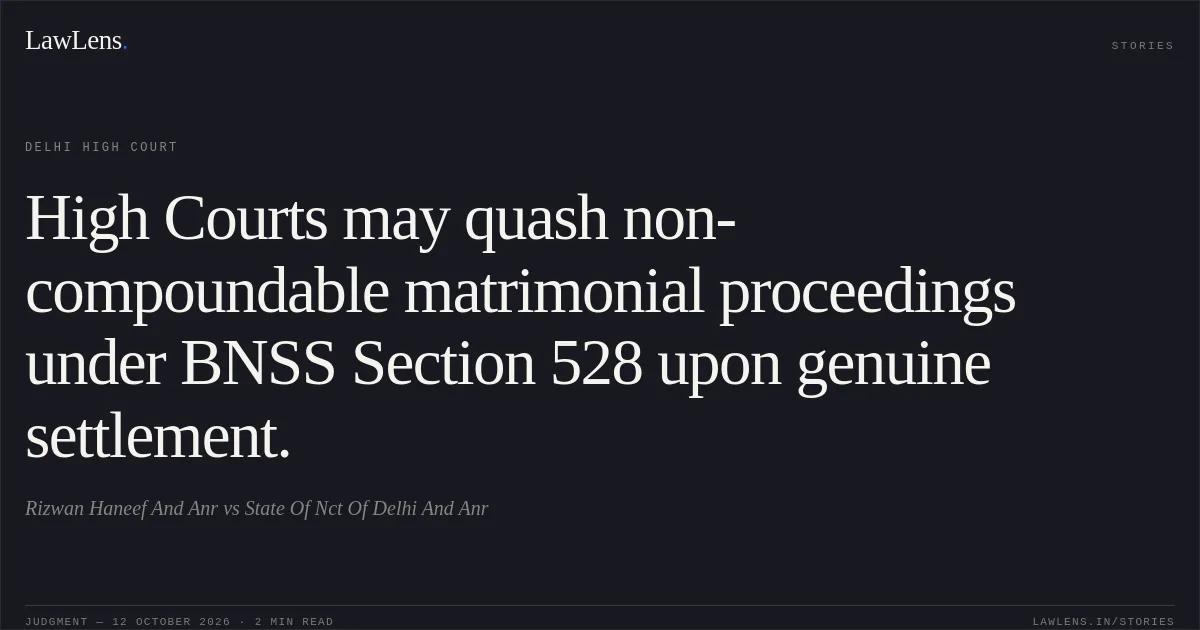
Facts
The petitioners sought quashing under Section 528 of the Bharatiya Nagarik Suraksha Sanhita, 2023 (“BNSS”) of FIR No. 437/2024, registered under Sections 498A/406/34 of the Indian Penal Code, 1860 and Sections 3/4 of the Dowry Prohibition Act, 1961, and the proceedings arising from it
Source reference: p.1, para. 1The FIR followed allegations of dowry demands, assault, and the complainant’s expulsion from the matrimonial home
Source reference: pp.2–3, paras. 5.2–5.4The parties later executed a settlement agreement under which petitioner no. 1 agreed to pay the complainant ₹1,70,000 in full and final settlement of her claims; the complainant confirmed that she had received the amount and did not wish to pursue the case
Source reference: p.3, paras. 6–8The State raised no serious objection to quashing
Source reference: p.3, para. 9Issues
Whether the High Court should exercise its inherent jurisdiction under Section 528 BNSS to quash the FIR and consequential proceedings for non-compoundable offences arising from a matrimonial dispute where the parties have settled
Source reference: pp.3–4, paras. 10–13Whether the settlement and the complainant’s stated decision not to pursue the matter justified quashing the proceedings to secure the ends of justice
Source reference: p.3, paras. 6–9; p.4, para. 13Law Applied
Section 528 BNSS, corresponding to Section 482 of the Code of Criminal Procedure, 1973, preserves the High Court’s inherent power to quash criminal proceedings to prevent abuse of process or secure the ends of justice
Source reference: p.1, para. 1; p.3, para. 11Relying on *Jitendra Raghuvanshi and Others v. Babita Raghuvanshi and Another*, (2013) 4 SCC 58, the Court applied the principle that proceedings involving non-compoundable offences may be quashed where they arise from a matrimonial dispute, the parties have genuinely and amicably settled, and quashing would secure the ends of justice
Source reference: pp.3–4, paras. 11–12Reasoning
The Court treated the dispute as a matrimonial matter resolved by the parties’ settlement. Petitioner no. 1 had paid the agreed sum, the complainant confirmed receipt and stated that she did not wish to proceed, and the State had no serious objection
Source reference: p.3, paras. 6–9Applying the principle in *Jitendra Raghuvanshi*, the Court found no impediment to exercising its inherent jurisdiction to quash the proceedings notwithstanding the non-compoundable nature of the offences
Source reference: p.4, paras. 12–13Holding
The Court allowed the petition and quashed FIR No. 437/2024, registered at PS Govind Puri under Sections 498A/406/34 IPC and Sections 3/4 of the Dowry Prohibition Act, together with all consequential proceedings
The petition and pending application were disposed of
Source reference: p.5, para. 15Acts & Sections Cited
7 provisions across 4 statutes referred to in this judgment. Each provision opens on LawLens.
Bharatiya Nagarik Suraksha Sanhita, 20231
Code of Criminal Procedure, 19732
Indian Penal Code, 18602
Original Court PDF
Rizwan Haneef And AnrvsState Of Nct Of Delhi And Anr
Click to open original judgment
Original judgment, available to read, download and summarize on LawLens.in

![A criminal acquittal does not invalidate disciplinary findings proved on a preponderance of probabilities.. Kande Shanker vs SOUTH CENTRAL RAILWAY. CAT - ['Hyderabad']. LawLens](/stories/thumbnails/a-criminal-acquittal-does-not-invalidate-disciplinary-findings-proved-on-a-preponderance-o-7490dc4d0f0c4d73ad22ab02000f6a81.webp)