Facts
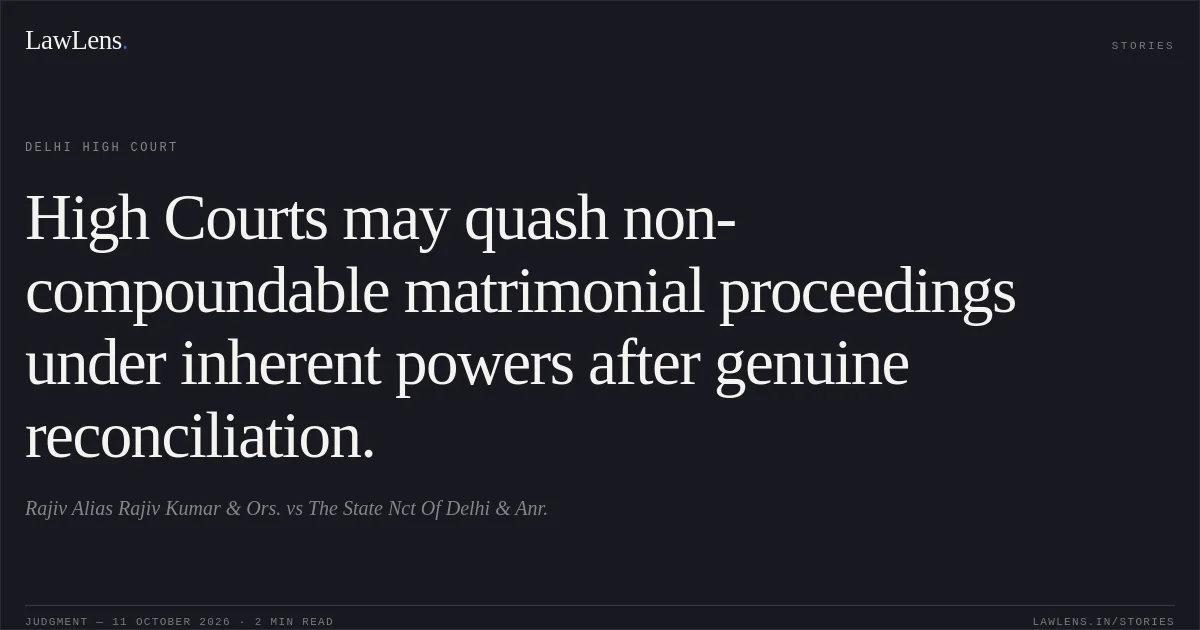
The petitioners sought quashing under Section 528 of the Bharatiya Nagarik Suraksha Sanhita, 2023, of FIR No. 975/2018, registered at PS Aman Vihar under Sections 498A/406/354/509/34 IPC, and the consequential proceedings.
Source reference: p. 1; p. 5, para. 15The FIR arose from allegations of harassment, beatings and dowry-related demands following matrimonial discord between petitioner no. 1 and respondent no. 2; petitioner nos. 2 and 3 were also named.
Source reference: p. 2, para. 6.1; p. 3, paras. 6.2–6.3The parties entered into a settlement on 16 May 2026, agreed to restore their matrimonial relationship, and had resumed cohabitation. Respondent no. 2 confirmed the reconciliation and stated that she did not wish to continue the proceedings; the State did not oppose quashing.
Source reference: p. 3, paras. 7–10; p. 3, para. 11Issues
1. Whether the High Court could quash the FIR and consequential proceedings, despite the offences being non-compoundable, on the basis of the parties’ matrimonial settlement.
Source reference: pp. 3–4, paras. 12–132. Whether the parties’ reconciliation and resumed cohabitation provided sufficient grounds to exercise that power in this case.
Source reference: pp. 3–5, paras. 7–14Law Applied
Section 528 BNSS, corresponding to Section 482 CrPC, empowers the High Court to quash criminal proceedings to secure the ends of justice, including proceedings for non-compoundable offences where the dispute is private, the settlement is genuine and voluntary, and quashing would not adversely affect an overriding public interest.
Source reference: p. 4, para. 12Relying on Jitendra Raghuvanshi v. Babita Raghuvanshi, (2013) 4 SCC 58, the Court reiterated that courts may quash proceedings arising from matrimonial disputes upon an amicable settlement, notwithstanding the bar on compounding under Section 320 CrPC.
Source reference: p. 4, para. 13Reasoning
The Court found the settlement credible: petitioner no. 1 and respondent no. 2 had reconciled, resumed living together and confirmed their position before the Court; respondent no. 2 did not wish to pursue the case.
Source reference: p. 3, paras. 7–10Given the matrimonial nature of the dispute, the settlement between the parties, and the State’s lack of objection, the Court held there was no impediment to exercising its inherent power to quash the non-compoundable offences.
Source reference: pp. 3–5, paras. 11–14Holding
The Court allowed the petition and quashed FIR No. 975/2018, registered under Sections 498A/406/354/509/34 IPC, together with all consequential proceedings.
The pending applications were also disposed of.
Source reference: p. 5, para. 16Acts & Sections Cited
8 provisions across 3 statutes referred to in this judgment. Each provision opens on LawLens.
Bharatiya Nagarik Suraksha Sanhita, 20231
Code of Criminal Procedure, 19732
Indian Penal Code, 18605
Original Court PDF
Rajiv Alias Rajiv Kumar & Ors.vsThe State Nct Of Delhi & Anr.
Click to open original judgment
Original judgment, available to read, download and summarize on LawLens.in