Facts
The petitioners sought quashing of FIR No. 0389/2023, registered under Sections 406/498A/34 IPC following respondent no. 2’s allegations of dowry-related harassment, retention of her stridhan, and related matrimonial cruelty
Source reference: pp. 1–3, paras. 1, 6.2During the proceedings, the parties settled their disputes through a mediation agreement dated 27 February 2026, which provided for mutual-consent divorce, custody of their minor daughter with respondent no. 2, and cooperation in quashing the FIR
Source reference: p. 3, paras. 6.3–6.5The divorce decree was granted on 14 May 2026
Source reference: p. 5, para. 17After the Court raised concerns about provision for the child, petitioner no. 1 presented LIC policies worth ₹40,31,039 in which the daughter was the beneficiary; the Court directed that the policies remain unchanged and that premiums be paid until maturity
Source reference: pp. 3–5, paras. 8–13Respondent no. 2 stated that she had no objection to quashing and requested copies of the policy documents
Source reference: p. 5, paras. 14–16Issues
1. Whether the High Court could quash the FIR and consequential proceedings under Section 528 BNSS, despite the offences being non-compoundable, in view of the parties’ settlement of their matrimonial disputes
Source reference: pp. 5–7, paras. 20–242. Whether the settlement and provision made for the minor daughter warranted quashing the proceedings in the interests of justice
Source reference: pp. 3–5, paras. 8–16, 20, 24Law Applied
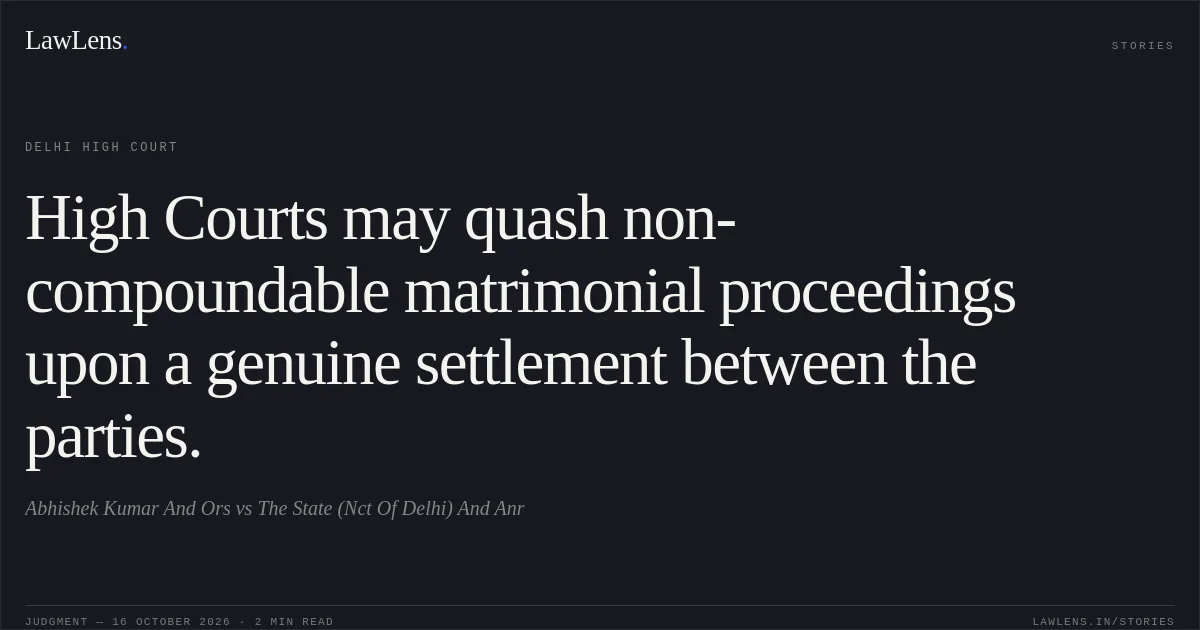
Article 226 of the Constitution and Section 528 BNSS, corresponding to Section 482 CrPC, confer inherent jurisdiction on the High Court to quash criminal proceedings to secure the ends of justice.
Source reference: pp. 5–6, paras. 21–22The Court relied on the principle that this power may be exercised in respect of non-compoundable offences arising from matrimonial disputes where the parties have genuinely and amicably settled and quashing would not adversely affect overarching public interest
Source reference: pp. 5–6, paras. 21–22Citing Jitendra Raghuvanshi and Others v. Babita Raghuvanshi and Another, (2013) 4 SCC 58, and its reliance on B.S. Joshi, the Court reiterated that Section 320 CrPC does not bar quashing under Section 482 where necessary to give effect to a genuine settlement in a matrimonial dispute
Source reference: pp. 6–7, para. 23Reasoning
The Court considered the parties’ mediation settlement, the mutual-consent divorce decree, respondent no. 2’s express lack of objection, and the State’s position of no objection
Source reference: pp. 3, 5–7, paras. 6.3–6.5, 14, 17, 19–20In addressing the child-welfare concern, it recorded the LIC investments made for the daughter and directed that the policies remain unchanged and their premiums continue to be paid until maturity; petitioner no. 1 also undertook to provide the policy documents to respondent no. 2
Source reference: pp. 3–5, paras. 8–13, 15–16In light of the settled matrimonial dispute and the absence of an identified impediment to quashing, the Court found it appropriate to exercise its inherent jurisdiction
Source reference: pp. 5–7, paras. 20–24Holding
The Court held that the settlement justified quashing the non-compoundable matrimonial offences and allowed the petition.
FIR No. 0389/2023 under Sections 406/498A/34 IPC, together with all consequential proceedings, was quashed
Source reference: p. 7, paras. 24–26The directions concerning preservation of the LIC policies and payment of premiums until maturity remained in place
Source reference: p. 5, paras. 12–13Acts & Sections Cited
5 provisions across 3 statutes referred to in this judgment. Each provision opens on LawLens.
Bharatiya Nagarik Suraksha Sanhita, 20231
Code of Criminal Procedure, 19732
Indian Penal Code, 18602
Original Court PDF
Abhishek Kumar And OrsvsThe State (Nct Of Delhi) And Anr
Click to open original judgment
Original judgment, available to read, download and summarize on LawLens.in