Facts
The petitioners, comprising the borrower-company, co-borrowers, and guarantor, challenged the notice dated 10 August 2023 issued by the Authorized Officer of Union Bank of India and published in Prabhat Khabar, proposing e-auction of six immovable properties under the SARFAESI framework.
Source reference: p. 2They alleged that the bank had proceeded without considering their objections or representation, despite their willingness to repay the outstanding demand of ₹51,01,499 in instalments. They also sought renewal of their cash-credit account, which they stated had remained due for renewal since 2022, and alleged violations of Rules 3 and 3-A of the Security Interest (Enforcement) Rules, 2002.
Source reference: p. 2The bank contested the maintainability of the writ petition on the ground that an efficacious alternative statutory remedy was available.
Source reference: p. 3Issues
1. Whether the writ petition under Article 226 of the Constitution was maintainable against the bank’s SARFAESI measures when an effective alternative remedy was available under the SARFAESI Act.
Source reference: pp. 3–4; para. 62. Whether the petitioners were entitled to have the e-auction notice quashed and to obtain directions concerning consideration of their objections, repayment by instalments, renewal of the cash-credit account, and protection of possession.
Source reference: p. 2Law Applied
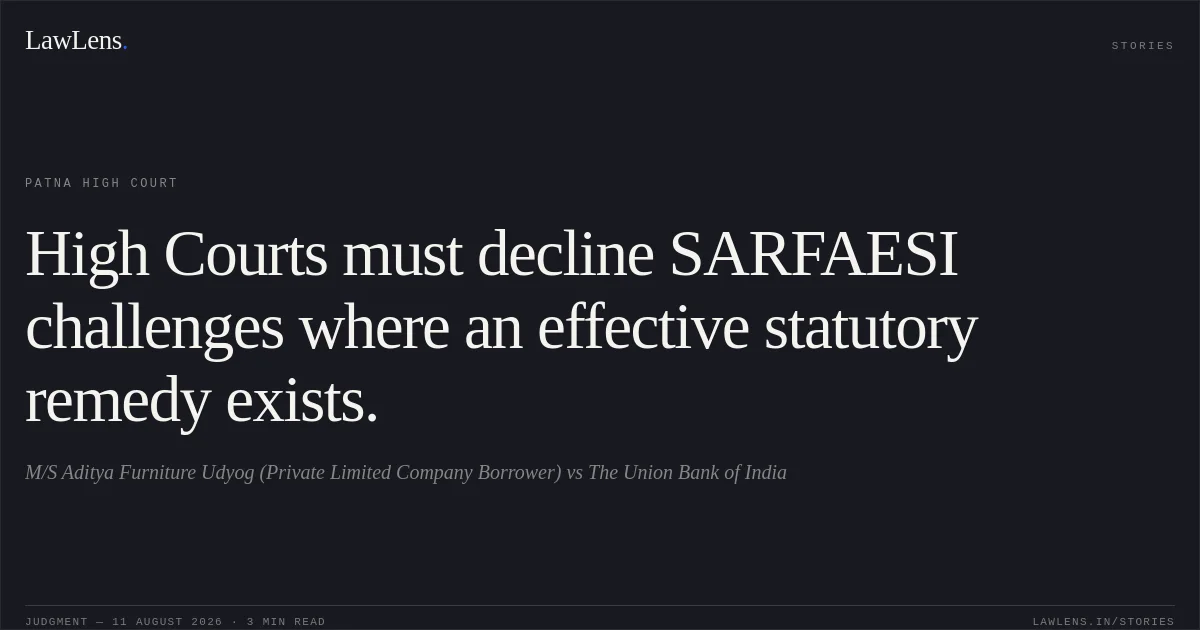
The Court applied the alternative-remedy doctrine governing the exercise of writ jurisdiction under Article 226, particularly in disputes concerning recovery of public dues and bank debts. Relying on United Bank of India v. Satyawati Tondon, (2010) 8 SCC 110, it held that High Courts should ordinarily decline to entertain writ petitions where the statute provides an effective remedial mechanism, especially in recovery proceedings involving banks and financial institutions.
Source reference: p. 3It further relied on Celir LLP v. Bafna Motors (Mumbai) (P) Ltd., (2024) 2 SCC 1, and PHR Invent Educational Society v. UCO Bank & Ors., 2024 INSC 297, which reiterated that challenges to measures under the SARFAESI Act should ordinarily be pursued before the appropriate statutory forum rather than through Article 226 proceedings.
Source reference: pp. 3–4The Court also noted the petitioners’ reliance on the SARFAESI Act and the Security Interest (Enforcement) Rules, 2002, including the provisions concerning the impugned sale notice.
Source reference: p. 2Reasoning
The Court treated the petition as a challenge to measures taken by the bank under the SARFAESI regime. Since that legislation provides an effective statutory remedy before the appropriate forum, the Court held that the petitioners could not ordinarily invoke Article 226 directly to challenge the e-auction notice or seek adjudication of their objections and repayment proposals.
Source reference: pp. 3–4Applying the principles in Satyawati Tondon, Celir LLP, and PHR Invent Educational Society, the Court declined to examine the merits of the alleged procedural violations, the proposed instalment repayment, or the request for renewal of the cash-credit account in writ jurisdiction.
Source reference: pp. 3–4The Court nevertheless preserved the petitioners’ right to pursue the appropriate statutory remedy and directed that the question of limitation be considered by the concerned authority.
Source reference: para. 6Holding
The writ petition was held to be not maintainable because an alternative and efficacious remedy was available under the SARFAESI Act.
The Court did not quash the e-auction notice or grant any direction concerning repayment, account renewal, or protection of possession. The petitioners were granted liberty to approach the appropriate forum, which was directed to consider the issue of limitation, and the writ petition was disposed of accordingly.
Source reference: paras. 6–7Acts & Sections Cited
2 provisions across 1 statute referred to in this judgment. Each provision opens on LawLens.
Original Court PDF
M/S Aditya Furniture Udyog (Private Limited Company Borrower)vsThe Union Bank of India
Click to open original judgment
Original judgment, available to read, download and summarize on LawLens.in