Facts
The petitioner, a proprietorship firm operating as Bombay Tent House, maintained Cash Credit Account No. 1606738545 with the Central Bank of India. The Bank issued a demand notice under Section 13(2) of the SARFAESI Act dated 6 February 2014, claiming ₹2,18,356.68, followed by a possession notice dated 1 August 2014 under Section 13(4).
Source reference: pp. 3–4The petitioner sought instalment and one-time-settlement arrangements but did not comply with the agreed payment schedule. The District Magistrate-cum-Collector, Samastipur, thereafter directed taking possession of the petitioner’s residential house by order dated 31 August 2016. The petitioner challenged that order before the Debt Recovery Tribunal (DRT), which initially directed maintenance of status quo upon production of a cheque for ₹2,18,356 and called upon the Bank to disclose the dues. The Bank subsequently recalculated the dues at ₹6,25,031, and the DRT dismissed the petitioner’s SARFAESI appeal by order dated 15 April 2017.
Source reference: pp. 4–6The petitioner then invoked the High Court’s writ jurisdiction seeking quashing of the DRT and District Magistrate’s orders, production of the account statement, and return of the title deed.
Source reference: pp. 1–2, 6Issues
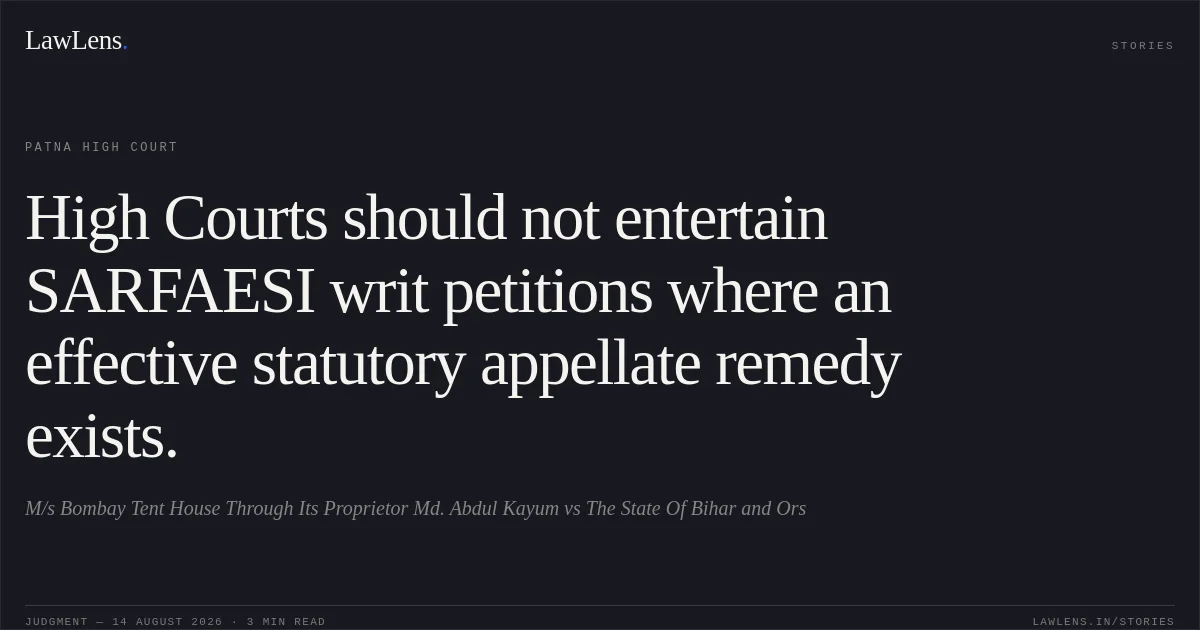
1. Whether the High Court should entertain a writ petition challenging orders passed under the SARFAESI Act when the petitioner had an effective statutory remedy before the Debt Recovery Appellate Tribunal (DRAT).
Source reference: paras. 10–112. Whether the petitioner was entitled to writ relief concerning the SARFAESI proceedings, possession of the secured property, the alleged repayment of dues, and production of the bank account statement.
Source reference: paras. 1, 10–16Law Applied
The Court applied the principle that a writ petition under Article 226 of the Constitution should ordinarily not be entertained where an effective alternative statutory remedy is available, particularly in matters concerning recovery of public money and bank dues.
Source reference: para. 12Relying on United Bank of India v. Satyawati Tondon, (2010) 8 SCC 110, the Court held that the SARFAESI Act constitutes a comprehensive statutory mechanism for recovery and grievance redressal, and that litigants should ordinarily exhaust those remedies before invoking Article 226.
Source reference: para. 12The Court further relied on Celir LLP v. Bafna Motors (Mumbai) (P) Ltd., (2024) 2 SCC 1, and PHR Invent Educational Society v. UCO Bank, 2024 INSC 297, reiterating that High Courts should not entertain SARFAESI challenges where an effective remedy under the statute exists.
Source reference: paras. 13–14The relevant statutory framework included the Bank’s enforcement measures under Sections 13(2) and 13(4) of the SARFAESI Act and the appellate remedies before the DRT and DRAT.
Source reference: pp. 3–5, para. 11Reasoning
The Court noted that the writ petition directly challenged both the District Magistrate’s order authorising possession and the DRT’s order dismissing the petitioner’s SARFAESI appeal.
Source reference: para. 10Since the petitioner could challenge the DRT’s order before the DRAT, the Court treated that remedy as adequate and effective.
Source reference: para. 11Applying the rule in Satyawati Tondon and the subsequent Supreme Court decisions, the Court declined to examine the petitioner’s factual claims regarding deposits, the disputed account statement, recalculation of dues, or the validity of the possession proceedings in writ jurisdiction.
Source reference: paras. 12–15The existence of an alternative statutory remedy was therefore determinative of maintainability, notwithstanding the petitioner’s contention that he was a small proprietor and that the property was his residential house.
Source reference: para. 8Holding
The High Court held that the writ petition was not maintainable because the petitioner had an effective alternative remedy before the DRAT.
The petition was accordingly disposed of without adjudicating the merits of the SARFAESI proceedings.
Source reference: para. 16The petitioner was granted liberty to approach the appropriate forum, and the concerned authority was directed to consider the issue of limitation in accordance with law.
Source reference: para. 16The writ petition and any pending interlocutory application were disposed of.
Source reference: paras. 17–18Acts & Sections Cited
2 provisions across 1 statute referred to in this judgment. Each provision opens on LawLens.
Securitisation and Reconstruction of Financial Assets and Enforcement of Security Interest Act, 20022
Original Court PDF
M/s Bombay Tent House Through Its Proprietor Md. Abdul KayumvsThe State Of Bihar and Ors
Click to open original judgment
Original judgment, available to read, download and summarize on LawLens.in