Facts
The petitioner sought to quash the charge-sheet and criminal proceedings for offences under Sections 420, 467, 468 and 471 of the IPC, and to set aside the orders refusing his discharge application under Section 239 CrPC.
Source reference: paras. 1–3The prosecution alleged that he represented himself as an RTI activist associated with the Prime Minister’s Office and used that claim to obtain confidential information and harass the complainant
Source reference: paras. 1–3The Magistrate rejected the discharge application, and the revisional court affirmed that decision, relying in part on a PMO communication stating that no such department existed and that the petitioner was not associated with the PMO.
Source reference: paras. 4–5The petitioner then invoked the High Court’s jurisdiction under Section 528 BNSS
Source reference: para. 1Issues
Whether the charge-sheet and criminal proceedings should be quashed on the ground that the alleged facts did not disclose offences under Sections 420, 467, 468 and 471 IPC, or that only an offence under Section 419 IPC was made out
Source reference: paras. 3, 6, 9–11Whether the orders refusing discharge and dismissing the revision disclosed perversity, illegality, or another basis for interference under the High Court’s inherent jurisdiction
Source reference: paras. 9–11Whether the petitioner was entitled to a certificate for appeal under Article 134(1)(c), read with Article 134-A, of the Constitution
Source reference: paras. 12–13Law Applied
Section 239 CrPC provides for discharge where the charge is groundless; Sections 420, 467, 468 and 471 IPC prescribe the offences alleged in this case.
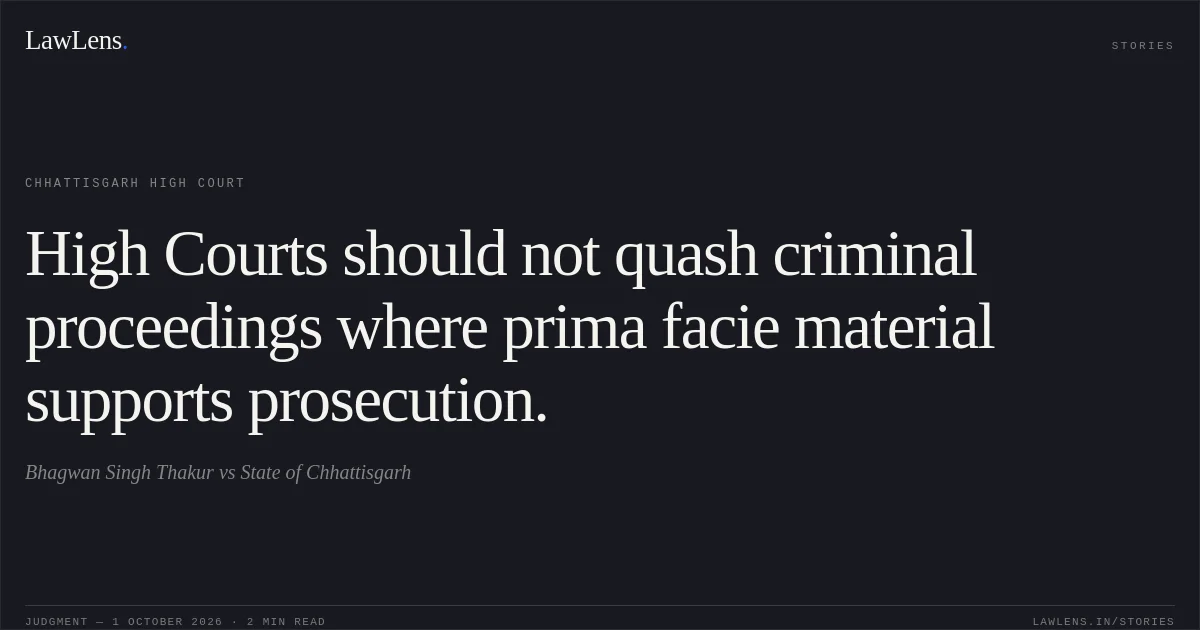
Source reference: no citationIn exercising inherent jurisdiction under Section 528 BNSS (corresponding to Section 482 CrPC), the High Court may interfere where the challenged order lacks a legal foundation, is perverse, or risks a failure of justice; it should not otherwise stifle criminal proceedings where the record discloses prima facie material.
Source reference: no citationThe Court relied on Accamma Sam Jacob v. State of Karnataka, 2026 INSC 362, including its caution against prematurely evaluating disputed matters or conducting a mini-trial
Source reference: para. 10Article 134(1)(c), read with Article 134-A, permits a certificate for appeal where the requisite basis for such certification exists
Source reference: paras. 12–13Reasoning
The Court considered the PMO communication confirming that the petitioner was not associated with the Office and that the department he claimed to represent did not exist. It held that this, together with the material considered by the courts below, constituted prima facie material supporting continuation of the proceedings.
Source reference: paras. 5, 9, 11The Magistrate’s and revisional court’s orders therefore could not be said to be perverse or illegal, and the petitioner had not shown that continuation of the case would amount to an abuse of process.
Source reference: paras. 9–11The Court rejected the request for a certificate because it saw no substantial question requiring authoritative determination by the Supreme Court.
Source reference: para. 13Holding
The High Court dismissed the petition and declined to quash the charge-sheet or criminal proceedings, leaving in place the orders rejecting discharge and dismissing the revision.
It also rejected the oral prayer for a certificate under Article 134(1)(c), read with Article 134-A, of the Constitution.
Source reference: para. 13Acts & Sections Cited
9 provisions across 3 statutes referred to in this judgment. Each provision opens on LawLens.
Bharatiya Nagarik Suraksha Sanhita, 20231
Indian Penal Code, 18605
Code of Criminal Procedure, 19733
Original Court PDF
Bhagwan Singh ThakurvsState of Chhattisgarh
Click to open original judgment
Original judgment, available to read, download and summarize on LawLens.in