Facts
The petitioner, proprietor of M/s Vishwa Fashion and General Store, obtained loan facilities from Canara Bank in 2020, secured by a mortgage of his dwelling house.
Source reference: pp. 2–4, paras. 2–4After the accounts were classified as non-performing assets, the Bank issued a demand notice under Section 13(2) of the SARFAESI Act and proceeded to take possession of the secured property.
Source reference: pp. 2–4, paras. 2–4The petitioner’s challenge before the DRT was dismissed; he later sought restoration of possession through this writ petition, alleging procedural irregularities and offering to repay the dues.
Source reference: pp. 2–4, paras. 2–4During the proceedings, an auction purchaser stated that the auction held on 24 February 2025 had been confirmed and that the full bid amount had been paid.
Source reference: pp. 9–10, paras. 17–20The Bank raised the objection that the petitioner had an effective statutory remedy under the SARFAESI Act.
Source reference: p. 11, para. 23Issues
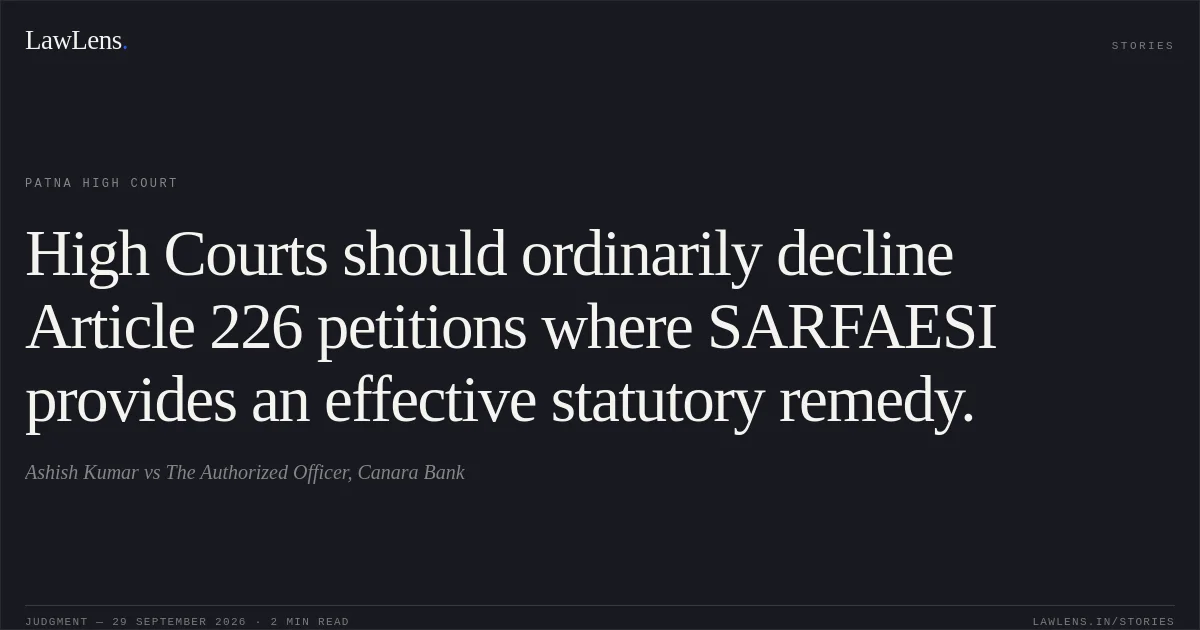
1. Whether the High Court should entertain the writ petition under Article 226 when an effective statutory remedy under the SARFAESI Act is available to the petitioner.
Source reference: p. 11, para. 23; pp. 16–17, paras. 28–292. Whether the Court should determine the petitioner’s challenges to the Bank’s possession and auction measures in this writ petition.
Source reference: p. 17, para. 29Law Applied
Article 226 relief is ordinarily declined where an effective statutory alternative remedy is available.
Source reference: p. 17, para. 27The Supreme Court has emphasised that this rule applies with particular force to proceedings for recovery of bank dues and measures under the SARFAESI Act: United Bank of India v. Satyawati Tondon, (2010) 8 SCC 110.
Source reference: p. 17, para. 27The Court also relied on State Bank of Travancore v. Mathew K.C., (2018) 3 SCC 85, concerning restraint in granting writ relief against SARFAESI recovery measures.
Source reference: pp. 12–15, para. 24PHR Invent Educational Society v. UCO Bank, (2024) 6 SCC 5179, and Celir LLP v. Bafna Motors (Mumbai) Pvt. Ltd., (2024) 2 SCC 1, which reiterate the rule against entertaining a writ petition where an effective SARFAESI remedy exists.
Source reference: p. 16, paras. 25–26Reasoning
The petitioner challenged measures taken under the SARFAESI Act, including possession of the secured property and the subsequent auction.
Source reference: pp. 11, 16–17, paras. 23, 27–28The Court treated the availability of an effective statutory remedy as decisive and applied the Supreme Court’s direction that High Courts ordinarily require parties to pursue remedies under the relevant statute before invoking Article 226, particularly in bank-recovery matters.
Source reference: pp. 11, 16–17, paras. 23, 27–28It therefore declined to examine the merits of the petitioner’s allegations or the auction purchaser’s claims.
Source reference: p. 17, para. 29Holding
The Court dismissed the writ petition without expressing any opinion on the merits of the petitioner’s claims, leaving him at liberty to pursue the appropriate statutory remedy in accordance with law.
Any interlocutory applications were also disposed of.
Source reference: p. 17, paras. 29–30Acts & Sections Cited
1 provisions across 1 statute referred to in this judgment. Each provision opens on LawLens.
Securitisation and Reconstruction of Financial Assets and Enforcement of Security Interest Act, 20021
Original Court PDF
Ashish KumarvsThe Authorized Officer, Canara Bank
Click to open original judgment
Original judgment, available to read, download and summarize on LawLens.in
![Retiral benefits cannot be withheld for disciplinary proceedings barred by post-retirement limitation.. ARUN JADHAV vs HOUSING AND URBAN AFFAIRS. CAT - ['Ernakulam']. LawLens](/stories/thumbnails/retiral-benefits-cannot-be-withheld-for-disciplinary-proceedings-barred-by-post-retirement-2904ba6a9e6b49cf9e70191ac4924f70.webp)
![Revaluation-based appointments must be assigned to the examination’s original vacancy year.. Tanazi Viswanath Sagar vs DEPARTMENT OF POSTS. CAT - ['Bangalore']. LawLens](/stories/thumbnails/revaluation-based-appointments-must-be-assigned-to-the-examinations-original-vacancy-year-90bb609c522f4688980c3615f61132fe.webp)
![An OMR sheet must be evaluated when examination records can verify a mistakenly entered booklet number.. KM JYOTI vs KENDRIYA VIDYALAYA SANGATHAN (KVS). CAT - ['Delhi']. LawLens](/stories/thumbnails/an-omr-sheet-must-be-evaluated-when-examination-records-can-verify-a-mistakenly-entered-bo-628f90f6f63e414cb40ce5a73ff688c9.webp)