Facts
The petitioner obtained an education loan of ₹10 lakh from Punjab National Bank in 2009, secured against his mother’s residential property, to pursue higher studies in the United Kingdom.
Source reference: no citationAfter returning to India in December 2015, he challenged the Bank’s classification of the loan account as a non-performing asset and its notice under Section 13(2) of the SARFAESI Act, 2002, alleging inadequate service and failure to consider applicable education-loan benefits.
Source reference: p. 3He also challenged the Bank’s rejection of his successive One-Time Settlement (OTS) proposals, including his proposal to pay ₹3,95,608 after credit for amounts already deposited.
Source reference: pp. 6–7The Bank maintained that the proposals did not satisfy the applicable OTS policy, that the petitioner had no enforceable right to acceptance of a particular settlement, and that a statutory remedy was available against the recovery measures.
Source reference: pp. 8–9Issues
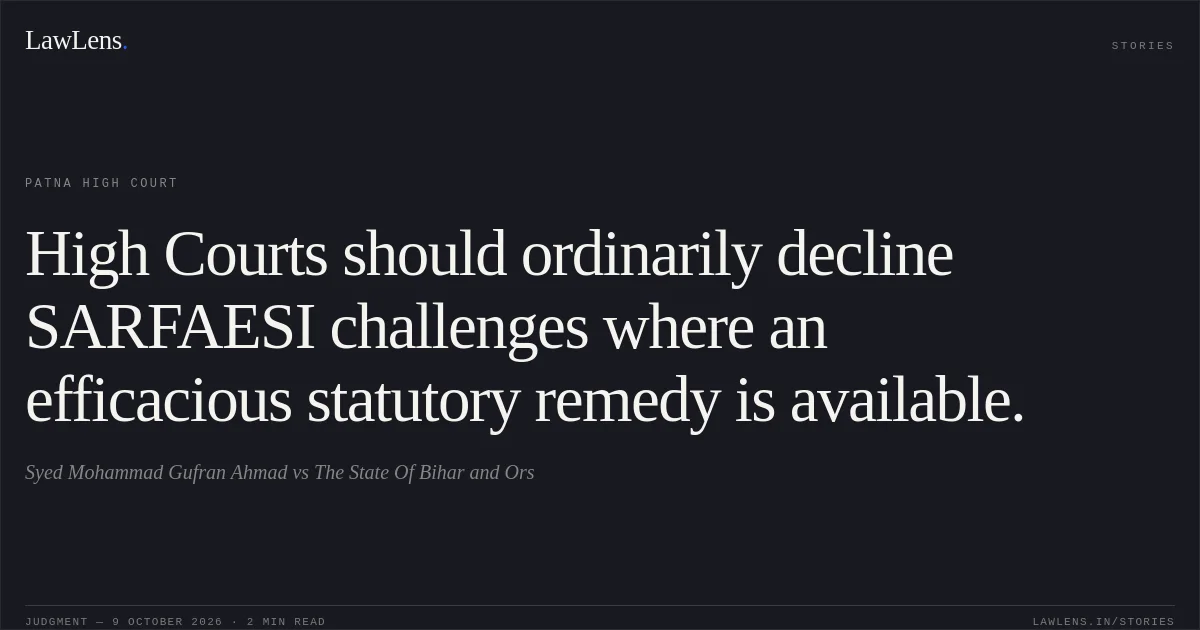
1. Whether the petitioner could invoke the High Court’s writ jurisdiction to challenge the Bank’s recovery measures when an effective statutory remedy was available.
Source reference: pp. 10–132. Whether the petitioner had an enforceable right to require the Bank to accept his OTS proposal.
Source reference: pp. 9–11, 13Law Applied
Section 13(2) of the SARFAESI Act provides for a demand notice by a secured creditor; the judgment records that a statutory remedy was available to the petitioner against the Bank’s SARFAESI measures.
Source reference: pp. 2–3, 10Under the alternative-remedy principle, a High Court ordinarily declines to entertain a petition under Article 226 where an effective statutory remedy is available, particularly in bank-recovery matters, as stated in United Bank of India v. Satyawati Tondon, (2010) 8 SCC 110, PHR Invent Educational Society v. UCO Bank, Civil Appeal No. 4845 of 2024, and Celir LLP v. Bafna Motors (Mumbai) Pvt. Ltd., (2024) 2 SCC 1.
Source reference: pp. 11–13State Bank of India v. Arvinda Electronics Pvt. Ltd. was relied on for the rule that a borrower has no right to demand OTS benefits as a matter of course and that OTS relief depends on the applicable eligibility criteria and policy guidelines.
Source reference: p. 9Reasoning
The Court found that the petition raised disputes about the legality of the recovery measures and the applicability of the relevant OTS policy, matters capable of examination by the competent statutory forum.
Source reference: pp. 10–11Because that remedy was available, the Court declined to exercise writ jurisdiction, applying the alternative-remedy principle.
Source reference: pp. 11–13It also held that the petitioner had not demonstrated an enforceable right to acceptance of his particular OTS offer; eligibility and the Bank’s treatment of the proposals could be examined by the appropriate forum.
Source reference: p. 13The Court did not decide the merits of either the SARFAESI challenge or the OTS dispute.
Source reference: p. 14Holding
The Court dismissed the writ petition as not maintainable, declining to exercise its jurisdiction because an efficacious alternative remedy was available.
It left the petitioner free to pursue the remedy available under law, to be considered on its own merits, and expressed no opinion on the merits of his claims.
Source reference: p. 14Acts & Sections Cited
1 provisions across 1 statute referred to in this judgment. Each provision opens on LawLens.
Securitisation and Reconstruction of Financial Assets and Enforcement of Security Interest Act, 20021
Original Court PDF
Syed Mohammad Gufran AhmadvsThe State Of Bihar and Ors
Click to open original judgment
Original judgment, available to read, download and summarize on LawLens.in