Facts
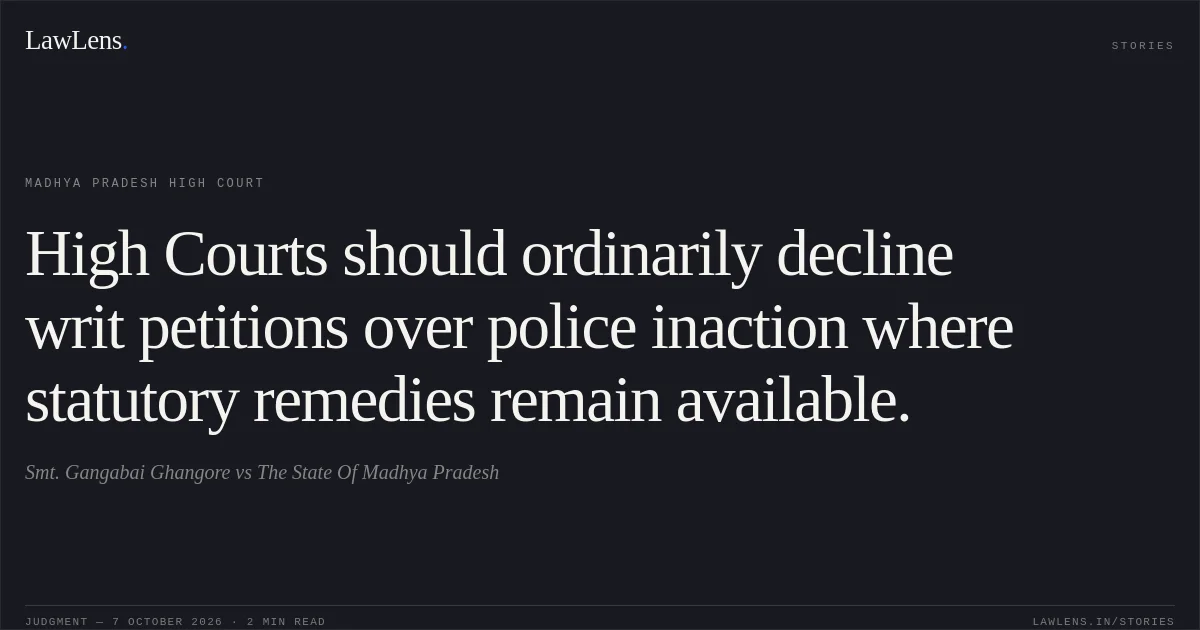
The petitioner claimed to have purchased land from respondent No. 9 and to have remained in possession of it. She alleged that respondent No. 9, despite having sold the land to her, subsequently sold part of it to respondent No. 8. She said that she had complained to the Collector and police authorities, but no action was taken.
Source reference: para. 2By a petition under Article 226, she sought directions to register an offence against respondents Nos. 7–9, act on her complaints, and protect her life, limb and property.
Source reference: para. 1The State opposed the petition, contending that she had an alternative remedy before the competent Magistrate.
Source reference: para. 3Issues
Whether the High Court should entertain a writ petition seeking registration of an offence and action on complaints when the petitioner has not pursued the available statutory remedies before the police and Magistrate.
Source reference: paras. 3, 9Whether the petitioner should be permitted to approach the competent Magistrate for redress.
Source reference: para. 10Law Applied
Under Sections 154(3) and 156(3) of the Code of Criminal Procedure, 1973, an aggrieved person may first approach the Superintendent of Police and, if the grievance remains unresolved, apply to the Magistrate, who may direct registration of an FIR and proper investigation; a criminal complaint under Section 200 is also available. The corresponding provisions identified in the judgment are Sections 173(4), 175 and 223 of the Bharatiya Nagarik Suraksha Sanhita, 2023.
Source reference: paras. 5, 8Relying on Sakiri Vasu v. State of U.P., (2008) 2 SCC 409; Sudhir Bhaskarrao Tambe v. Hemant Yashwant Dhage, (2016) 6 SCC 277; M. Subramaniam v. S. Janaki (Criminal Appeal No. 102 of 2011, decided 20 March 2020); Shweta Bhadoriya v. State of M.P., (2017) 1 MPLJ (Cri) 338; and Ashiwini Kumar Upadhyay v. Union of India, 2026 LiveLaw (SC) 437, the Court applied the principle that a High Court should ordinarily not entertain a writ petition seeking FIR registration or proper investigation where these statutory remedies have not been exhausted.
Source reference: paras. 5–8Reasoning
The petitioner’s grievances concerned alleged police inaction on complaints and a request to register an offence.
Source reference: paras. 1–2Applying the cited authorities, the Court held that the CrPC/BNSS provides an effective statutory route: the petitioner could pursue relief before the competent Magistrate, including seeking an order for investigation or proceeding by way of complaint.
Source reference: paras. 5–8As she had approached the High Court without availing that alternative remedy, the petition could not be entertained.
Source reference: para. 9The Court did not decide the underlying land dispute or the merits of the allegations.
Source reference: no citationHolding
The petition was dismissed as not maintainable in view of the unexhausted alternative remedy.
The petitioner was granted liberty to approach the competent Magistrate under the applicable provisions of the CrPC/BNSS for redress.
Source reference: para. 10Acts & Sections Cited
18 provisions across 2 statutes referred to in this judgment. Each provision opens on LawLens.
Code of Criminal Procedure, 1973
Bharatiya Nagarik Suraksha Sanhita, 20237
Original Court PDF
Smt. Gangabai GhangorevsThe State Of Madhya Pradesh
Click to open original judgment
Original judgment, available to read, download and summarize on LawLens.in