Facts
The petitioner, described by the Court as a defaulting borrower, challenged a Magistrate’s order in C.Misc. No. 50129/2021 insofar as it concerned his residential apartment, and the consequential possession notice issued by the first respondent under the SARFAESI Act
Source reference: p. 4The Court had granted an interim stay of recovery proceedings on 22 November 2022, which had remained in effect for nearly four years
Source reference: p. 6The Court considered whether the writ petition could be entertained despite the statutory remedy available to the petitioner under Section 17 of the Act
Source reference: p. 4–5Issues
1. Whether the petitioner could invoke the High Court’s writ jurisdiction to challenge measures taken by the secured creditor under the SARFAESI Act when a remedy under Section 17 was available
Source reference: p. 4–52. Whether the interim stay of the recovery proceedings should continue in light of that statutory remedy
Source reference: p. 6–7Law Applied
Articles 226 and 227 of the Constitution confer extraordinary jurisdiction, but the High Court ordinarily exercises restraint where an efficacious statutory remedy is available. Section 17 of the SARFAESI Act provides a borrower with a remedy before the Debts Recovery Tribunal against measures taken by a secured creditor under the Act
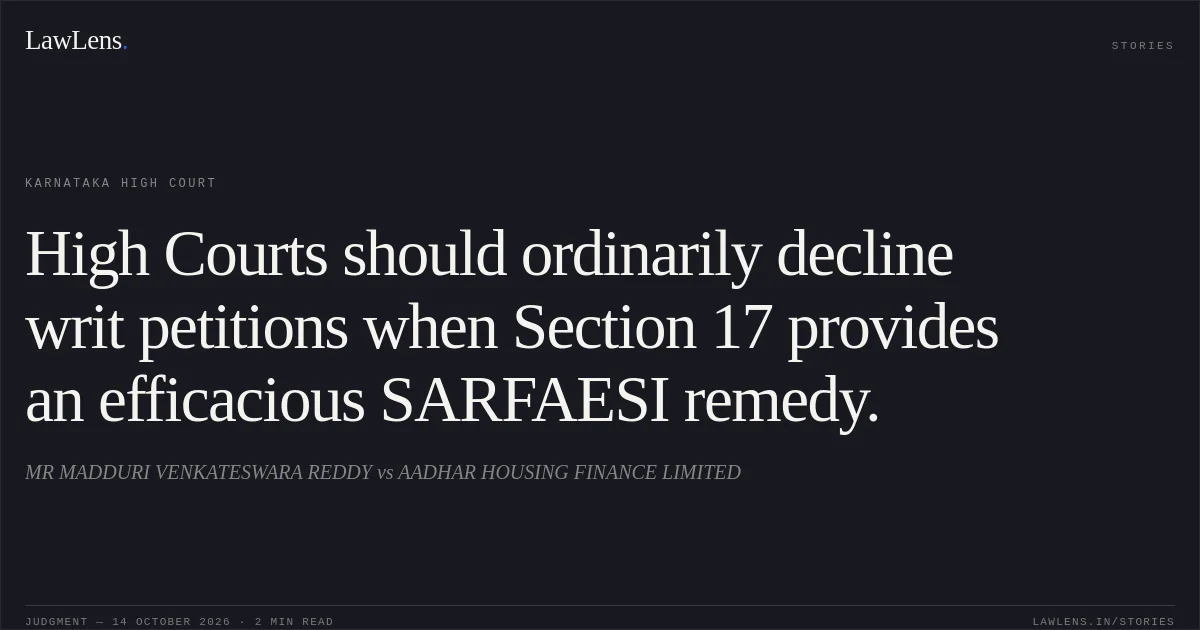
Source reference: p. 5, 7In United Bank of India v. Satyawati Tondon, (2010) 8 SCC 110, the Supreme Court reiterated that High Courts should ordinarily refrain from entertaining Article 226 petitions where an efficacious remedy under the SARFAESI Act is available
Source reference: p. 5–6Reasoning
The Court applied the alternative-remedy principle because the petitioner’s challenge concerned measures taken under the SARFAESI Act and Section 17 provided a statutory avenue for redress before the Debts Recovery Tribunal
Source reference: p. 5, 7It considered that allowing the interim stay to continue would indefinitely prejudice the secured creditor and impede the Act’s recovery mechanism, particularly after the stay had stalled proceedings for nearly four years
Source reference: p. 6–7The Court therefore declined to examine the merits of the challenge to either the Magistrate’s order or the possession notice
Source reference: p. 7Holding
The Court held that the writ petition was not maintainable and dismissed it without expressing an opinion on the merits
It vacated the interim order and left the petitioner at liberty to pursue any remedy available under the SARFAESI Act, subject to questions of limitation and maintainability being determined by the competent forum
Source reference: p. 8Pending interlocutory applications, if any, were disposed of
Source reference: p. 8Acts & Sections Cited
1 provisions across 1 statute referred to in this judgment. Each provision opens on LawLens.
Securitisation and Reconstruction of Financial Assets and Enforcement of Security Interest Act, 20021
Original Court PDF
MR MADDURI VENKATESWARA REDDYvsAADHAR HOUSING FINANCE LIMITED
Click to open original judgment
Original judgment, available to read, download and summarize on LawLens.in
![Non-inclusion in railway pass or medical records cannot alone defeat compassionate appointment consideration.. YADVENDRA vs NORTH EASTERN RAILWAY. CAT - ['Allahabad']. LawLens](/stories/thumbnails/non-inclusion-in-railway-pass-or-medical-records-cannot-alone-defeat-compassionate-appoint-e186bad941e646b9b28be0fa75663d2f.webp)
![Ten years’ qualifying service is not required for family pension after one year of continuous railway service.. ANJANA DEVI vs NORTH EASTERN RAILWAY. CAT - ['Allahabad']. LawLens](/stories/thumbnails/ten-years-qualifying-service-is-not-required-for-family-pension-after-one-year-of-continuo-21aef602d06c48fbabbee8c57d854298.webp)
![Back-wage claims require merits-based assessment; absence of an earlier direction alone cannot defeat them.. MANNO LAL SAROJ vs NORTH CENTRAL RAILWAY. CAT - ['Allahabad']. LawLens](/stories/thumbnails/back-wage-claims-require-merits-based-assessment-absence-of-an-earlier-direction-alone-can-62ea890f59a24aa499e6a8a6e1f6bf69.webp)