Facts
The petitioners, former employees who retired after long service tenures, sought pension on higher wages under the Employees’ Pension Scheme (EPS), 1995
Source reference: para. 3Following the Supreme Court judgment in Employees' Provident Fund Organisation v. Sunil Kumar B. (2022 INSC 1171), the petitioners submitted online joint options to receive pension based on actual wages exceeding the statutory ceiling
Source reference: para. 4, 5The respondent (EPFO) rejected these applications via orders dated April 8, April 9, and December 4, 2025, on the primary ground that the respective employers failed to submit requisite documents, specifically Form 6A (annual contribution statements) and contribution challans
Source reference: para. 9, 16The petitioners challenged these rejections, contending that the statutory duty to maintain and submit such records lies solely with the employer and the EPFO, and that they should not suffer penal consequences for administrative lapses beyond their control
Source reference: para. 10, 12, 13Issues
Whether an eligible employee can be denied the benefit of pension on higher wages solely because the employer fails to produce specific documents (such as Form 6A) when other materials (such as Form 3A and EPF account statements) are available to substantiate the claim
Source reference: para. 18Law Applied
The court applied Section 6-A of the Employees’ Provident Fund and Miscellaneous Provisions Act, 1952, and Paragraphs 11(3) and 20 of the Employees’ Pension Scheme, 1995, which govern the statutory obligations of employers to submit contribution particulars
Source reference: para. 3, 6, 10It followed the Supreme Court's mandate in Employees’ Provident Fund Organisation v. Sunil Kumar B. (2022 INSC 1171), allowing joint options for higher pension
Source reference: para. 4Furthermore, the court applied the principle that social security legislation is "beneficial legislation" intended to protect employees, requiring a workable and realistic approach to verification rather than a technical or mechanical one
Source reference: para. 22, 25Reasoning
The court reasoned that employees have no control over the preservation or submission of statutory returns like Form 6A or challans, as these are the employer's legal obligations
Source reference: para. 19It noted that for service periods prior to 2010—before the digitization of records—insisting on a "perfect set of documents" is unreasonable
Source reference: para. 18, 21The court found that if alternative records like Form 3A (yearly contribution details) or EPF account statements indicate that deductions were indeed made on higher wages, the EPFO must conduct an independent inquiry
Source reference: para. 20, 24The respondent is duty-bound to examine its own internal electronic data, member ledgers, and past returns rather than summarily rejecting claims due to an employer’s non-cooperation
Source reference: para. 24, 26The court concluded that the impugned orders reflected a mechanical approach that defeated the object of the pension scheme
Source reference: para. 27Holding
The High Court allowed the writ petitions and quashed the EPFO's rejection orders
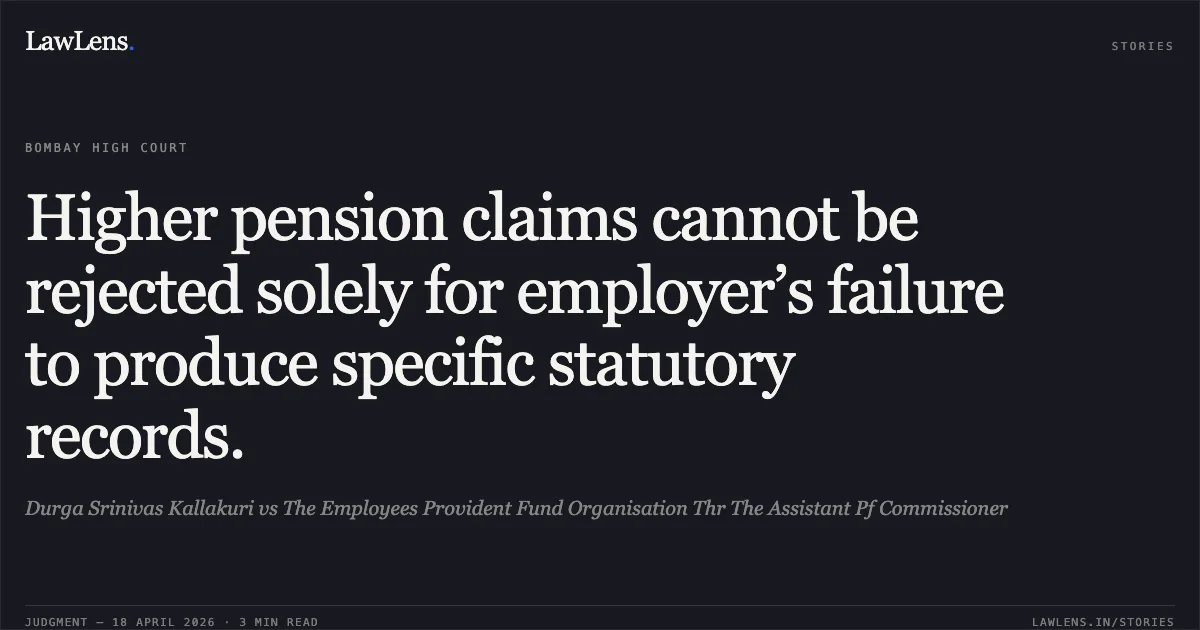
The court held that pension claims cannot be rejected solely on the ground of non-production of Form 6A or challans by the employer, particularly for the pre-2010 period
Source reference: para. 28(iii)The matters were remanded to the respondent authority for fresh consideration within twelve weeks
Source reference: para. 28(ii), (vii)The EPFO was directed to verify the claims using its own internal records and any other corroborative material; if contributions on higher wages are established, the claims must be processed subject to the deposit of differential contributions and interest
Source reference: para. 28(iv), (v)The EPFO was ordered to pass reasoned, speaking orders for each application
Source reference: para. 28(viii)Acts & Sections Cited
4 provisions across 3 statutes referred to in this judgment. Linked provisions open on LawLens.
Employees’ Provident Funds And Miscellaneous Provisions Act, 19521
Employees1
Employees2
Original Court PDF
Durga Srinivas KallakurivsThe Employees Provident Fund Organisation Thr The Assistant Pf Commissioner
Click to open original judgment
Original judgment, available to read, download and summarize on LawLens.in


