Facts
The Uttarakhand Board of Technical Education issued an advertisement on February 8, 2014, for the post of Vyavasthapak (Manager) in the Government Estate Department
Source reference: p. 1The essential qualifications prescribed were a Bachelor’s Degree and a Diploma in Catering and Hotel Management from a government-recognized institute
Source reference: p. 1The petitioners, who possessed Bachelor’s Degrees in Hotel Management but lacked the specific Diploma, had their candidatures rejected
Source reference: p. 1-2They approached the Court seeking a mandamus to consider them qualified, arguing that a degree is a higher qualification than a diploma and covers the same syllabus
Source reference: p. 2During proceedings, it was noted that the Recruitment Rules were amended in 2023 to include degree holders, but the petitioners’ selection process pertained to 2014
Source reference: p. 5Issues
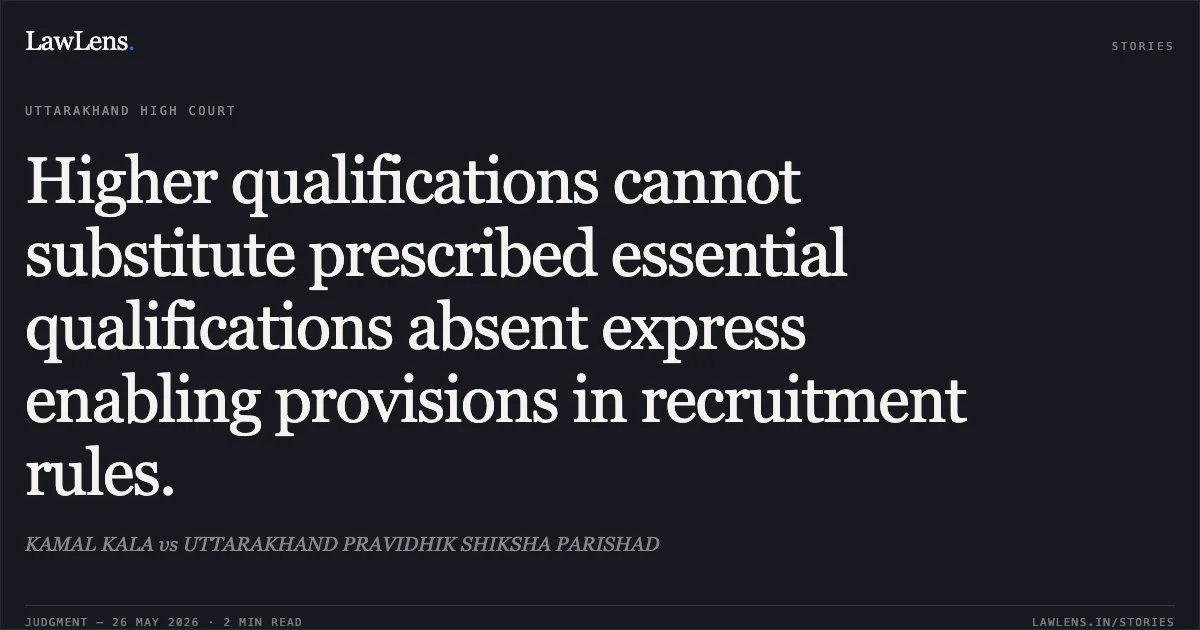
1. Whether a candidate possessing a higher qualification (Degree) can be considered eligible for a post where the Recruitment Rules specifically prescribe a lower qualification (Diploma) as the essential requirement
Source reference: p. 2-3 / para. 4-52. Whether a subsequent amendment to the Recruitment Rules (2023) can be applied retrospectively to a selection process initiated under old rules (2014)
Source reference: p. 5 / para. 11Law Applied
The State, as an employer, has the sole prerogative to prescribe eligibility qualifications; judicial review cannot be used to expand these criteria or declare equivalence between qualifications
Source reference: p. 3 / para. 5Higher qualifications do not automatically presuppose or replace mandatory lower qualifications unless the rules expressly permit such an inference (Himakshi v. Rahul Verma (2026 SCC OnLine 642) and Zahoor Ahmad Rather v. Sheikh Imtiyaz Ahmad)
Source reference: p. 3-4 / para. 7The "rules of the game" doctrine: eligibility must be determined based on the rules existing on the date of the advertisement and cannot be altered retrospectively (Tej Prakash Pathak v. High Court of Rajasthan [(2025) 2 SCC 1])
Source reference: p. 5-6 / para. 12Reasoning
Since the Recruitment Rules specifically recognized only a "Diploma" and were silent on "Bachelors Degrees," the Selecting Body could not broaden the eligibility criteria
Source reference: p. 3 / para. 6Determining the equivalence of two qualifications is a matter for subject experts and the State, not the Judiciary
Source reference: p. 3 / para. 5-6Without an enabling provision in the Rules, degree holders do not ipso facto become eligible for diploma-restricted posts
Source reference: p. 4 / para. 8-9Eligibility is fixed at the time of recruitment; allowing the amendment to apply retrospectively would violate Article 16 of the Constitution by depriving other potential candidates of equal opportunity who might have applied had the criteria been different in 2014
Source reference: p. 6 / para. 12Holding
The petitioners were ineligible as they did not possess the mandatory Diploma required by the 2014 advertisement and rules
The 2023 amendment could not apply to a 2014 selection process; consequently, the rejection of the petitioners' candidatures was upheld, and the writ petition was dismissed
Source reference: p. 5-6 / para. 11, 14Original Court PDF
KAMAL KALAvsUTTARAKHAND PRAVIDHIK SHIKSHA PARISHAD
Click to open original judgment
Original judgment, available to read, download and summarize on LawLens.in


![Subsequent exoneration does not retrospectively invalidate a finalized promotion select list.. UNNIKRISHNAN M vs M/o Environment And Forests. CAT - ['Ernakulam']. LawLens](/stories/thumbnails/subsequent-exoneration-does-not-retrospectively-invalidate-a-finalized-promotion-select-li-ce80a0e84f2f4887857271e8b4341c42.webp)