Facts
The applicant-wife challenged the judgment of the Principal Judge, Family Court, Surendranagar, dated 10.06.2020, which rejected her application for maintenance under Section 125 of the Code of Criminal Procedure (CrPC).
Source reference: para. 1The applicant married the respondent-husband on 02.05.2014; notably, this was her third marriage.
Source reference: para. 5Evidence revealed that the applicant suppressed her previous marriages and the receipt of ₹11.50 lakhs as permanent alimony from a prior settlement.
Source reference: para. 7During cross-examination, she admitted to holding an MBA degree and having previously earned ₹15,000 per month.
Source reference: para. 5The respondent-husband alleged that the applicant voluntarily deserted her matrimonial home and her two-and-a-half-year-old daughter to reside in Surendranagar.
Source reference: para. 5, 7Issues
1. Whether the Family Court erred in rejecting the maintenance application on the grounds that the applicant is highly educated and capable of self-support?
Source reference: para. 32. Whether the applicant is disentitled to maintenance under Section 125(4) of the CrPC due to voluntary desertion of the matrimonial home without sufficient reason?
Source reference: para. 6, 73. Whether the High Court should exercise its revisional jurisdiction to interfere with the factual findings of the Family Court?
Source reference: para. 8Law Applied
The court primarily applied Section 125 of the CrPC, specifically the proviso and sub-section (4), which mandates that a wife is not entitled to maintenance if she refuses to live with her husband without sufficient reason.
Source reference: para. 6The court further relied on the principles governing revisional jurisdiction under Sections 397 and 401 of the CrPC, as elucidated in Amit Kapoor v. Ramesh Chander & Anr. (2012) 9 SCC 460, which stipulates that findings of fact should not be disturbed unless they are found to be perverse, arbitrary, or suffer from non-compliance with the law.
Source reference: para. 8Reasoning
The Court observed that the Family Court had properly evaluated the evidence regarding the applicant’s conduct and financial capacity.
Source reference: para. 7Although the applicant initially suppressed her marital history and the ₹11.50 lakh alimony, these facts were established during cross-examination.
Source reference: para. 7Applying Section 125 CrPC, the Court noted that the applicant voluntarily left her matrimonial home and abandoned her minor child, thereby failing to establish "sufficient reason" for living separately.
Source reference: para. 7The Court highlighted that the applicant’s MBA qualification and prior work experience demonstrated her capability to maintain herself, which, coupled with her conduct, justified the denial of maintenance.
Source reference: para. 7, 9Under the limited scope of revisional jurisdiction, the Court found no palpable error or perversity in the lower court's reasoning that would warrant judicial interference.
Source reference: para. 8Holding
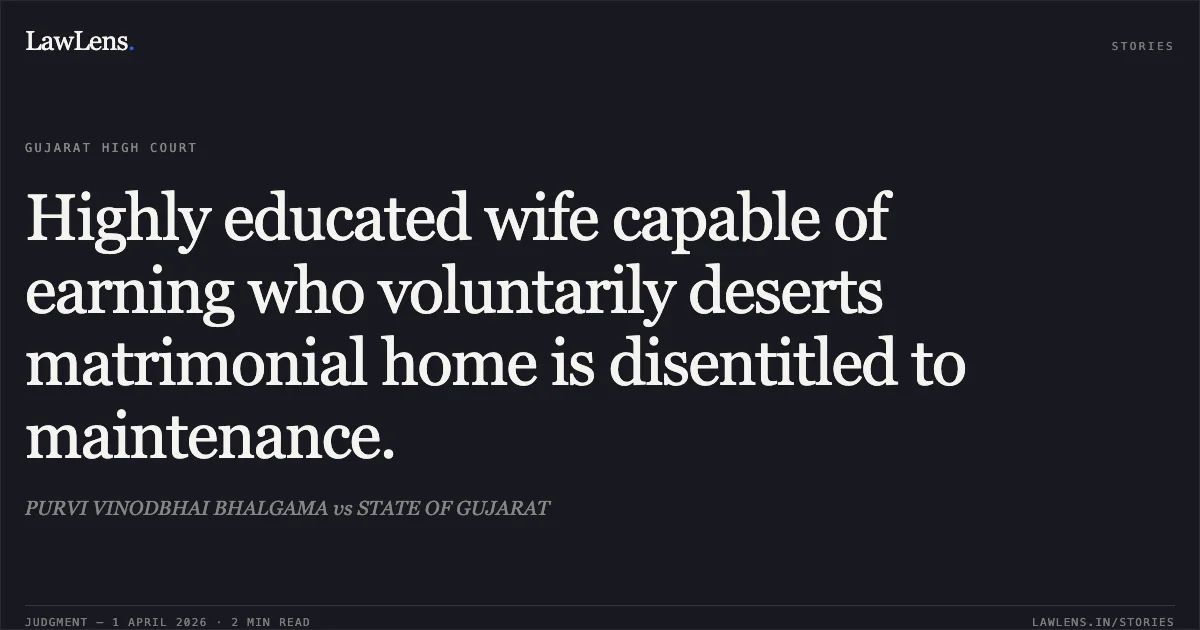
The High Court answered the issues in the negative, holding that the applicant was not entitled to maintenance due to her voluntary desertion and her capacity for self-support as an educated professional.
The Court affirmed that the Family Court’s decision was based on a sound appreciation of evidence and did not suffer from any legal infirmity.
Source reference: para. 10Consequently, the revision application was dismissed, and the rule was discharged.
Source reference: para. 10Acts & Sections Cited
4 provisions across 2 statutes referred to in this judgment. Each provision opens on LawLens.
Code of Criminal Procedure, 19733
Hindu Marriage Act, 19551
Original Court PDF
PURVI VINODBHAI BHALGAMAvsSTATE OF GUJARAT
Click to open original judgment
Original judgment, available to read, download and summarize on LawLens.in


