Facts
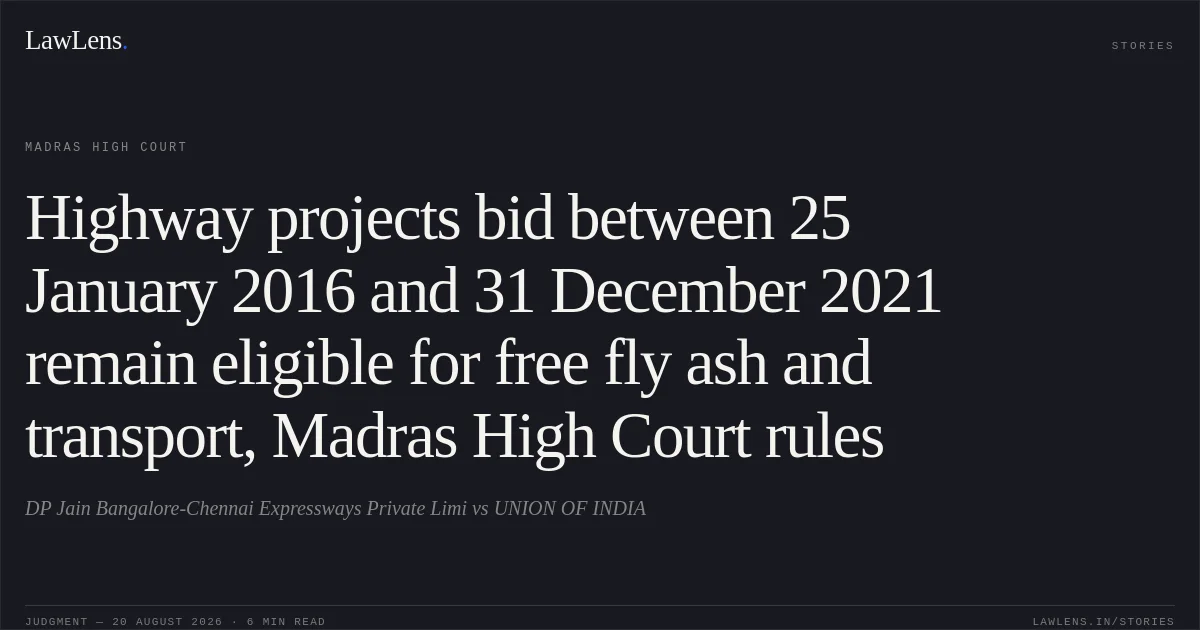
The appellants were concessionaires executing National Highway projects awarded by the National Highways Authority of India (“NHAI”). DP Jain Bangalore-Chennai Expressways Pvt. Ltd. was executing the Arakkonam–Kancheepuram section of the Bangalore–Chennai Expressway under a Letter of Award dated 16.09.2021 and Concession Agreement dated 04.02.2022; its associated thermal power plant (“TPP”) was Vallur Thermal Power Project operated by NTECL. DPJ Pollachi HAM Project Pvt. Ltd. was executing the Madathukulam–Pollachi section of NH-209 under a Letter of Award dated 13.02.2019 and Concession Agreement dated 05.12.2019; the relevant TPP was Mettur Thermal Power Station.
Source reference: paras. 3.1–3.2The appellants claimed entitlement to fly ash/pond ash free of cost and free of transportation under the environmental notifications issued from 1999 onwards, particularly for projects whose bid dates fell between 25.01.2016 and 31.12.2021. NHAI and the concerned TPPs disputed the claim, relying on the 31.12.2021 notification, the Ministry of Power Circular dated 22.02.2022, the absence of memoranda of understanding (“MoUs”), the contractual dispute-resolution mechanism, and the appellants’ alleged inclusion of earthwork costs in their bids.
Source reference: paras. 4–10The learned Single Judge dismissed both writ petitions on 15.10.2025, holding, inter alia, that the obligation to supply free fly ash was confined to the ten-year period under the 1999 notification, that the relevant costs had been built into the bids, and that the appellants had alternative contractual remedies. The appellants challenged that order in the present writ appeals.
Source reference: para. 6Issues
Whether the obligation to supply fly ash free of cost and free of transportation, originally introduced by the 14.09.1999 notification, survived beyond ten years and continued for projects whose bid due dates fell between 25.01.2016 and 31.12.2021.
Source reference: para. 11(i)Whether the appellants’ highway projects fell within the class of projects eligible for free fly ash and free transportation under the saved regime.
Source reference: para. 11(ii)Whether NHAI was bound by the position taken in its pleadings before the Punjab and Haryana High Court and the Supreme Court that such an obligation existed.
Source reference: para. 11(iii)Whether the absence of an MoU between NHAI and the concerned TPPs defeated the appellants’ entitlement.
Source reference: para. 11(iv)Whether the existence of an arbitration clause and the pendency of Dispute Resolution Board (“DRB”) proceedings rendered the writ petitions non-maintainable, particularly in light of State of U.P. v. Bridge & Roof Co. (India) Ltd.
Source reference: para. 11(v)Whether the appellants’ claims were barred by delay and laches.
Source reference: para. 11(vi)Whether grant of fly ash or reimbursement of the cost of borrow earth would result in unjust enrichment or double payment.
Source reference: para. 11(vii)Whether NTECL could be directed to supply ash free of cost despite its e-auction-based utilisation record, the absence of contractual privity, and the 31.12.2021 notification.
Source reference: para. 11(viii)What relief, if any, the appellants were entitled to.
Source reference: para. 11(ix)Law Applied
The Court applied the Environment (Protection) Act, 1986 and the Environment (Protection) Rules, 1986, under which the MoEF&CC issued the 14.09.1999 notification requiring thermal power plants to make ash available without charge for specified construction purposes for “at least ten years”; the 03.11.2009 amendment deleted the ten-year limitation and required pond ash to be made available free of charge to road-construction agencies; and the 25.01.2016 amendment required thermal power plants to bear transportation costs within a radius of 300 kilometres.
Source reference: paras. 4(i)–4(iii)The Court treated the 31.12.2021 notification as superseding the earlier regime prospectively, while recognising the saving and administrative continuation of eligibility for projects with bid dates between 25.01.2016 and 31.12.2021 through the Ministry of Power’s Minutes dated 14.06.2023 and OMs dated 26.06.2023 and 13.07.2023.
Source reference: paras. 4(v), 4(vii)–4(viii), 12.2–12.3It applied the doctrines of legitimate expectation and promissory estoppel based on consistent governmental representations.
Source reference: paras. 20.1–20.2It further relied on the principle that a State authority cannot approbate and reprobate, and that sworn admissions in pleadings may be relied upon in other proceedings, as recognised in Premlata v. Naseeb Bee and Basant Singh v. Janki Singh.
Source reference: paras. 14.1–14.2The Court distinguished Bridge & Roof by holding that arbitration is appropriate for contractual interpretation and quantification, but cannot determine the validity of statutory instruments or issue a mandamus against a non-signatory TPP.
Source reference: paras. 16.1–16.6Reasoning
The Court held that “at least ten years” in the 1999 notification prescribed a minimum period rather than a maximum period. More significantly, the 2009 amendment deleted the ten-year restriction and replaced it with an unqualified obligation to make pond ash available free of charge to road-construction agencies; the 2016 amendment added free transportation within the prescribed radius.
Source reference: paras. 12.1–12.2Although the 31.12.2021 notification formally superseded the earlier notification, the subsequent governmental minutes and OMs consistently preserved eligibility for projects whose bid dates fell between 25.01.2016 and 31.12.2021, thereby supporting both statutory continuity and legitimate expectation.
Source reference: para. 12.3Both projects fell within that period. The Pollachi project was specifically identified in the official list as eligible for 23,20,782 MT of fly ash from Mettur Thermal Power Station with free transportation. The Bangalore–Chennai project was recognised in NHAI’s records as falling within the eligible class, its bid due date being 05.01.2021.
Source reference: paras. 13.1–13.5NHAI’s contrary position in the present proceedings was rejected because its sworn pleadings in other proceedings affirmed the same obligation; the Court held that the absence of a final decision in those proceedings did not deprive the admissions of evidentiary value.
Source reference: paras. 14.2–14.5The Court further held that an MoU was merely a facilitative mechanism for coordinating supply and could not operate as a condition precedent to a statutory entitlement.
Source reference: paras. 15.1–15.2The writ petitions were therefore maintainable insofar as they sought a declaration regarding the statutory regime and relief against TPPs that were not parties to the concession agreements. However, quantification of reimbursement claims remained within the DRB/arbitration framework.
Source reference: paras. 16.1–16.6The Court also rejected the unjust-enrichment objection, distinguishing the contractual price for construction work from the actual cost of raw material used in construction.
Source reference: paras. 18.1–18.4The Court nevertheless declined to issue an unconditional mandamus against NTECL. Under the 31.12.2021 notification, free supply became operative where the TPP was otherwise unable to dispose of its ash and the requisite notice had been served. NTECL had demonstrated utilisation rates exceeding 100% through public e-auctions, and no equivalent official determination had specifically quantified NTECL’s obligation to the Bangalore–Chennai project.
Source reference: paras. 19.1–19.6Holding
The appeals were allowed in part and in part allowed with calibrated relief. The Court set aside the Single Judge’s finding that the free-fly-ash obligation was limited to ten years from 1999.
It declared that the Bangalore–Chennai Expressway project, having a bid due date of 05.01.2021, belonged to the eligible class entitled to free fly ash and free transportation; its monetary reimbursement claim was relegated to the DRB or, failing that, arbitration under Article 38 of the Concession Agreement.
Source reference: para. 23(i)The Pollachi appeal was allowed, and the project was declared eligible for 23,20,782 MT of fly ash free of cost and with free transportation from Mettur Thermal Power Station, with quantification of reimbursement for unavailable ash left to the DRB or arbitral tribunal.
Source reference: para. 23(ii)Non-execution of an MoU did not defeat either claim, but no unconditional mandamus was issued against NTECL; NHAI was directed to take up the matter afresh with NTECL/TANGEDCO and establish whether the statutory condition for free supply existed.
Source reference: paras. 19.5–19.6There was no order as to costs, and the connected miscellaneous petitions were closed.
Source reference: para. 23(iii)Acts & Sections Cited
4 provisions across 3 statutes referred to in this judgment. Each provision opens on LawLens.
Environment (Protection) Act, 19861
Arbitration and Conciliation Act, 19961
MP Land Revenue Code 19592
Original Court PDF
DP Jain Bangalore-Chennai Expressways Private LimivsUNION OF INDIA
Click to open original judgment
Original judgment, available to read, download and summarize on LawLens.in