Facts
The petitions, along with LPA No. 211 of 2025, were clubbed because they raised common questions concerning restoration of commuted pension.
Source reference: para. 1The petitioners were retired employees governed by the service rules adopted or framed by the State of Himachal Pradesh.
Source reference: para. 2Upon retirement, they voluntarily opted to commute a portion of their pension and received a lump-sum commuted value; their monthly pension was correspondingly reduced, subject to restoration of the commuted portion after fifteen years.
Source reference: para. 3The petitioners contended that, because the commuted amount was effectively recovered through deductions from pension within approximately 10–12 years, together with interest at 8% per annum, continued deduction until completion of fifteen years was excessive, arbitrary and amounted to unjust enrichment by the State.
Source reference: paras. 4, 16–23The State opposed the challenge, maintaining that commutation was voluntary, that the petitioners had accepted the fifteen-year condition with full knowledge, and that the scheme incorporated actuarial and mortality risks because no recovery was made from family members if a pensioner died before full recovery.
Source reference: paras. 24–28Issues
Whether Rule 10-A of the Central Civil Services (Commutation of Pension) Rules, 1981, prescribing restoration of the commuted portion of pension only after fifteen years, is arbitrary, unconstitutional or liable to be quashed merely because the commuted amount may be recovered through pension deductions within approximately 10–12 years.
Source reference: paras. 15–23, 40–44Whether the Court could direct immediate or proportionate restoration of full pension, or otherwise substitute the fifteen-year period with a shorter period on the basis of individual mathematical calculations concerning recovery, interest, commutation factors and life expectancy.
Source reference: paras. 40–44, 49–58Whether the State should be directed to constitute an Expert Committee to reconsider the commutation period in light of changed actuarial, economic and demographic circumstances.
Source reference: paras. 43–49, 52Law Applied
The Court applied Rules 5, 6, 8 and 10-A of the CCS (Commutation of Pension) Rules, 1981, under which a Government servant may voluntarily commute up to 40% of pension, the commutation becomes operative upon payment or credit of the commuted value, the lump sum is calculated using the prescribed commutation table, and the commuted portion is restored after fifteen years.
Source reference: paras. 11–15The Court held that commutation is not a loan or simple principal-recovery transaction but an actuarially structured pension scheme accounting for mortality risk, interest, longevity, public finances and the possibility that the State may be unable to recover the entire commuted amount upon the pensioner’s death.
Source reference: paras. 49–52It relied on Common Cause, A Registered Society v. Union of India, (1987) 1 SCC 142, which upheld the fifteen-year restoration period on a “years of purchase” and actuarial-equilibrium basis.
Source reference: para. 40It also relied on Forum of Retired IPS Officers v. Union of India, upheld by the Supreme Court, for the principle that pension and commutation tables are matters of economic and actuarial policy subject to limited judicial review.
Source reference: paras. 41–42The Court further considered Shila Devi v. State of Punjab, which rejected a similar challenge and held that courts should not interfere absent manifest arbitrariness or patent irrationality.
Source reference: para. 43The applicable standard was therefore whether the rule was ex facie arbitrary, discriminatory, irrational or constitutionally infirm, rather than whether an alternative actuarial or mathematical formula could be devised.
Source reference: paras. 56–63Reasoning
The Court rejected the petitioners’ premise that commutation operates like a loan whose only purpose is recovery of the lump sum paid.
Source reference: paras. 24–27, 49–52Although the petitioners demonstrated that, in individual cases, deductions could mathematically equal the commuted amount with interest before fifteen years, the Court held that such calculations ignored the broader actuarial structure of the scheme, including upfront payment, mortality risk, waiver of unrecovered amounts upon death and payment of family pension.
Source reference: paras. 24–27, 49–52The fifteen-year period had been retained through successive expert and Pay Commission assessments and had already been judicially accepted in Common Cause and subsequent decisions.
Source reference: paras. 34–37, 47–48Since the petitioners voluntarily accepted commutation and its statutory conditions, they could not retain the benefit of the lump-sum payment while challenging the accompanying restoration period.
Source reference: paras. 24–28, 62–70The Court further held that it could not replace the actuarial judgment of the rule-making authority with individual calculations or a judicially preferred formula in the absence of manifest arbitrariness, discrimination or patent irrationality.
Source reference: paras. 41–42, 56–61Nevertheless, recognising changes in the commutation factor, interest rates and life expectancy, the Court considered it appropriate for the State to examine the policy through an expert mechanism, while clarifying that no enforceable mandamus for such constitution was being issued.
Source reference: paras. 45–52Holding
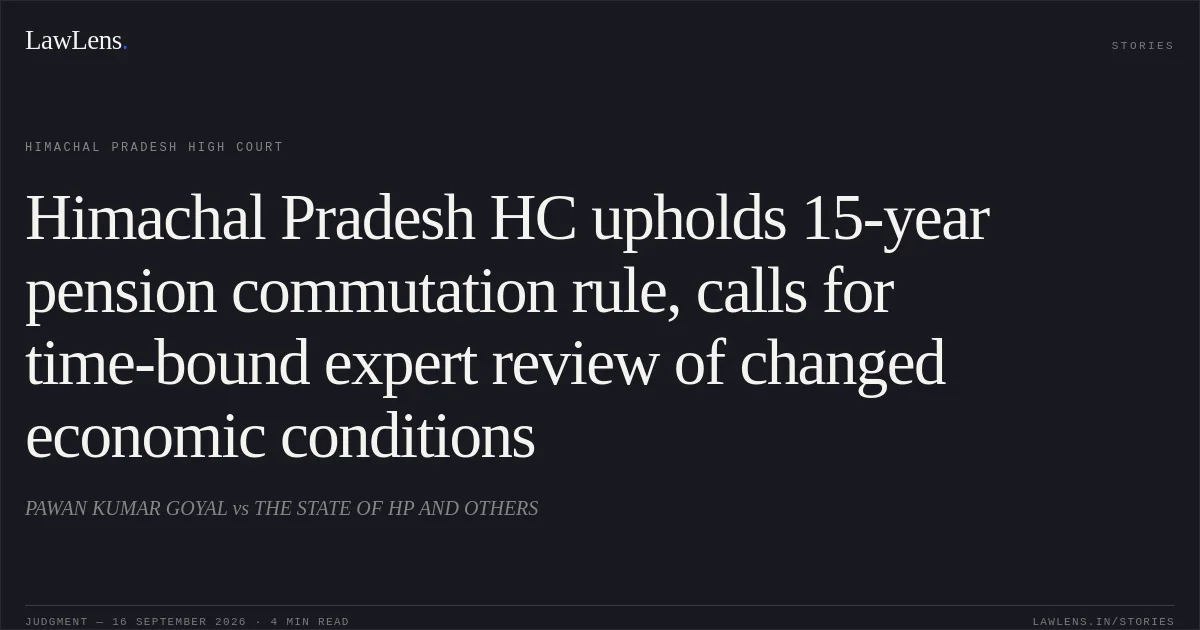
The Court upheld the validity and continued application of the fifteen-year restoration period under Rule 10-A and analogous pension provisions.
It declined to order immediate, proportionate or earlier restoration of the commuted pension, refund alleged excess recoveries, or interfere with the Single Judge’s decision in Rajinder Kumar Bhardwaj.
Source reference: paras. 49–51The Court observed that the State may constitute an Expert Committee, in consultation with pensioners, the Finance Department, Pay Commission, relevant departments and the Union Government, to examine changed circumstances and recommend any policy modifications; however, it declined to issue a specific mandamus directing such action.
Source reference: paras. 49–52All writ petitions and LPA No. 211 of 2025 were accordingly disposed of, with pending miscellaneous applications also disposed of.
Source reference: para. 53Original Court PDF
PAWAN KUMAR GOYALvsTHE STATE OF HP AND OTHERS
Click to open original judgment
Original judgment, available to read, download and summarize on LawLens.in