Facts
The State appealed the Special Judge’s judgment acquitting Desh Raj of offences under Sections 363 and 376(2)(n) IPC and Section 5(1) read with Section 6 of the POCSO Act.
Source reference: paras. 1–2, 9The prosecution alleged that the accused took the 16½-year-old prosecutrix from her home on 28 June 2015 and repeatedly sexually assaulted her before she returned to her family on 1 July 2015.
Source reference: paras. 3(a)–(b), 25Her father complained to police on 20 July 2015.
Source reference: paras. 3(a)–(b), 25The High Court reviewed the prosecutrix’s testimony, her Section 164 CrPC statement, the evidence of her parents, and the medical and forensic material.
Source reference: paras. 50–55, 67–69Issues
Whether the trial court’s acquittal was a reasonable view of the evidence, or should be reversed on appeal.
Source reference: paras. 16–22Whether the prosecutrix’s testimony, considered with her prior statement and the other evidence, proved kidnapping and repeated penetrative sexual assault beyond reasonable doubt.
Source reference: paras. 26, 50–56, 65–69Whether the POCSO Act’s statutory presumption applied on the facts as the High Court understood them.
Source reference: paras. 70–73Law Applied
On an appeal against acquittal, the appellate court may reappreciate the evidence but should not interfere where the trial court’s view is reasonably available on the record; acquittal strengthens the presumption of innocence, and reversal is warranted where the judgment is perverse or no reasonable view consistent with acquittal is possible (Muralidhar alias Gidda v. State of Karnataka; H.D. Sundara v. State of Karnataka; Surendra Singh v. State of Uttarakhand).
Source reference: paras. 17–22A prosecutrix’s credible testimony can, without corroboration, sustain a conviction, but material contradictions or improbabilities may make it unsafe to rely on her evidence; the prosecution must prove every ingredient beyond reasonable doubt.
Source reference: paras. 28–46The Court also considered the law on kidnapping from lawful guardianship and inducement, including Sections 361 and 363 IPC and S. Varadarajan v. State of Madras and Thakorlal D. Vadgama v. State of Gujarat.
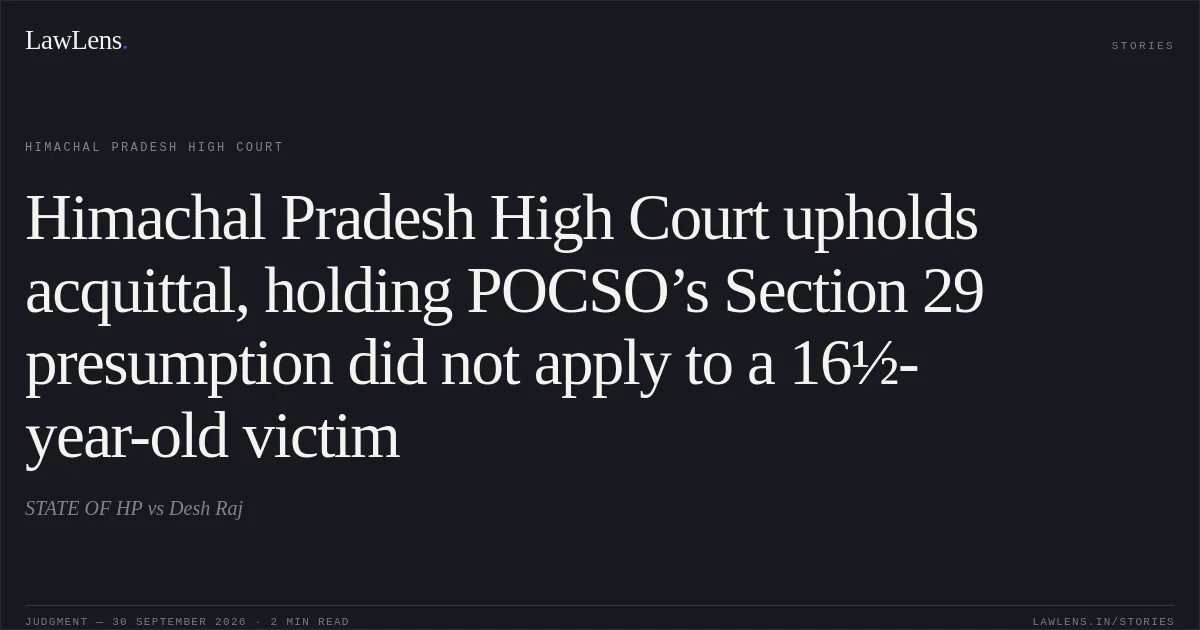
Source reference: paras. 56–64As to Section 29 of the POCSO Act, the judgment stated that the presumption did not apply because the prosecutrix was 16½ years old.
Source reference: paras. 70–73Reasoning
The High Court found material differences between the prosecutrix’s trial testimony and her Section 164 CrPC statement concerning the alleged assault and the parties’ movements.
Source reference: paras. 51–54It also noted that her father’s account included an allegation of a second kidnapping not forming part of the prosecution case, and that the delay in reporting the matter was not adequately explained.
Source reference: para. 55Her account that she travelled with the accused to several places by public transport without resistance or contacting her parents was treated as supporting the trial court’s view on whether she had been taken or induced to leave.
Source reference: paras. 65–66The medical evidence showed no recent injuries, while the medical and forensic reports did not corroborate the alleged assaults.
Source reference: paras. 67–69Considering these matters together, the Court held that the trial court’s assessment was a possible view and that the prosecution had not proved its case beyond reasonable doubt.
Source reference: para. 74Holding
The High Court declined to disturb the acquittal, finding no basis to reverse the trial court’s reasonable assessment of the evidence.
The State’s appeal was disposed of, and the accused was directed to furnish bonds under Section 437-A CrPC.
Source reference: paras. 75–77Acts & Sections Cited
23 provisions across 4 statutes referred to in this judgment. Each provision opens on LawLens.
Indian Penal Code, 18606
Protection of Children from Sexual Offences Act, 2012
Code of Criminal Procedure, 19736
Bharatiya Nagarik Suraksha Sanhita, 20231
Original Court PDF
STATE OF HPvsDesh Raj
Click to open original judgment
Original judgment, available to read, download and summarize on LawLens.in