Facts
The petitioner filed a private complaint against 18 respondents alleging illegal allotment of government land through fabricated revenue records.
Source reference: para. 2On 26.05.2005, a Magistrate directed an investigation under Section 156(3) Cr.P.C.
Source reference: para. 2The police subsequently filed a Khatma (closure) report on 28.12.2013, concluding no offence was committed.
Source reference: para. 2On 23.03.2015, the Judicial Magistrate First Class (JMFC), Mauganj, rejected the closure report and ordered further investigation specifically regarding the seizure of revenue records and handwriting expert verification.
Source reference: para. 2The petitioner approached the High Court under Section 482 Cr.P.C. seeking a direction for the police to conduct the reinvestigation/further investigation and file a charge-sheet, alleging that the police had failed to comply with the Magistrate's directions for several years.
Source reference: para. 1, 3Issues
Whether the High Court should exercise its inherent jurisdiction under Section 482 Cr.P.C. to direct the police to conduct a reinvestigation and file a charge-sheet when a Magistrate’s order for further investigation is already pending compliance.
Source reference: para. 5, 6Law Applied
The Court primarily applied Section 482 of the Code of Criminal Procedure, 1973, concerning the inherent powers of the High Court to prevent abuse of process or secure the ends of justice.
Source reference: para. 5It relied on the principle that the formation of an opinion under Section 173 Cr.P.C. regarding the filing of a charge-sheet is the exclusive domain of the investigating agency.
Source reference: para. 6The court applied the doctrine of "alternative remedy" and "supervisory jurisdiction," acknowledging that a Magistrate who passes an order under Section 156(3) Cr.P.C. retains the power to monitor compliance and ensure a fair investigation.
Source reference: para. 5, 7Reasoning
The Court reasoned that Section 482 Cr.P.C. cannot be invoked for the day-to-day supervision of an investigation or to dictate the final outcome (such as directing a charge-sheet) because the investigating agency must independently form its opinion based on collected material.
Source reference: para. 5, 6Since the Magistrate’s order dated 23.03.2015 directing further investigation was already in effect, the Magistrate possessed the necessary supervisory jurisdiction to ensure the police complied with said directions.
Source reference: para. 5The Court found that the petitioner failed to demonstrate any "extraordinary circumstance" that would justify the High Court bypassing the Magistrate's existing oversight.
Source reference: para. 7The petitioner’s grievance regarding police inaction was deemed a matter that should be addressed first by the Magistrate or through administrative representations to higher police officials rather than through inherent judicial powers.
Source reference: para. 5, 9Holding
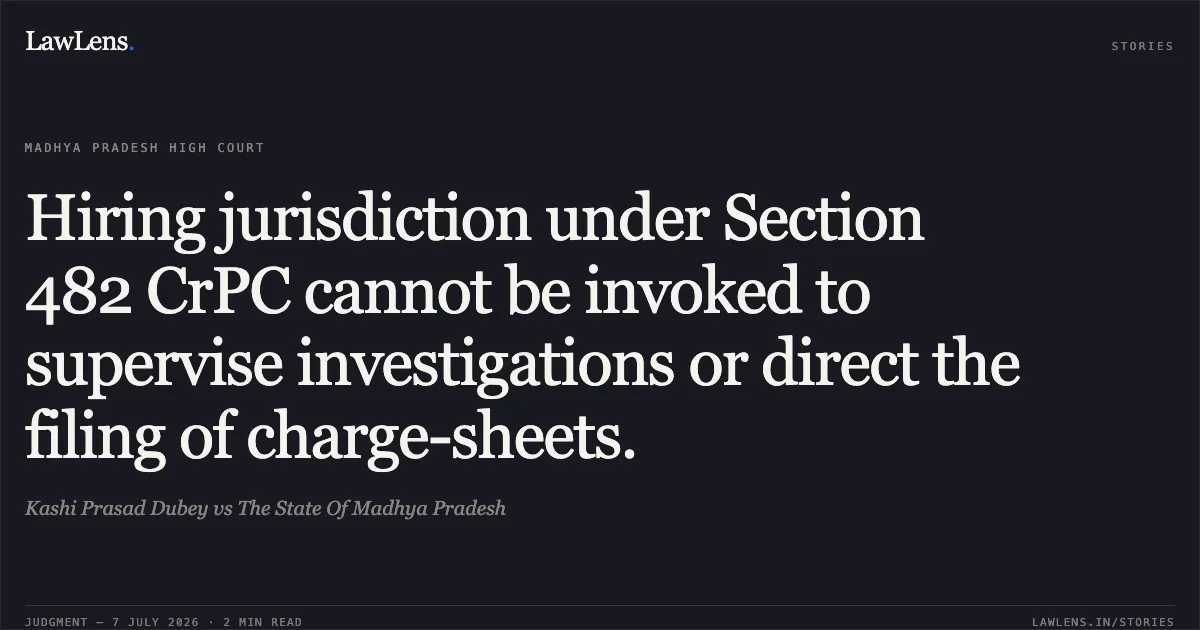
The High Court dismissed the petition, holding that it cannot direct the investigating agency to submit a charge-sheet.
The Court held that the petitioner’s appropriate remedy for non-compliance with the further investigation order lies with the Magistrate who is already seized of the matter.
Source reference: para. 5The Court granted the petitioner liberty to file a fresh representation before the Superintendent of Police, Rewa, for an expeditious investigation, which must be decided in accordance with the law.
Source reference: para. 9Acts & Sections Cited
24 provisions across 2 statutes referred to in this judgment. Each provision opens on LawLens.
Code of Criminal Procedure, 19733
Original Court PDF
Kashi Prasad DubeyvsThe State Of Madhya Pradesh
Click to open original judgment
Original judgment, available to read, download and summarize on LawLens.in


