Facts
The Borrower booked an apartment in the Builder’s Hyderabad project for approximately ₹2.31 crore and paid ₹51,11,576 from his own funds. The Bank sanctioned a ₹2 crore housing loan and disbursed ₹1,68,80,531 to the Builder in tranches under a tripartite arrangement.
Source reference: para. 3–9The Builder failed to deliver possession by the contractual deadline, despite receiving about 95% of the consideration. The Borrower paid a further ₹76,23,150 to the Bank, including interest and later repayments, and sought a refund, interest, rent reimbursement and compensation before the National Consumer Disputes Redressal Commission (“Commission”).
Source reference: para. 3–9The Commission ordered the Builder to refund the amount with 9% interest, found the Bank deficient in service and directed it to pay ₹2 lakh, but did not address the Borrower’s rent and compensation claims.
Source reference: para. 10The Borrower and the Bank appealed; the Builder did not challenge the Commission’s order and deposited the amount directed by it.
Source reference: para. 12, 15Issues
1. Whether the Borrower was entitled to a refund of the entire amount paid to the Builder, including loan proceeds disbursed by the Bank, and, if so, at what rate of interest.
Source reference: para. 20(a)2. Whether the Borrower was entitled to compensation, including reimbursement of claimed rent.
Source reference: para. 20(b)3. Whether the Bank was deficient in rendering service to the Borrower.
Source reference: para. 20(c)4. What relief, if any, the Bank was entitled to in these proceedings.
Source reference: para. 20(d)Law Applied
The Court applied the doctrine of unjust enrichment, reflected in Sections 64, 65, 70 and 72 of the Indian Contract Act, 1872, under which restitution restores a benefit to the person at whose expense it was received but does not permit a claimant to recover money that remains unpaid borrowed funds [*Mahabir Kishore v. State of Madhya Pradesh*, (1989) 4 SCC 1; *Mafatlal Industries Ltd. v. Union of India*, (1997) 5 SCC 536].
Source reference: para. 23–28Clause 24 of the Agreement for Sale provided for a 12% rate upon delay and, on termination, refund with simple interest at 12% per annum.
Source reference: para. 29–31Under Sections 14(1)(d) and 22 of the Consumer Protection Act, 1986, compensation must correspond to proved loss or injury; interest and rent cannot both be awarded for the same deprivation, and compensation is not a windfall [*Ghaziabad Development Authority v. Balbir Singh*, (2004) 5 SCC 65; *DLF Homes Panchkula (P) Ltd. v. D.S. Dhanda*, (2020) 16 SCC 318].
Source reference: para. 34–40Section 73 of the Contract Act limits damages to loss naturally arising from breach, taking account of available means of remedying the resulting inconvenience.
Source reference: para. 40Section 2(1)(g) of the 1986 Act defines deficiency in service, and the complainant bears the initial burden of proving it [*Ravneet Singh Bagga v. KLM Royal Dutch Airlines*, (2000) 1 SCC 66].
Source reference: para. 42Reasoning
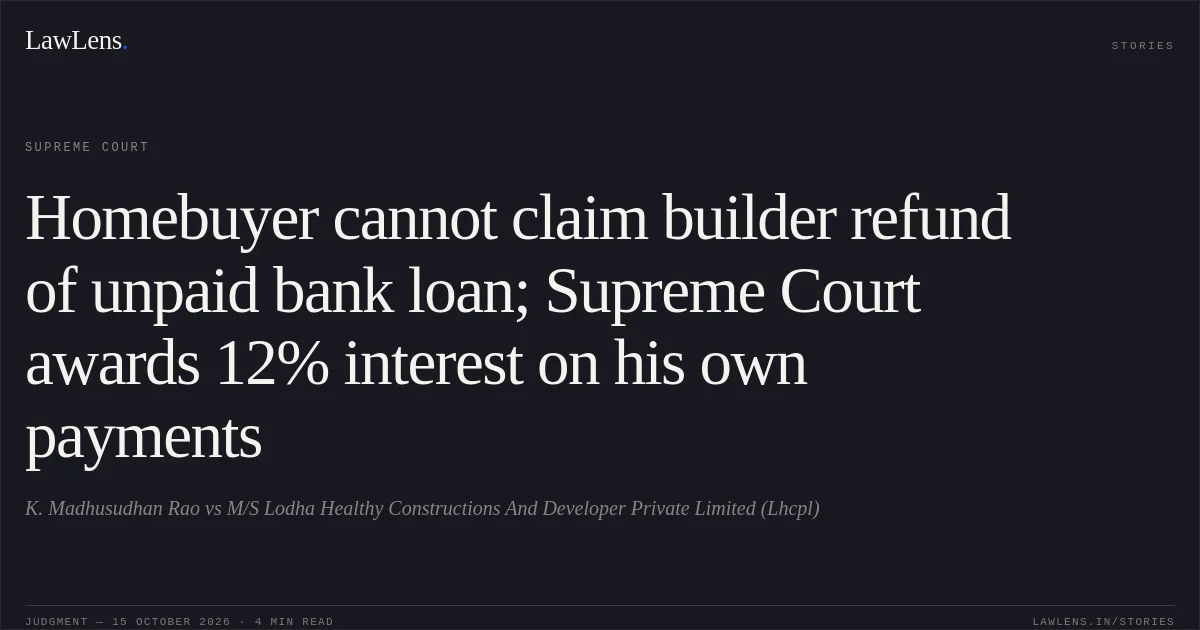
The Builder’s receipt of the consideration without delivering the apartment justified restitution, but the Borrower had personally paid only ₹1,27,34,726, including amounts paid directly to the Builder and the Bank. The remaining amount was unpaid loan money; the tripartite agreement’s deeming provision did not convert it into the Borrower’s own funds. A refund of that balance to the Borrower while the loan remained outstanding would unjustly enrich him. Clause 24 therefore supported 12% simple interest on the Borrower’s own payments from their respective dates.
Source reference: para. 27–32The Court declined the claimed rent: the claim had expanded beyond the complaint and lacked adequate supporting evidence; awarding rent in addition to interest would compensate twice for the same loss; and the Borrower elected to terminate and seek a refund. Nevertheless, given the prolonged deprivation of both the apartment and the Borrower’s money, the Court awarded ₹15 lakh as full and final compensation for rent, mental agony, harassment and litigation expenses.
Source reference: para. 35–41As to the Bank, the Borrower’s requests for construction-progress verification discharged his initial burden. The Bank produced no inspection reports despite asserting that inspections had occurred; the Court therefore upheld the finding of deficiency and the ₹2 lakh award.
Source reference: para. 43–44The Bank’s recovery claim was left for determination in its pending appeal before the High Court.
Source reference: para. 45Holding
The appeals were disposed of and the Commission’s order modified. The Commission was directed to release to the Borrower ₹1,27,34,726 with simple interest at 12% per annum from the respective dates of deposit until payment, and a further ₹15 lakh in compensation within one month.
The remaining deposited amount was to be kept in an interest-bearing account pending the Bank’s appeal; the High Court was directed to decide that appeal on its own merits, without being influenced by the Supreme Court’s observations.
Source reference: para. 47(iii)–(iv)The Bank’s deficiency finding and the ₹2 lakh award against it were upheld.
Source reference: para. 44Acts & Sections Cited
8 provisions across 1 statute referred to in this judgment. Each provision opens on LawLens.
Indian Contract Act, 18728
Original Court PDF
K. Madhusudhan RaovsM/S Lodha Healthy Constructions And Developer Private Limited (Lhcpl)
Click to open original judgment
Original judgment, available to read, download and summarize on LawLens.in