Facts
The appellant, Md. Saheb, was accused of committing rape on his 13-year-old minor daughter on September 24, 2010.
Source reference: para. 4The informant (appellant's wife/P.W.4) alleged that she found her daughter unconscious and saw the appellant hiding.
Source reference: para. 4She further alleged that on September 28, 2010, the appellant attempted to assault the minor again, leading to his capture by villagers.
Source reference: para. 4During the trial, all eight material witnesses—including the victim and the informant—turned hostile and denied the allegations.
Source reference: paras. 9, 13, 15The trial court convicted the appellant under Section 376 of the IPC, sentencing him to 10 years of Rigorous Imprisonment, relying on the victim's statement recorded under Section 164 Cr.P.C. before a Magistrate (Ext. 7) and medical evidence (Ext. 6).
Source reference: para. 2Issues
1. Whether a conviction under Section 376 IPC can be sustained based on a Section 164 Cr.P.C. statement and medical evidence when the victim and all material witnesses have turned hostile.
Source reference: para. 172. Whether the medical findings of healed hymenal tears and genital conditions consistent with sexual intercourse provide sufficient corroboration to electronic or oral testimony in child rape cases.
Source reference: paras. 15, 25Law Applied
Section 376 of the IPC regarding the punishment for rape.
Source reference: para. 11A statement under Section 164 Cr.P.C. cannot be discarded merely because a witness retracts it, as it carries judicial satisfaction, as established in Vijaya Singh & Anr. v. State of Uttarakhand (2024).
Source reference: para. 18The principle regarding the heightened duty of courts to protect children in sexual abuse cases as cited in State of Rajasthan v. Om Prakash (2002) and Pradeep v. State of Haryana (2023).
Source reference: paras. 20-21The principle that a prosecutrix turning hostile is not fatal if other evidence establishes guilt and that a victim's reliable testimony requires no further corroboration, as per Hemudan Nanbha Gadhvi v. State of Gujarat (2019) and Ganesan v. State (2020).
Source reference: paras. 22-23Reasoning
The Court observed that while Section 164 Cr.P.C. statements are not substantive evidence on their own, they are crucial for corroboration when family members retract allegations due to social pressure or dependency.
Source reference: para. 17The Court found that the victim's statement before the Magistrate (Ext. 7) was recorded after due caution and explicitly detailed the rape.
Source reference: para. 16This "initial disclosure" was bridged by the "unimpeachable scientific evidence" of the medical report (P.W. 8), which found healed hymenal tears and a genital condition consistent with penetration.
Source reference: para. 25The Court reasoned that the hostility of the witnesses (P.W. 1-6) was a result of family pressure and could not outweigh the judicial statement and objective forensic findings.
Source reference: paras. 15, 19The court held that the trial judge's duty is heightened in child abuse cases to ensure that "perverse lust" does not go unpunished due to witness intimidation.
Source reference: para. 20Holding
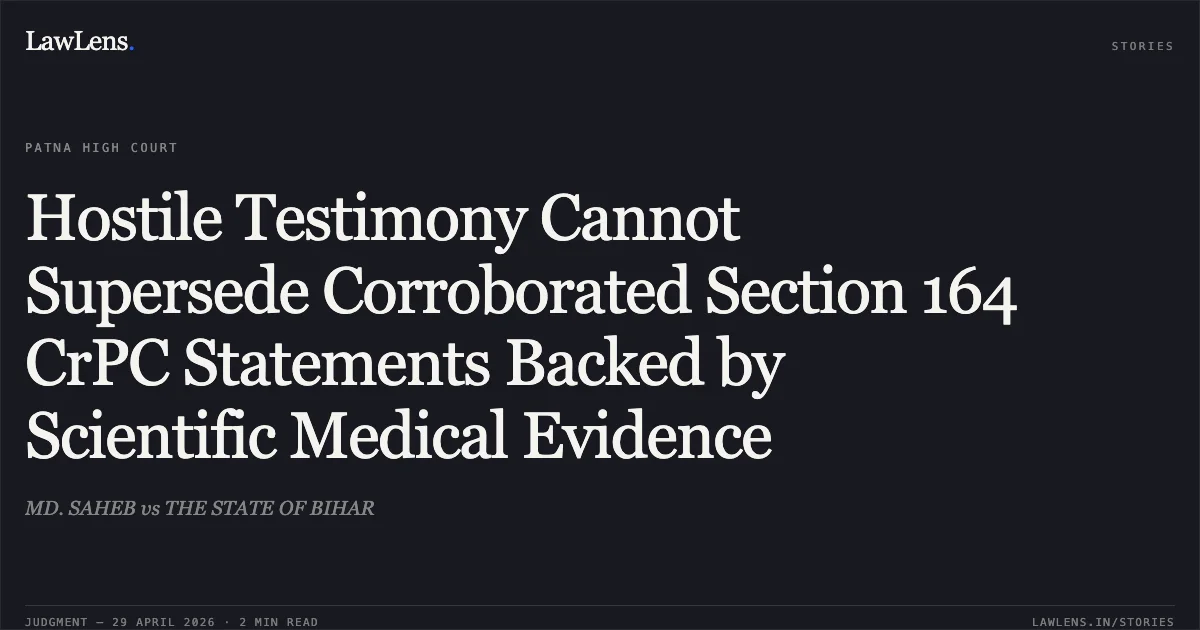
The judicial statement under Section 164 Cr.P.C., corroborated by medical evidence, is sufficient to sustain a conviction despite witnesses turning hostile.
The High Court upheld the judgment of conviction and the order of sentence (10 years RI) passed by the Additional Session Judge, Darbhanga; the appeal was dismissed, and the appellant was directed to be taken into custody forthwith.
Source reference: paras. 28, 29-30Acts & Sections Cited
1 provisions across 1 statute referred to in this judgment. Each provision opens on LawLens.
Indian Penal Code, 18601
Original Court PDF
MD. SAHEBvsTHE STATE OF BIHAR
Click to open original judgment
Original judgment, available to read, download and summarize on LawLens.in


