Facts
The State filed an appeal against a February 2023 judgment from the Special Judge (POCSO), Waraseoni, which acquitted the respondent of charges involving the outraging of a minor's modesty
Source reference: para. 1The incident allegedly occurred in July 2020, when the respondent purportedly dragged the victim into a room and molested her while her mother was away
Source reference: para. 2Following an investigation and trial, the lower court found the evidence insufficient for conviction
Source reference: para. 6The State sought leave to appeal, arguing that minor discrepancies in witness testimonies should not have resulted in an acquittal
Source reference: para. 7Issues
1. Whether the delay of 39 days in filing the appeal should be condoned
Source reference: para. 12. Whether the State should be granted leave to appeal the judgment of acquittal under Section 378 of the Cr.P.C. based on the evidence provided
Source reference: para. 13. Whether the trial court’s decision to acquit the respondent was perverse or legally implausible given the testimony of the prosecution witnesses
Source reference: para. 11Law Applied
The court applied the statutory requirements for condoning delays and the standards for granting leave to appeal under Section 378 of the Code of Criminal Procedure
Source reference: para. 1Indian Penal Code (Sections 354 and 354-K) and Section 8 of the Protection of Children from Sexual Offences (POCSO) Act
Source reference: para. 1H.D. Sundara v. State of Karnataka (2023), Babu Sahebagouda Rudragoudar v. State of Karnataka (2024), and Mallappa v. State of Karnataka (2024): These cases establish that if a trial court's view is legally plausible, an appellate court cannot overturn an acquittal simply because an alternative view exists.
Source reference: para. 12, para. 13, para. 14Reasoning
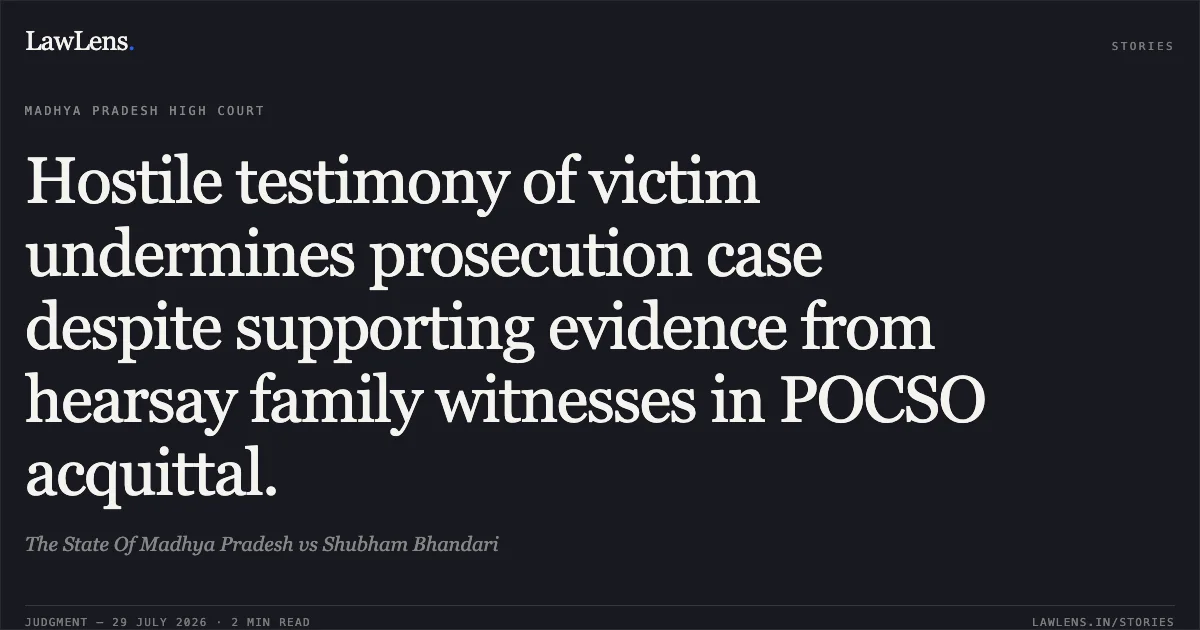
The High Court observed that the most critical witness, the prosecutrix, turned hostile and explicitly denied that any offence occurred, citing family rivalry as a potential motive for the initial complaint
Source reference: para. 9While family members of the victim supported the prosecution's narrative, the court found their testimonies to be hearsay or secondary, as none were eyewitnesses to the alleged event
Source reference: para. 10-11Furthermore, the court noted significant contradictions and variations in the parents' statements
Source reference: para. 11Applying the principles from the cited Supreme Court rulings, the court reasoned that the trial court’s decision to acquit was a "possible view" based on the evidence. Since the prosecution failed to prove the case beyond a reasonable doubt and no patent perversity was found in the lower court's judgment, interference was not warranted
Source reference: para. 15Holding
The Court allowed the application for condonation of delay but dismissed the application for leave to appeal
An acquittal will not be disturbed in appeal unless the trial court's findings are found to be perverse, illegal, or completely unsupported by the evidence on record; Consequently, the criminal appeal was dismissed
Source reference: para. 14-15, 16Acts & Sections Cited
4 provisions across 3 statutes referred to in this judgment. Each provision opens on LawLens.
Code of Criminal Procedure, 19732
Indian Penal Code, 18601
Protection of Children from Sexual Offences Act, 20121
Original Court PDF
The State Of Madhya PradeshvsShubham Bhandari
Click to open original judgment
Original judgment, available to read, download and summarize on LawLens.in