Facts
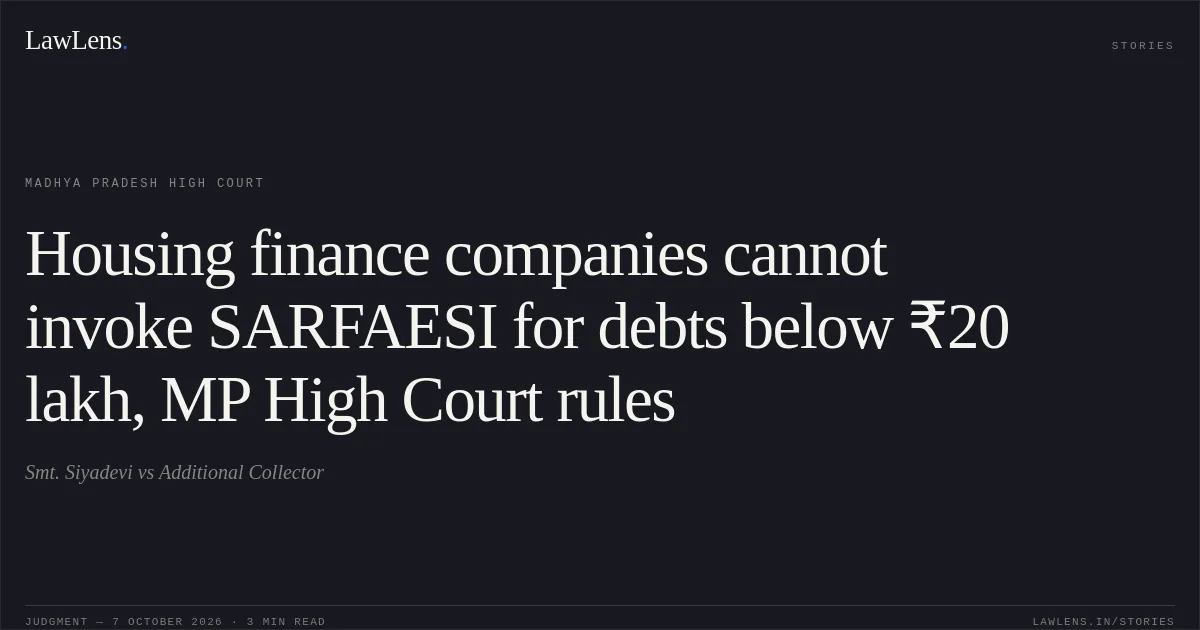
The petitioner claimed ownership of a residential property in Gohad, Bhind, which she mortgaged as co-borrower for a housing loan of ₹9,79,992 sanctioned to her son in January 2018.
Source reference: pp. 2–3, 5Following default, the lender classified the account as an NPA and issued a fresh notice under Section 13(2) of the SARFAESI Act on 18 October 2023, demanding ₹8,99,581.
Source reference: pp. 2–3, 5It later claimed symbolic possession and sought assistance under Section 14; the Additional Collector directed the Tehsildar to take physical possession.
Source reference: pp. 2–3, 5The petitioner challenged the demand notice, Section 14 order and consequential possession notice, arguing principally that the debt was below the ₹20 lakh threshold applicable to the lender as an HFC/NBFC.
Source reference: pp. 2–3, 5Issues
Whether the ₹20 lakh threshold prescribed by the Central Government’s SARFAESI notifications applied to the respondent Housing Finance Company, preventing it from invoking the Act for a secured debt below that amount.
Source reference: pp. 6–10Whether the availability of a remedy under Section 17 of the SARFAESI Act barred the petitioner’s writ petition challenging the secured creditor’s jurisdiction to invoke the Act.
Source reference: p. 6Whether the Additional Collector was competent to exercise powers under Section 14, and whether the absence of notice to the petitioner invalidated the possession proceedings.
Source reference: pp. 4–5, 11–12Law Applied
Section 2(1)(m)(iv) of the SARFAESI Act permits the Central Government to specify institutions as financial institutions for the Act; the notifications dated 24 February 2020 and 12 February 2021 prescribed, respectively, ₹50 lakh and ₹20 lakh thresholds for the relevant classes of NBFCs.
Source reference: pp. 6–7The Court considered the RBI’s subsequent regulatory framework, including the 2023 Scale Based Regulation, which placed HFCs within the NBFC regulatory framework while retaining specific HFC directions.
Source reference: pp. 7–10Under Godrej Sara Lee Ltd. v. Excise and Taxation Officer-cum-Assessing Authority, an alternative remedy is not an absolute bar where the challenge raises a foundational question of jurisdiction.
Source reference: p. 6Under M/s R.D. Jain & Co. v. Capital First Ltd., an Additional District Magistrate may exercise Section 14 powers where statutory requirements for delegation or exercise of powers are satisfied.
Source reference: p. 11The Court considered Virendra Rathore v. Tehsildar, which held the NBFC threshold inapplicable to HFCs under the regulatory framework then considered, and the later decisions in Piramal Capital & Housing Finance Ltd. v. Golam Sabir and Gupta Hardware Store v. Union of India, which supported applying the ₹20 lakh threshold in light of the relevant notifications and regulatory framework; it also noted the contrary view in Prabhakaran v. Hinduja Housing Finance.
Source reference: pp. 7–10Reasoning
The Court treated the lender’s authority to invoke SARFAESI as a jurisdictional question and therefore declined to regard Section 17 as an absolute bar to the writ petition.
Source reference: p. 6It distinguished Virendra Rathore on the ground that the case before it included the subsequent RBI regulatory framework, and relied on Piramal Capital’s consideration of that framework to conclude that the ₹20 lakh threshold applied to the respondent HFC.
Source reference: pp. 7–10The demand notice claimed ₹8,99,581, and the later amount referred to in the proceedings was ₹11,34,396; both were below the threshold.
Source reference: pp. 10–11, 13The Court accordingly held that the secured creditor lacked authority to initiate the SARFAESI measures in this case, rendering the Section 13(2) notice and consequential Section 13(4) and Section 14 proceedings unsustainable.
Source reference: pp. 10–11, 13It did not finally determine the Additional Collector’s competence or the natural-justice challenge, because the threshold ruling disposed of the matter.
Source reference: pp. 11–12Holding
The Court held that the SARFAESI proceedings could not be sustained because the secured debt was below the applicable ₹20 lakh threshold.
It quashed the Section 13(2) demand notice dated 18 October 2023, the consequential measures under Section 13(4), the Section 14 order dated 8 April 2026, and the consequential possession notice.
Source reference: pp. 13–14The petition was allowed, without costs, while leaving the respondent free to pursue other remedies available in law, subject to the petitioner’s and other parties’ rights and defences.
Source reference: pp. 14–15Acts & Sections Cited
5 provisions across 2 statutes referred to in this judgment. Each provision opens on LawLens.
Securitisation and Reconstruction of Financial Assets and Enforcement of Security Interest Act, 20024
National Housing Bank Act, 19871
Original Court PDF
Smt. SiyadevivsAdditional Collector
Click to open original judgment
Original judgment, available to read, download and summarize on LawLens.in