Facts
The petitioner approached the High Court seeking partial quashing of FIR No. RC0482025S0013, registered by the Central Bureau of Investigation (CBI) under Sections 61(2), 143, and 318 of the Bharatiya Nyaya Sanhita, 2023
Source reference: p. 1The FIR alleged a human trafficking and cheating racket where young Indians were induced to pay substantial sums—Rs. 25,00,000/- in the complainant's case—on the false promise of work visas in the USA.
Source reference: p. 2Instead, victims were moved through illegal "Dunki routes" via Egypt and Nicaragua; the complainant was ultimately apprehended at the US border and deported.
Source reference: p. 2The petitioner sought quashing based on a "Panchayati Compromise Deed" dated 28.03.2026 executed with the complainant, arguing that the dispute was settled and he only provided legitimate travel services.
Source reference: p. 3The CBI opposed the petition, contending that the matter involved a serious organized crime with broad societal impact rather than a private dispute.
Source reference: p. 3Issues
1. Whether the High Court should exercise its inherent jurisdiction under Section 528 of the Bharatiya Nagarik Suraksha Sanhita, 2023 (BNSS) to quash an FIR involving allegations of human trafficking and organized cheating based on a private settlement between the accused and the victim
Source reference: p. 3, 8Law Applied
The Court applied Section 528 of the BNSS (corresponding to Section 482 of the CrPC) regarding the inherent powers of the High Court
Source reference: p. 1It relied on the principles established in Gian Singh v. State of Punjab, which held that while private or commercial disputes may be quashed upon settlement, serious or heinous offences with a wider societal impact cannot be quashed merely because the parties settled
Source reference: p. 4The Court further applied the guidelines from Narinder Singh v. State of Punjab and Parbatbhai Aahir v. State of Gujarat, which mandate that the High Court must distinguish between cases of a "predominantly civil flavor" and those involving "mental depravity" or "societal interest"
Source reference: p. 5-7Finally, it cited Dinesh Sharma v. Emgee Cables & Communication Ltd. (2025) to emphasize that economic offences and organized crimes have wider ramifications on the country's systems and cannot be viewed lightly
Source reference: p. 8Reasoning
The Court rejected the petitioner’s argument that the settlement rendered the criminal proceedings a "futility."
Source reference: p. 8It observed that the allegations did not constitute a private commercial or mercantile dispute but involved an organized racket of human trafficking and cheating.
Source reference: p. 8The Court reasoned that such crimes exploit vulnerable individuals, placing them in "physical and legal peril," and thus have a significant impact on society at large.
Source reference: p. 8It noted that the "Dunki route" allegations signify organized criminal activity that transcends the individual grievances of the complainant.
Source reference: p. 8Applying the Parbatbhai Aahir test, the Court found that the overriding element of public interest in punishing human trafficking outweighs any private compromise.
Source reference: p. 6Furthermore, the Court noted that the investigation was still ongoing and that the petitioner’s claims regarding the merits of the evidence were premature for adjudication at the quashing stage.
Source reference: p. 8Holding
The Court held that the facts and circumstances of the case did not warrant the exercise of inherent powers under Section 528 BNSS, as the offences were serious and affected societal interests beyond the immediate parties.
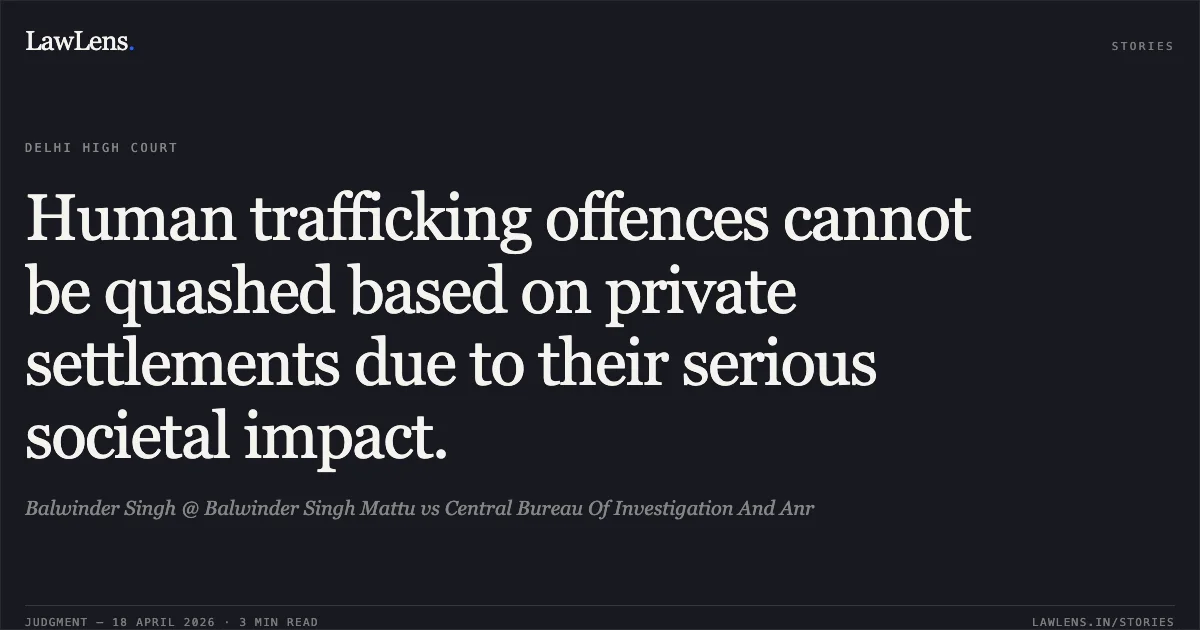
The High Court dismissed the petition for quashing the FIR.
Source reference: p. 10However, it clarified that all legal rights and remedies for the parties in the pending criminal proceedings remain open.
Source reference: p. 10Acts & Sections Cited
12 provisions across 4 statutes referred to in this judgment. Each provision opens on LawLens.
Bharatiya Nagarik Suraksha Sanhita, 20231
Code of Criminal Procedure, 19732
Bharatiya Nyaya Sanhita, 20233
Indian Penal Code, 18606
Original Court PDF
Balwinder Singh @ Balwinder Singh MattuvsCentral Bureau Of Investigation And Anr
Click to open original judgment
Original judgment, available to read, download and summarize on LawLens.in


![Subsequent exoneration does not retrospectively invalidate a finalized promotion select list.. UNNIKRISHNAN M vs M/o Environment And Forests. CAT - ['Ernakulam']. LawLens](/stories/thumbnails/subsequent-exoneration-does-not-retrospectively-invalidate-a-finalized-promotion-select-li-ce80a0e84f2f4887857271e8b4341c42.webp)