Facts
The appellant challenged Order-in-Appeal C.Cus.II No. 888/2015 dated 03.09.2015 concerning statutory customs dues.
Source reference: paras. 1–3During the pendency of the appeal, the Revenue informed the Tribunal that insolvency proceedings had been initiated against the appellant and that the NCLT had approved a resolution plan.
Source reference: paras. 1–3The Revenue thereafter produced the NCLT’s order dated 19.12.2023 in State Bank of India v. Reliance Communications Infrastructure Ltd., CP (IB) No. 3025/2019, approving the resolution plan submitted by Reliance Projects & Property Management Services Ltd. under Section 31(1) of the Insolvency and Bankruptcy Code, 2016 (IBC).
Source reference: para. 3The NCLT directed that the approved plan would be binding on the corporate debtor, its creditors, the Central Government, State Governments, local authorities, guarantors and other stakeholders.
Source reference: para. 4None appeared for the appellant when the appeal was called for hearing.
Source reference: para. 1Issues
1. Whether, after approval of a resolution plan under Section 31(1) of the IBC, proceedings concerning statutory customs dues could be initiated or continued if those dues were not included in the approved resolution plan.
Source reference: paras. 4–72. Whether the pending customs appeal could be continued in view of the binding effect and extinguishment principles applicable to claims under an approved resolution plan.
Source reference: para. 7Law Applied
The Tribunal applied Section 31(1) of the IBC, under which an approved resolution plan is binding on the corporate debtor, its employees, members, creditors, the Central Government, State Governments, local authorities, guarantors and other stakeholders.
Source reference: paras. 5–6It relied principally on Ghanashyam Mishra and Sons Pvt. Ltd. v. Edelweiss Asset Reconstruction Company Ltd., [2021] 13 S.C.R. 737, wherein the Supreme Court held that statutory dues owed to the Central Government, State Government or local authorities constitute operational debt and that such authorities are bound by an approved resolution plan.
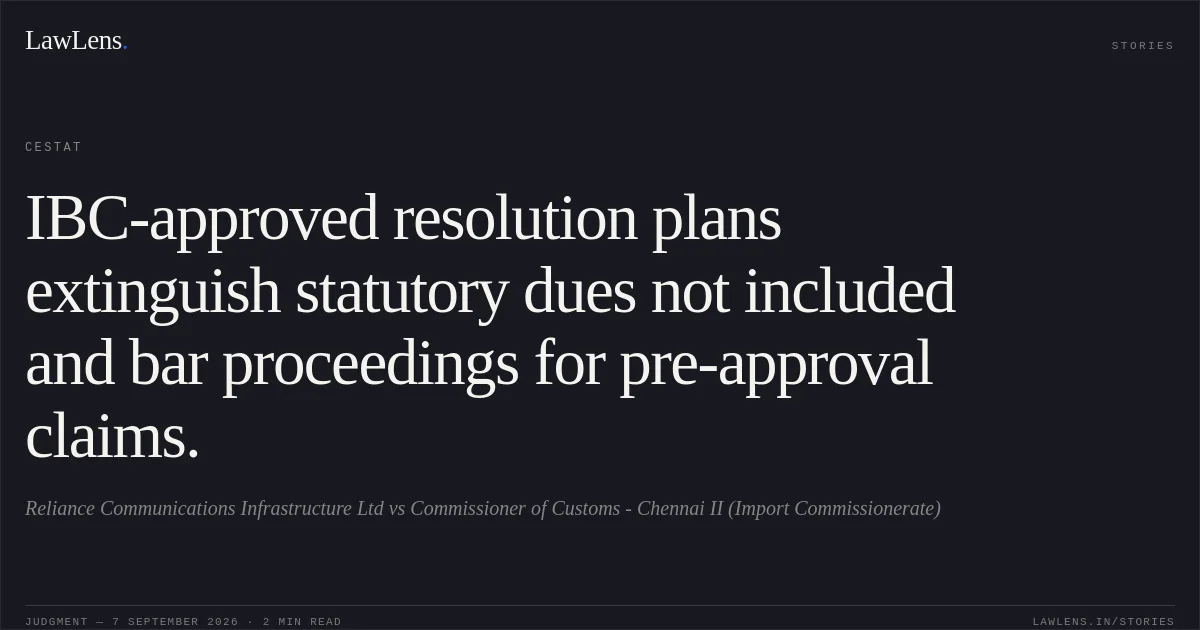
Source reference: paras. 5–6Claims not forming part of the approved plan stand extinguished, and no person may initiate or continue proceedings in respect of such claims for the period preceding approval of the plan under Section 31.
Source reference: paras. 5–6Reasoning
The NCLT had approved the resolution plan and expressly made it binding on governmental authorities and other stakeholders.
Source reference: paras. 3–4Applying the Supreme Court’s ruling in Ghanashyam Mishra, the Tribunal held that statutory customs dues were subject to the resolution-plan framework.
Source reference: para. 7Although the parties had not clarified whether the customs dues in dispute were specifically included in the resolution plan, the Supreme Court’s rule made clear that any pre-approval statutory dues not included in the plan stood extinguished and could not be the subject of continuing proceedings.
Source reference: para. 7Consequently, the Tribunal concluded that the pending customs appeal could not be continued before it.
Source reference: para. 7Holding
The Tribunal held that, following approval of the resolution plan under Section 31(1) of the IBC, claims not forming part of the plan could not be pursued or adjudicated in continuing proceedings.
The customs appeal was accordingly disposed of on that basis, without adjudication of the underlying customs dispute.
Source reference: para. 7Acts & Sections Cited
3 provisions across 1 statute referred to in this judgment. Each provision opens on LawLens.
Insolvency and Bankruptcy Code, 2016.3
Original Court PDF
Reliance Communications Infrastructure LtdvsCommissioner of Customs - Chennai II (Import Commissionerate)
Click to open original judgment
Original judgment, available to read, download and summarize on LawLens.in