Facts
Universal Textile Waterproof Co. (India), a partnership firm, borrowed ₹6 crore from NKGSB Co-operative Bank in 2012; its partners, Amrit Rajani and Pooja Rajani, guaranteed the facility.
Source reference: para. 1Following default, the Bank pursued SARFAESI proceedings and later sought arbitration under Section 84 of the Multi-State Co-operative Societies Act, 2002 (MSCS Act).
Source reference: para. 3The Central Registrar’s delegated authority appointed an arbitrator, whose appointment was subsequently revalidated for the Bank’s disputes.
Source reference: para. 7–11The firm and its partners separately petitioned to set aside the appointment and halt the arbitration, contending, among other things, that no notice under Section 21 of the Arbitration and Conciliation Act, 1996 (A&C Act) had been given and that the partners’ insolvency proceedings triggered an interim moratorium under Section 96 of the Insolvency and Bankruptcy Code, 2016 (IBC).
Source reference: para. 1, 3, 7–11The partners’ Section 95 IBC applications had been filed before the 2026 amendment to Section 96; the Court also considered the amendment’s effect on pending applications.
Source reference: para. 4, 25–27Issues
1. Whether arbitration under Section 84 of the MSCS Act could proceed without a prior notice invoking arbitration under Section 21 of the A&C Act
Source reference: para. 12, 16, 21–242. Whether the interim moratorium under Section 96 IBC barred arbitration against the partners as personal guarantors, including in light of the 2026 amendment to Section 96
Source reference: para. 25–273. Whether the arbitrator’s appointment for multiple disputes involving the Bank gave rise to disqualification or a legally sustainable apprehension of partiality
Source reference: para. 10–11, 28–29Law Applied
Section 84 of the MSCS Act requires specified disputes touching a multi-state cooperative society’s constitution, management or business—including claims for debts due to the society—to be referred to an arbitrator appointed by the Central Registrar; under Section 84(5), the A&C Act applies to the procedure except where the MSCS Act otherwise provides.
Source reference: para. 17–20Section 85 of the MSCS Act separately governs limitation for specified disputes.
Source reference: para. 17–20Section 21 A&C Act identifies when arbitral proceedings commence; applying Bhagheeratha Engineering Ltd. v. State of Kerala, (2026) 5 SCC 758, the Court held that a Section 21 notice is not a mandatory precondition to arbitration and its absence is not fatal where the claim is otherwise valid and arbitrable.
Source reference: para. 22–24Section 96 IBC ordinarily imposes an interim moratorium in relation to debts upon filing a Section 94 or 95 application, but Section 96(4), effective 26 May 2026, excludes applications for insolvency resolution of personal guarantors to corporate debtors; Tata Capital Financial Services Ltd. v. Neel Motors LLP & Ors. was followed in treating the amendment as applying prospectively to applications pending on its commencement date.
Source reference: para. 27The Court also relied on Kalpesh Shantikumar Mehta & Ors. v. NKGSB Co-op. Bank Ltd. & Anr. (CARBP 220/2022, 9 January 2023), which held that appointment by the statutory authority, rather than by a disputing party, does not attract the relevant appointment-based disqualification merely because the arbitrator handles multiple references for the Bank.
Source reference: para. 15, 28–29Reasoning
The Court treated Section 84 as a statutory reference mechanism under which covered disputes must be arbitrated by an arbitrator appointed by the Central Registrar.
Source reference: para. 20–24Because the MSCS Act provides its own limitation rules in Section 85 and Section 84(5) imports the A&C Act only subject to the MSCS Act, the Court rejected the argument that absence of a Section 21 notice prevented the arbitration from proceeding.
Source reference: para. 20–24As to the partners’ moratorium objection, the Court applied Section 96(4), as interpreted in Tata Capital, and concluded that the 2026 amendment covered applications already pending when it took effect; accordingly, Section 96’s interim-moratorium protection did not apply to the partners’ personal-guarantor proceedings.
Source reference: para. 27Finally, the arbitrator had been appointed from the statutory panel by the designated authority, not by the Bank itself.
Source reference: para. 28–29The Court therefore found that multiple appointments for Bank-related disputes did not, without more, establish disqualification under the applicable schedules of the A&C Act.
Source reference: para. 28–29Holding
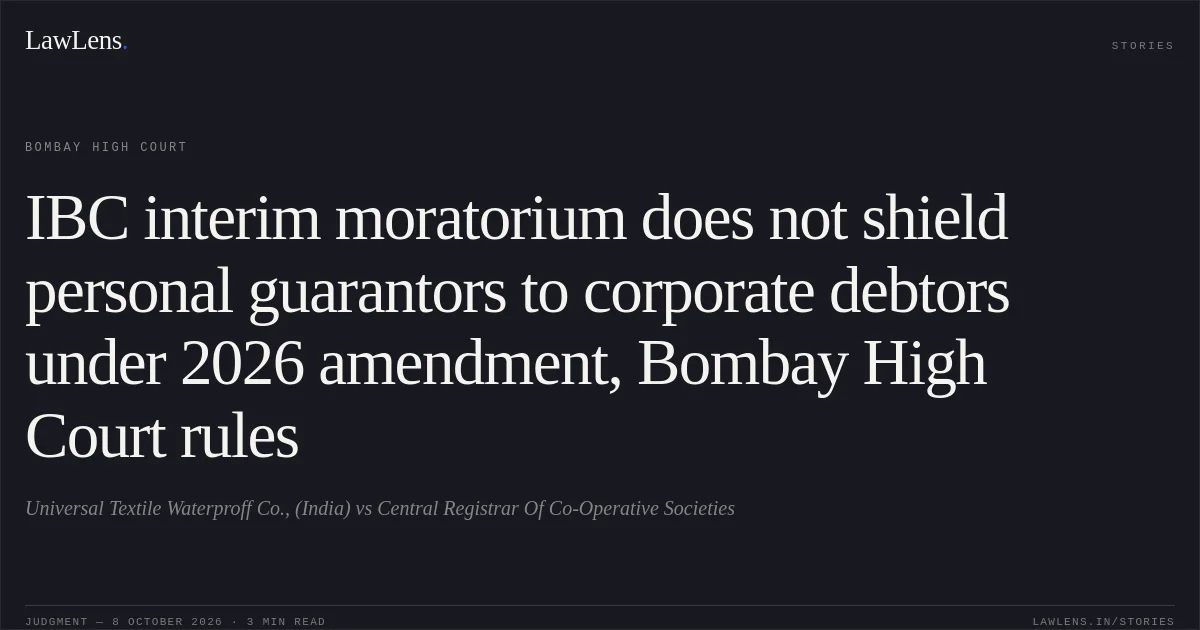
The Court answered the objections against the petitioners: a Section 21 notice was not a prerequisite to the statutory arbitration; Section 96 did not bar the proceedings against the partners as personal guarantors in light of Section 96(4); and the arbitrator’s multiple appointments did not establish disqualification.
Finding no merit in either petition, the Court dismissed both writ petitions, discharged the Rule and made no order as to costs.
Source reference: para. 30Acts & Sections Cited
16 provisions across 5 statutes referred to in this judgment. Each provision opens on LawLens.
Multi-State Co-operative Societies Act, 20023
Securitisation and Reconstruction of Financial Assets and Enforcement of Security Interest Act, 20023
Insolvency and Bankruptcy Code, 2016.5
Arbitration and Conciliation Act, 19964
Negotiable Instruments Act, 18811
Original Court PDF
Universal Textile Waterproff Co., (India)vsCentral Registrar Of Co-Operative Societies
Click to open original judgment
Original judgment, available to read, download and summarize on LawLens.in