Facts
The Plaintiff, a non-banking financial company, filed a summary suit to recover Rs. 203,66,31,506/- based on term loan facilities extended to Defendant No. 1 (Principal Borrower)
Source reference: para 1, 4Defendant No. 2 (HDIL) acted as the corporate guarantor, while Defendant Nos. 3 and 4 were personal guarantors
Source reference: para 4On August 20, 2019, the NCLT initiated Corporate Insolvency Resolution Process (CIRP) against Defendant No. 2, triggering a moratorium under Section 14 of the Insolvency and Bankruptcy Code, 2016 (IB Code)
Source reference: para 5, 14Subsequently, insolvency applications under Section 95 were filed against Defendant Nos. 3 and 4, triggering an interim moratorium under Section 96 of the IB Code
Source reference: para 5, 15No insolvency proceedings were initiated against Defendant No. 1
Source reference: para 12The Plaintiff sought to proceed with the summons for judgment specifically against Defendant No. 1 while staying the suit against the other defendants
Source reference: para 2Issues
Whether the moratorium under Section 14 of the IB Code against a corporate guarantor and the interim moratorium under Section 96 against personal guarantors apply to a principal borrower against whom no insolvency proceedings are initiated.
Source reference: para 13Law Applied
The court applied Section 14 of the IB Code, which prohibits the continuation of suits against the "corporate debtor" during CIRP
Source reference: para 17It interpreted Section 96, which mandates an interim moratorium "in relation to all the debts" of a debtor upon filing an application under Section 94 or 95
Source reference: para 18The court relied on the Supreme Court's ruling in SBI v. V. Ramakrishnan, which held that Section 14 does not protect personal guarantors
Source reference: para 24It further applied Dilip B. Jiwrajka v. Union of India, clarifying that the Section 96 moratorium is "debt-centric" to insulate the specific debtor from legal actions
Source reference: para 26Legal principles from the Indian Contract Act, 1872, were integrated, specifically Section 128 (co-extensive liability) and Section 140 (subrogation)
Source reference: para 34, 44The court also distinguished the Delhi High Court's view in Axis Trustee Services Ltd. v. Brij Bhushan Singal and the Supreme Court’s ruling in BRS Ventures Investment Ltd. v. SREI Infrastructure regarding the independent nature of obligations between borrowers and sureties
Source reference: para 27-29, 35-37Reasoning
The court reasoned that under Section 14, the moratorium is strictly limited to the corporate debtor in CIRP (Defendant No. 2) and does not extend to the principal borrower (Defendant No. 1)
Source reference: para 17Regarding Section 96, the court analyzed the phrase "in relation to all the debts" and concluded that this protection is intended to benefit only the specific individual or firm undergoing insolvency
Source reference: para 19-21The court distinguished its previous decision in Tata Capital v. Geeta Passi, noting that in that case, the moratorium was triggered by the principal borrower, which necessitated a stay for guarantors to avoid piecemeal adjudication
Source reference: para 30-33, 40Conversely, where the moratorium is triggered by a guarantor, the principal borrower remains liable to independent adjudication in Civil Court
Source reference: para 45The court emphasized that under the Contract Act, a creditor’s right to proceed against a borrower is distinct from its right against a guarantor
Source reference: para 43Since the NCLT lacks jurisdiction to adjudicate the liability of a borrower not in insolvency, the term "any debt" in Section 96 cannot be stretched to stay suits against such borrowers
Source reference: para 45Holding
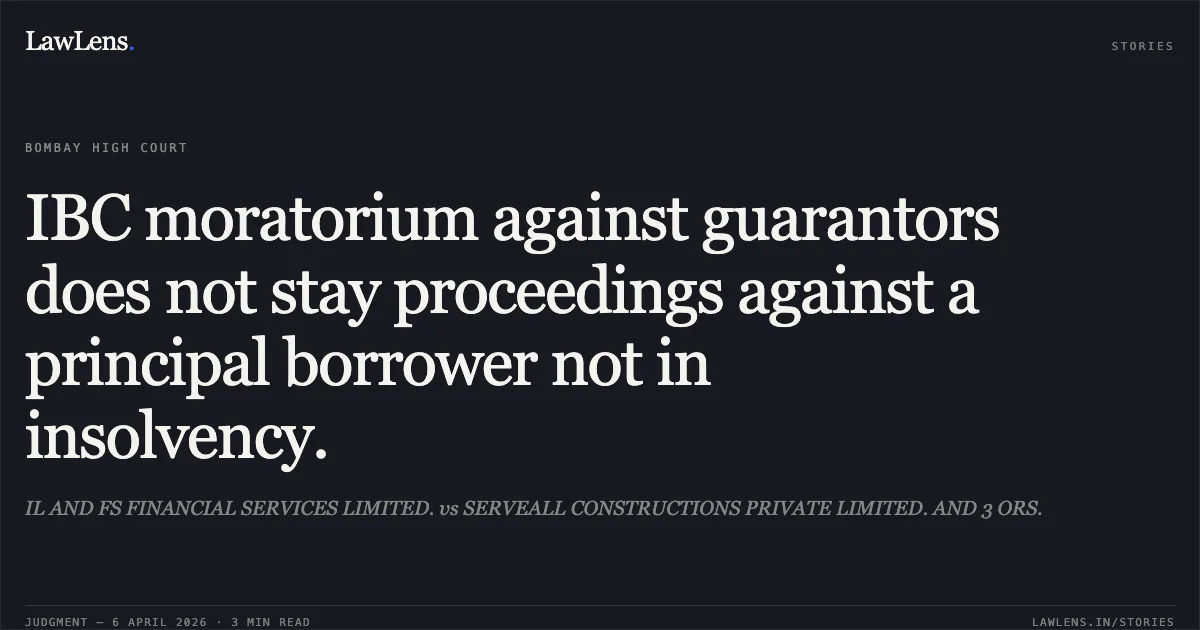
The Court held that neither the Section 14 moratorium nor the Section 96 interim moratorium triggered by the guarantors (D2, D3, and D4) stays the proceedings against the principal borrower (D1)
The Court ordered that the summary suit shall remain stayed only against Defendant Nos. 2, 3, and 4 while the respective moratoriums are operative, but the suit shall proceed against Defendant No. 1
Source reference: para 46, 48Acts & Sections Cited
29 provisions across 3 statutes referred to in this judgment. Each provision opens on LawLens.
Insolvency and Bankruptcy Code, 2016.
Indian Contract Act, 1872
Code of Civil Procedure, 19081
Original Court PDF
IL AND FS FINANCIAL SERVICES LIMITED.vsSERVEALL CONSTRUCTIONS PRIVATE LIMITED. AND 3 ORS.
Click to open original judgment
Original judgment, available to read, download and summarize on LawLens.in


