Facts
The respondent had booked a residential unit in a project developed by M/s Unnati Fortune Holdings Ltd. (“Company”). Following delay in completion, the parties executed a Memorandum of Settlement dated 07.12.2018, under which ₹2.60 crore was payable to the respondent, with ₹70 lakh acknowledged as already paid and the balance to be discharged, inter alia, through post-dated cheques.
Source reference: p.3, paras 5–7The petitioner, a director and authorised signatory of the Company, signed the settlement and the subject cheques.
Source reference: p.3, paras 6–7The cheques were dishonoured with the endorsement “Account Blocked,” resulting in complaints under Sections 138 and 141 of the Negotiable Instruments Act, 1881 (“NI Act”), in which summoning orders were passed on 26.04.2019, 26.07.2019 and 11.09.2019.
Source reference: pp.3–4, para.9The National Company Law Tribunal admitted insolvency proceedings against the Company on 27.03.2019, declared a moratorium under Section 14 of the Insolvency and Bankruptcy Code, 2016 (“IBC”), and appointed an Interim Resolution Professional, thereby suspending the powers of the Board of Directors under Section 17 of the IBC.
Source reference: p.4, para.8The petitioner sought quashing of the complaints’ summoning orders under Section 528 of the Bharatiya Nagarik Suraksha Sanhita, 2023, contending that the statutory cause of action under Section 138 arose after the moratorium and that he no longer controlled the Company’s bank accounts.
Source reference: pp.2, 4–5, paras 4, 10–11The respondent relied on the continuing personal liability of natural persons under Sections 138 and 141 of the NI Act.
Source reference: p.5, para.12Issues
1. Whether a moratorium imposed under Section 14 of the IBC against a corporate debtor requires quashing of proceedings under Sections 138 and 141 of the NI Act against its director and authorised signatory.
Source reference: p.6, para.152. Whether the petitioner’s loss of control over the Company and the fact that the statutory cause of action arose after commencement of the moratorium rendered the complaints and summoning orders legally untenable.
Source reference: pp.8–10, paras 22–273. Whether the petitioner’s role as director and signatory, together with the allegations and admitted signatures on the cheques, warranted adjudication at trial rather than interference under Section 528 of the BNSS.
Source reference: pp.9–10, paras 25–28Law Applied
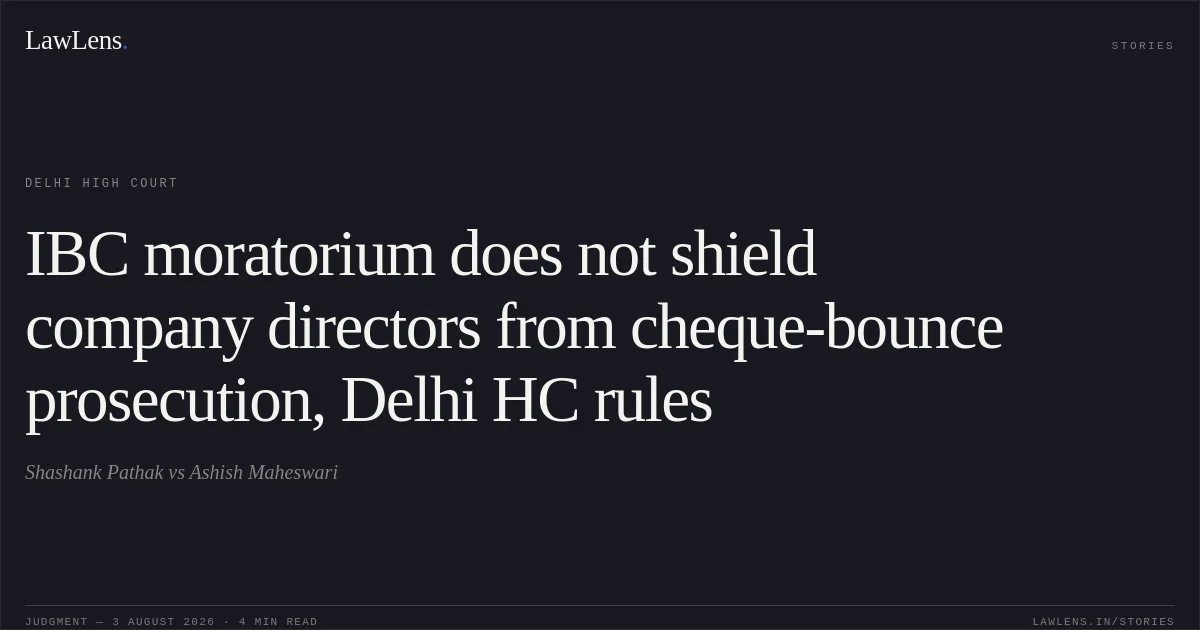
The Court applied Section 14 of the IBC, holding that its moratorium operates in favour of the corporate debtor and bars proceedings against the corporate debtor, but does not extend to natural persons prosecuted under Sections 141(1) and 141(2) of the NI Act.
Source reference: p.6, para.16Relying on P. Mohanraj v. Shah Brothers Ispat (P) Ltd., the Court held that proceedings under Sections 138/141 may be initiated or continued against directors and other responsible natural persons during the corporate insolvency resolution process.
Source reference: p.6, para.16It further relied on Ajay Kumar Radheyshyam Goenka v. Tourism Finance Corporation of India Ltd., which affirmed that insolvency does not extinguish the personal penal liability of directors and officers.
Source reference: p.7, para.18Rakesh Bhanot v. Gurdas Agro Pvt. Ltd. distinguished civil recovery protection under an IBC moratorium from criminal proceedings under Section 138 of the NI Act and reaffirmed that directors’ statutory liability continues despite the moratorium.
Source reference: pp.7–8, paras 19–20The Court distinguished Vishnoo Mittal v. Shakti Trading Company, observing that the post-moratorium accrual of the cause of action is relevant but not, by itself, conclusive of the director’s liability.
Source reference: pp.8–9, paras 22–24The scope of Section 528 of the BNSS was also applied: quashing is inappropriate where the complaints contain the necessary averments and the alleged defences require evidence.
Source reference: p.10, paras 27–28Reasoning
The Court held that the cheques and the Memorandum of Settlement preceded commencement of the CIRP, and that the complaints specifically alleged that the petitioner was a director, authorised signatory and person responsible for the Company’s affairs.
Source reference: pp.3, 9–10, paras 6–7, 25–26The petitioner admittedly signed the cheques.
Source reference: pp.3, 9–10, paras 6–7, 25–26Although the Board’s powers were suspended after appointment of the IRP, that suspension affected the erstwhile management’s ability to operate the Company and its accounts; it did not retrospectively invalidate acts performed before the moratorium or extinguish liability arising from those acts.
Source reference: p.10, para.27The Court rejected the argument that the later expiry of the statutory notice period automatically defeated prosecution, holding that the principle in Vishnoo Mittal could not override the larger-Bench rule in P. Mohanraj and the subsequent clarification in Rakesh Bhanot.
Source reference: pp.8–9, paras 22–24Questions concerning the petitioner’s knowledge, due diligence, the effect of the IRP’s appointment, and the circumstances of issuance of the cheques were matters for trial under Section 141 and could not be conclusively determined in petitions for quashing.
Source reference: p.10, paras 27–28Holding
The Court answered the issues against the petitioner.
It held that the Section 14 IBC moratorium protected the Company but did not suspend or extinguish the petitioner’s statutory liability as a director and authorised signatory under Sections 138 and 141 of the NI Act.
Source reference: p.12, paras 35–36CRL.M.C. Nos. 1549/2026, 1550/2026 and 1589/2026 were dismissed, and the challenged summoning orders were not interfered with.
Source reference: pp.10–12, paras 29, 37Pending applications were disposed of, interim orders in favour of the petitioner were vacated, and the petitioner was directed to appear before the Trial Court, which was to proceed in accordance with law.
Source reference: p.12, paras 37–40The Court clarified that its observations would not prejudice determination of the petitioner’s guilt or innocence at trial.
Source reference: p.12, para.40Original Court PDF
Shashank PathakvsAshish Maheswari
Click to open original judgment
Original judgment, available to read, download and summarize on LawLens.in