Facts
On October 5, 2011, the applicant (complainant) withdrew ₹70,000 from a bank in Ambikapur.
Source reference: para. 2While returning home, two unknown motorcyclists snatched her handbag containing the cash and fled
Source reference: para. 2An FIR was registered under Section 392/34 of the IPC, leading to the arrest of Respondents 2 and 3 and the alleged recovery of the motorcycle and a portion of the cash
Source reference: para. 2, 8On November 3, 2018, the Judicial Magistrate First Class (JMFC) acquitted the accused by granting them the benefit of doubt
Source reference: para. 2This acquittal was upheld by the First Additional Sessions Judge, Ambikapur, on July 30, 2019, on the grounds that the prosecution failed to prove the case beyond reasonable doubt and failed to conduct a Test Identification Parade (TIP)
Source reference: para. 2The applicant filed the present revision petition challenging these concurrent findings of acquittal
Source reference: para. 2Issues
1. Whether the concurrent findings of acquittal passed by the Trial Court and the Appellate Court suffer from perversity, illegality, or gross misappreciation of evidence warranting interference under revisional jurisdiction?
Source reference: para. 12, 132. Whether the prosecution established the identity of the accused and the recovery of stolen property beyond reasonable doubt in the absence of a Test Identification Parade and reliable eyewitness testimony?
Source reference: para. 10, 11Law Applied
The court primarily considered Section 392 of the IPC regarding robbery and Section 34 regarding common intention
Source reference: para. 2It applied Section 9 of the Indian Evidence Act, 1872, regarding the necessity of a Test Identification Parade (TIP) to establish the identity of unknown accused persons
Source reference: para. 10The court also referenced Section 27 of the Evidence Act regarding the discovery of facts pursuant to memorandum statements
Source reference: para. 8Finally, it applied the settled legal principle that revisional jurisdiction against concurrent findings of acquittal is restricted to cases of perversity or manifest illegality
Source reference: para. 12Reasoning
The High Court observed that the complainant (PW-3) admitted during cross-examination that she had not seen the assailants’ faces because the bag was snatched from behind
Source reference: para. 9This admission rendered her unable to identify the accused or the motorcycle used in the crime
Source reference: para. 9The court noted that the investigation was critically flawed as no Test Identification Parade (TIP) was conducted under Section 9 of the Evidence Act to verify the identity of the arrested persons
Source reference: para. 10Furthermore, the court found the alleged recovery of the motorcycle and cash under Section 27 of the Evidence Act to be doubtful, as seizure witnesses admitted to signing documents at the police station rather than at the place of recovery
Source reference: para. 6Since the prosecution failed to produce any independent eye-witnesses and the existing testimony (PW-2) was deemed hearsay or contradictory, the court held that the essential ingredients of the offence were not established
Source reference: para. 6, 11Consequently, the findings of the lower courts were found to be based on a proper appreciation of evidence rather than perversity
Source reference: para. 13Holding
The High Court dismissed the revision petition, affirming the concurrent judgments of acquittal
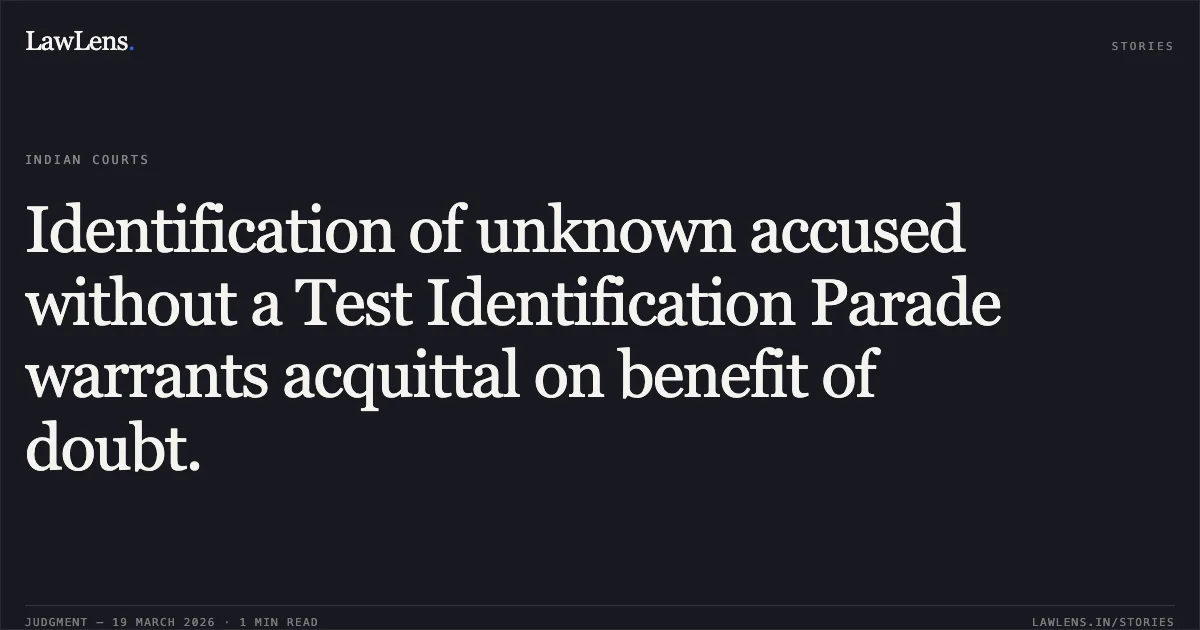
It held that in the absence of a Test Identification Parade or reliable identification by the complainant, the involvement of the accused remained highly doubtful
Source reference: para. 10The court concluded that there was no illegality or material irregularity in the lower courts' decisions to extend the benefit of doubt to the accused
Source reference: para. 13The court directed the transmission of the order and records to the lower court for compliance
Source reference: para. 15Acts & Sections Cited
2 provisions across 1 statute referred to in this judgment. Each provision opens on LawLens.
Indian Penal Code, 18602
Original Court PDF
SMT. MUKTI SINGHvsSTATE OF CHHATTISGARH
Click to open original judgment
Original judgment, available to read, download and summarize on LawLens.in