Facts
The Appellant (NCBS) entered into a construction agreement with the Respondent (URC) on 19.06.2017
Source reference: p. 5Following the rollout of the Goods and Services Tax (GST) on 01.07.2017, disputes arose regarding the applicable tax rate (12% vs 18%) and whether the value of non-tendered (NT) items was inclusive or exclusive of GST
Source reference: p. 7-8An Arbitral Tribunal awarded URC ₹3,52,50,404/-, treating the ₹9,65,91,596/- value for NT items as exclusive of GST
Source reference: p. 3, 14NCBS challenged this under Section 34 of the Arbitration and Conciliation (A&C) Act, 1996, but the Commercial Court dismissed the petition on 28.04.2025
Source reference: p. 3NCBS then preferred this appeal under Section 37 of the A&C Act, specifically challenging the inclusion of ₹1,47,34,311/- as differential GST on NT items
Source reference: p. 18Issues
1. Whether the arbitral award is vitiated by "patent illegality" under Section 34(2-A) of the A&C Act for ignoring vital evidence regarding the GST component in non-tendered items
Source reference: p. 23 / para. 42-432. Whether the sum of ₹9,65,91,596/- representing the value of non-tendered works was inclusive or exclusive of 18% GST
Source reference: p. 18 / para. 35Law Applied
The court primarily applied Section 34 and Section 37 of the Arbitration and Conciliation Act, 1996, regarding the grounds for setting aside arbitral awards
Source reference: p. 2-3It relied on the principle from Delhi Airport Metro Express (P) Ltd. v. DMRC and Ssangyong Engineering and Construction Co. Ltd. v. NHAI, which establishes that an award is patently illegal and perverse if it is based on no evidence or if the arbitrator ignores vital evidence in arriving at a decision
Source reference: p. 24The court noted the limits of appellate interference, affirming that the court cannot reappreciate evidence as a first appellate court unless the award shocks the conscience of the court or is patently illegal
Source reference: p. 23-25Reasoning
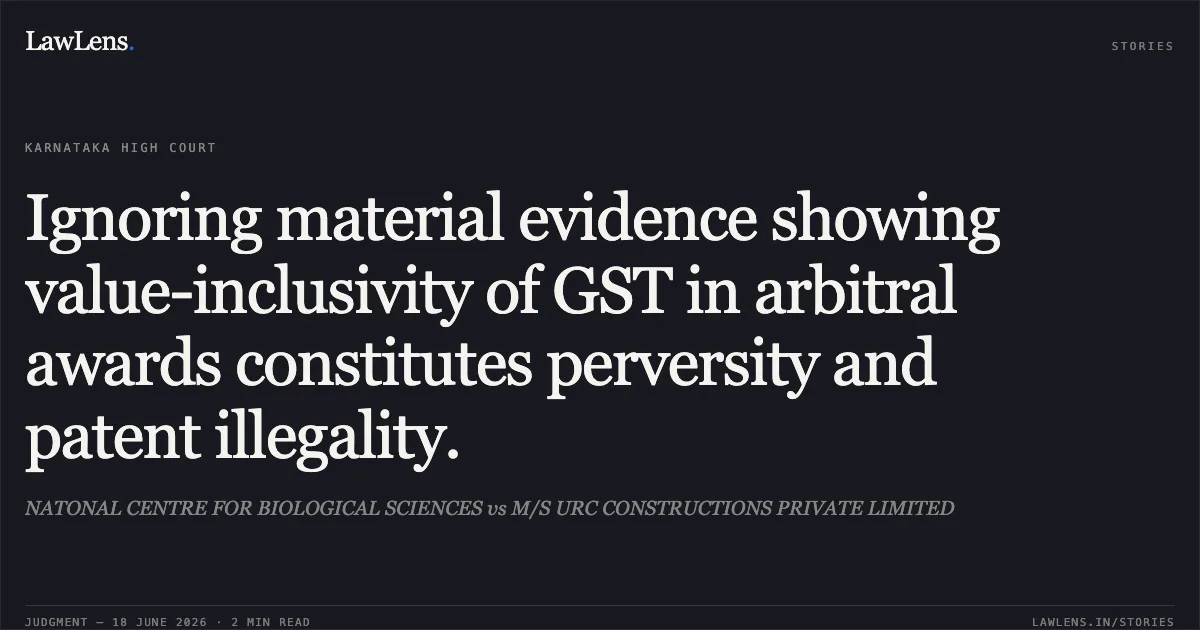
The Court found that while an appellate court generally cannot reappraise evidence, the Arbitral Tribunal committed a "patent illegality" by ignoring vital documentary evidence
Source reference: para. 43, 63The Tribunal had relied solely on the 21st and final bill to conclude that the NT item value was GST-exclusive
Source reference: para. 47The High Court observed that NCBS had produced earlier RA Bills (Nos. 6, 8, 9, 10, and 14) and a tabular statement (Annexure-R5) which explicitly showed that the aggregate figure of ₹9,65,91,596/- was composed of individual invoices that included 18% GST
Source reference: para. 54, 59The Court reasoned that by failing to consider these invoices—which directly contradicted URC’s claim that the figure was a "base value"—the Tribunal reached a perverse conclusion
Source reference: para. 61-63Calculating a fresh 18% GST on a figure that already contained a tax component resulted in an ex-facie error
Source reference: para. 61Holding
The Court allowed the appeal in part and set aside the arbitral award only to the extent that it treated the NT item value of ₹9,65,91,596/- as exclusive of GST
The Court held that the failure to consider vital evidence (the underlying RA bills) rendered that portion of the award patently illegal
Source reference: para. 63Consequently, the awarded GST and interest must be recomputed
Source reference: para. 64The Court clarified that while NCBS's specific figure for deduction was not yet fully established, URC is at liberty to re-agitate its claim for the differential GST value through appropriate proceedings
Source reference: para. 65-66Acts & Sections Cited
7 provisions across 4 statutes referred to in this judgment. Each provision opens on LawLens.
Arbitration and Conciliation Act, 19964
Commercial Courts Act, 20151
KARNATAKA GOODS AND SERVICES TAX ACT, 20171
Central Goods and Services Tax Act, 20171
Original Court PDF
NATONAL CENTRE FOR BIOLOGICAL SCIENCESvsM/S URC CONSTRUCTIONS PRIVATE LIMITED
Click to open original judgment
Original judgment, available to read, download and summarize on LawLens.in


