01Facts
The respondents applied for admission to IISER’s 2026 undergraduate programmes through the IISER Aptitude Test. Both claimed reservation under the Other Backward Classes–Non-Creamy Layer (OBC-NCL) category. Vidya Sankar uploaded an OBC-NCL certificate dated 09.02.2026, while Riya Zainab T. uploaded one dated 13.01.2026.
¶ 9–15 · pp. 36–42The appellants rejected the respondents’ OBC-NCL claims because the certificates uploaded by them were issued during the previous financial year and the fresh certificates were obtained or submitted only after 21.06.2026. The respondents approached the Kerala High Court. The learned Single Judge held that the requirement was procedural and directed that they be considered under the OBC-NCL category based on the certificates subsequently produced.
¶ 4–5 · pp. 20–2802Issues
i.Whether candidates who failed to upload an OBC-NCL certificate issued on or after 01.04.2026 by the prescribed cut-off date of 21.06.2026 could nevertheless be considered under the OBC-NCL category on the basis of certificates obtained or submitted later
¶ 19–21, 36–42 · pp. 46–53, 63–68ii.Whether the requirement in the IISER information brochure that the OBC-NCL certificate be valid for the financial year 2026–27 and issued on or after 01.04.2026 was arbitrary or legally invalid
¶ 43–44 · pp. 69–70iii.Whether the Kerala High Court had territorial jurisdiction under Article 226(2) of the Constitution despite the brochure’s jurisdiction clause conferring jurisdiction on courts in Odisha
¶ 50–52 · pp. 74–7603Law Applied
The Court applied Article 226(2) of the Constitution, under which a High Court may exercise writ jurisdiction where the cause of action arises wholly or partly within its territory; it held that the respondents’ applications, document submissions and receipt of rejection communications in Kerala constituted a sufficient part of the cause of action.
¶ 50–52 · pp. 74–76The Court treated clauses 6 and 13 of the IISER information brochure as binding admission conditions requiring an OBC-NCL certificate issued on or after 01.04.2026, valid for 2026–27, and uploaded by 21.06.2026.
¶ 11–15, 19 · pp. 37–47It distinguished Dolly Chhanda v. Chairman, JEE, (2005) 9 SCC 779, Charles K. Skaria v. Dr. C. Mathew, (1980) 2 SCC 752, and Ram Kumar Gijroya v. DSSSB, (2016) 4 SCC 754, which permit limited procedural relaxation where the substantive qualification or reservation status existed by the relevant date.
¶ 21–35 · pp. 48–62It relied on Yoshika Verma v. Union of India, 2022 SCC OnLine P&H 3760, for the principle that admission rules concerning current OBC-NCL status must be applied strictly and uniformly, and that courts should not dilute clear requirements on grounds of equity or sympathy.
¶ 21–35 · pp. 48–6204Reasoning
The Court held that the requirement was not merely a technical requirement concerning proof of an otherwise established status. OBC-NCL status depends on the applicable income criteria for the three financial years preceding the year of admission, and the prescribed certificate had to reflect the candidate’s status for 2026–27.
¶ 36–39 · pp. 63–66The certificates initially uploaded by the respondents were issued during 2025–26 and expired for the relevant purpose on 31.03.2026. The fresh certificates, issued on 22.06.2026 and 08.07.2026, were obtained or submitted after the mandatory deadline of 21.06.2026.
¶ 42 · p. 67The brochure expressly stated that failure to upload the prescribed certificate by that date would result in consideration only under the unreserved category. The Court found that this condition was clearly notified, rationally connected with verification of current non-creamy-layer status, and uniformly applicable to all candidates.
¶ 39–44 · pp. 65–70The precedents permitting later submission of certificates were distinguishable because they involved mistaken or delayed proof of an already existing entitlement, whereas the present cases concerned non-compliance with a specific, current-year certificate requirement.
¶ 21–35 · pp. 48–62Although the Court affirmed territorial jurisdiction, it found no basis to interfere with the admission authority’s substantive decision.
¶ 50–54 · pp. 74–7705Holding
The writ appeals were allowed. The Division Bench set aside the Single Judge’s judgment directing consideration of the respondents under the OBC-NCL category and dismissed W.P.(C) Nos. 26238 and 27028 of 2026.
¶ 53–54 · pp. 76–77The Court held that candidates who failed to upload an OBC-NCL certificate issued on or after 01.04.2026 by 21.06.2026 were not entitled to consideration under the OBC-NCL category and could be considered only under the unreserved category.
¶ 53–54 · pp. 76–77The Court did not interfere with the finding that the Kerala High Court possessed territorial jurisdiction under Article 226(2).
¶ 54 · p. 77Original Court PDF
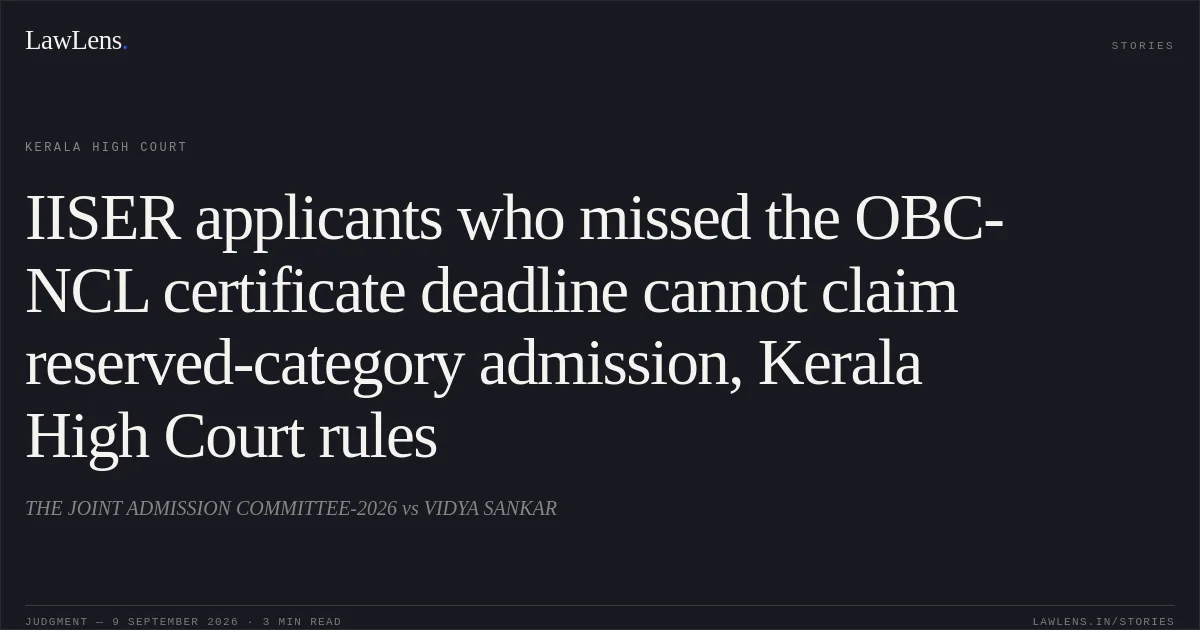
THE JOINT ADMISSION COMMITTEE-2026vsVIDYA SANKAR
Click to open original judgment
Original judgment, available to read, download and summarize on LawLens.in