Facts
The applicants sought either the conduct of a Limited Departmental Competitive Examination (LDCE) for the post of Junior Engineer (Civil/Electrical) or the regularization of their current ad-hoc appointments to said posts
Source reference: para. 1.8, 4.2Under Recruitment Rules (RRs) notified on 27.03.2006, 5% of JE posts were to be filled via LDCE
Source reference: para. 1.1, 11Between 2006 and 2010, the MCD appointed several candidates on an ad-hoc/LAC basis by dispensing with the LDCE requirement due to administrative exigencies, purportedly seeking relaxation from the GNCTD
Source reference: para. 2.4, 2.7, 6.1In 2012, the Lt. Governor directed cancellation of these appointments as they violated the RRs
Source reference: para. 2.10, 6.2A subsequent Office Order dated 31.03.2022 revealed that a one-time relaxation was granted only to the 14 candidates appointed in 2006, while the LDCE provision itself was slated for re-examination
Source reference: para. 8.8, 15The 2010 appointees (applicants) challenged show-cause notices for reversion and sought regularization
Source reference: para. 4.6, 21Issues
1. Whether the applicants, appointed/promoted to the post of Junior Engineer under the 5% quota without qualifyng the LDCE, are entitled to regularization of their services
Source reference: para. 102. Whether the Tribunal should issue a mandamus directing the respondents to conduct the LDCE in a time-bound manner
Source reference: para. 10, 23Law Applied
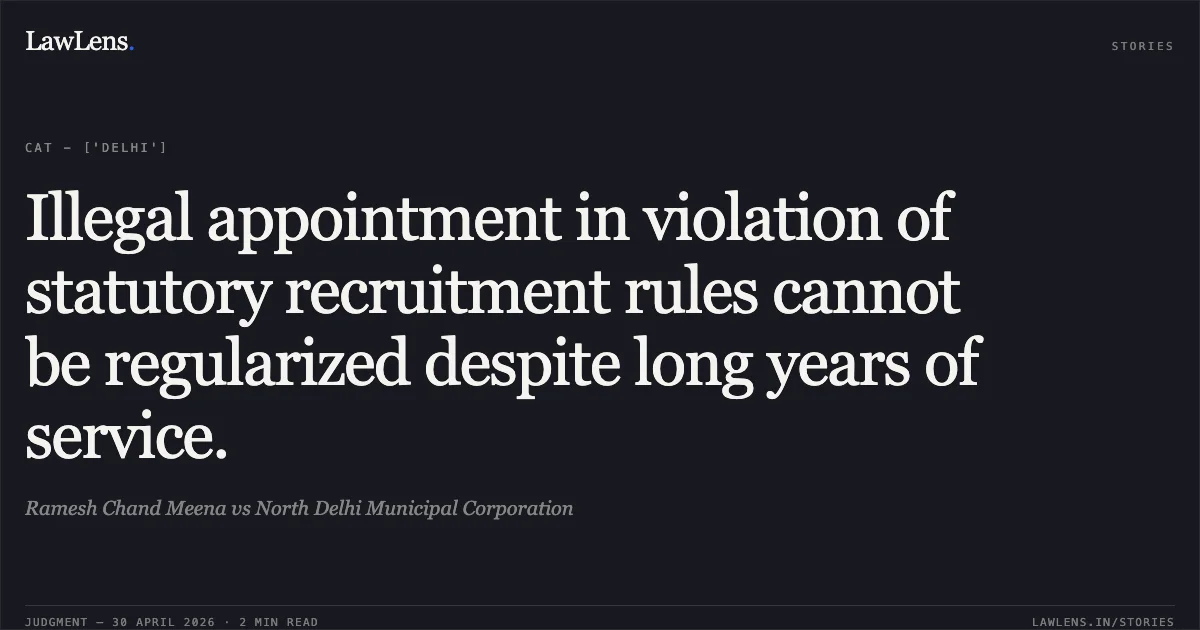
The Tribunal primarily applied the constitutional principle of public employment as settled in State of Karnataka v. Umadevi (2006) 4 SCC 1, which holds that appointments made in violation of statutory Recruitment Rules are illegal and cannot be regularized
Source reference: para. 6, 17It distinguished the "regular" vs. "illegal" appointment doctrine, noting that failure to follow the prescribed mode of recruitment (LDCE) constitutes an illegality
Source reference: para. 17The Tribunal also noted that doctrines of legitimate expectation or estoppel cannot operate against statutory provisions
Source reference: para. 18Judicial interference in policy-level administrative decisions or at the stage of a show-cause notice is restricted
Source reference: para. 2.1, 21Reasoning
The Tribunal found that the Recruitment Rules of 2006 mandatorily required LDCE for the 5% promotional quota
Source reference: para. 11The applicants’ initial appointments were "illegal entry" because they bypassed the competitive examination required by law
Source reference: para. 14, 18The Tribunal distinguished Pawan Sharma & Ors. v. GNCTD [WP(C) 2117/2025], noting that in that case, the recruitment mirrored a regular selection process, whereas here, the selection process (LDCE) was entirely abandoned
Source reference: para. 13-14The Lt. Governor’s Office Order of 31.03.2022 specifically granted relaxation only to a 2006 batch as a "one-time measure," which explicitly prohibited treating it as a precedent for the 2010 batch
Source reference: para. 15-16Regarding the conduct of the exam, the Tribunal reasoned that since the Lt. Governor had directed a re-examination of the LDCE provision itself, a mandamus to hold the exam under the old rules would be premature and interfere with the administration's policy-making domain
Source reference: para. 23Holding
The Tribunal answered both issues in the negative and dismissed the OAs
It held that the applicants are not entitled to regularization as their appointments were in violation of the Recruitment Rules
Source reference: para. 22The Tribunal declined to direct the conduct of the LDCE, leaving it to the competent authority to decide following their policy re-examination
Source reference: para. 23The show-cause notices for reversion were upheld as being within jurisdiction, and the applicants were granted liberty to reply to said notices before the competent authority
Source reference: para. 24Acts & Sections Cited
1 provisions across 1 statute referred to in this judgment. Each provision opens on LawLens.
General Clauses Act, 18971
Original Court PDF
Ramesh Chand MeenavsNorth Delhi Municipal Corporation
Click to open original judgment
Original judgment, available to read, download and summarize on LawLens.in