Facts
The respondents were appointed as a Peon and Lower Division Clerk in the personal establishment of the Chairman/Members of the Madhya Pradesh Minority Commission pursuant to an advertised selection process and interview held on 12.03.1997. Their appointment orders, issued on 01.10.1997, described the appointments as temporary for 89 days. They continued in service for approximately eleven years before their services were discontinued on 26.02.2009
Source reference: paras. 3, 11The respondents initially succeeded before the Labour Court through an ex parte award dated 24.11.2009 directing reinstatement. In proceedings initiated by the State, execution of the award was stayed subject to compliance with Section 17-B of the Industrial Disputes Act, 1947. The High Court subsequently set aside the award and remanded the matter. On remand, the Labour Court rejected the respondents’ claims, holding that their initial appointments were illegal and that they were not entitled to protection under Section 25-F of the Industrial Disputes Act
Source reference: para. 4The learned Single Judge, by order dated 22.07.2025, allowed the respondents’ writ petitions, held their retrenchment illegal, and directed reinstatement with 50% back wages up to the date of the order and full salary thereafter, subject to adjustment of amounts paid under Section 17-B. The State challenged that order in the present appeals, contending that the appointments were against non-sanctioned, temporary and co-terminus posts and that the Minority Commission posts had subsequently remained vacant
Source reference: paras. 5–10Issues
1. Whether the Labour Court could reject the respondents’ claims on the ground that their initial appointments were illegal when the reference principally concerned the legality of their retrenchment?
Source reference: paras. 15–16, 22–242. Whether the respondents’ discontinuation from service was illegal for non-compliance with the statutory requirements governing retrenchment under the Industrial Disputes Act, 1947?
Source reference: paras. 16, 253. Whether reinstatement with 50% back wages was appropriate, or whether monetary compensation alone should be granted in view of the temporary nature of the appointments and the lapse of time?
Source reference: paras. 17–20, 264. Whether the subsequent absence of a Chairman or Members of the Commission and the alleged non-availability of sanctioned posts rendered the respondents’ appointments or reinstatement legally impermissible?
Source reference: paras. 6, 9, 21, 26Law Applied
The Court applied the Industrial Disputes Act, 1947, particularly the protections governing retrenchment under Section 25-F and the payment of subsistence wages under Section 17-B; a temporary or daily-wage employee cannot be discontinued without compliance with applicable statutory requirements
Source reference: paras. 16, 25Relying on Ajaypal Singh v. Haryana Warehousing Corporation, (2015) 6 SCC 321, the Court held that, unless the termination or reference specifically raises the illegality of the initial appointment under Articles 14 and 16 or the applicable service rules, the employer cannot defeat a retrenchment claim merely by subsequently alleging that the appointment was a “back-door” appointment
Source reference: paras. 22–24BSNL v. Man Singh, (2012) 1 SCC 558 and Incharge Officer v. Shankar Shetty, (2010) 9 SCC 126 establish that reinstatement is not automatic for daily wagers and that compensation may be appropriate in suitable cases; however, those decisions do not impose an absolute bar on reinstatement where retrenchment is illegal
Source reference: paras. 17–20Secretary, State of Karnataka v. Umadevi (3), (2006) 4 SCC 1 was relied upon for the principle that temporary, contractual or casual employees cannot claim regularisation merely on the basis of legitimate expectation where the initial appointment was not made through the prescribed selection procedure
Source reference: para. 19Reasoning
The Court held that the Labour Court exceeded the scope of the reference by adjudicating upon the legality of the respondents’ initial appointments instead of determining whether their retrenchment complied with the Industrial Disputes Act
Source reference: paras. 15–16The respondents had been selected pursuant to an advertisement and interview, and their appointment orders did not stipulate that their services would automatically terminate with the tenure of the Chairman or Members. Accordingly, the subsequent sanction orders and the State’s later contention regarding non-sanctioned posts could not, by themselves, retrospectively invalidate the appointments
Source reference: paras. 16, 21, 26The Court further noted that ten of the thirteen persons appointed through the same selection process continued in service, while only the three respondents were discontinued, making their selective termination arbitrary and discriminatory
Source reference: para. 21Since no notice or retrenchment order complying with the statutory requirements had been issued, the discontinuation was legally unsustainable
Source reference: para. 25The authorities cited by the State concerning compensation in lieu of reinstatement were distinguished because the respondents had served for nearly twelve years and the Single Judge’s grant of reinstatement with limited back wages represented a permissible exercise of discretion
Source reference: paras. 17–20Holding
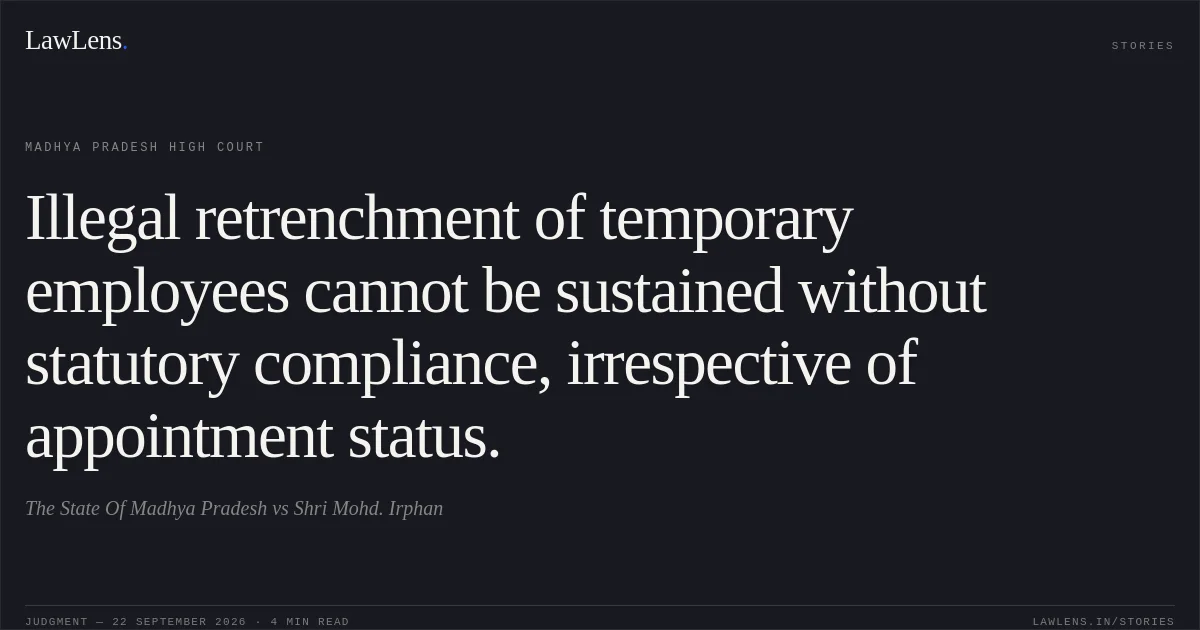
The appeals were dismissed. The Division Bench affirmed the Single Judge’s order dated 22.07.2025, holding that the respondents’ retrenchment was illegal and that their initial appointments could not be treated as illegal merely because of subsequent sanction-related objections or the later vacancy of the Chairman and Members’ posts
The respondents were therefore entitled to reinstatement with 50% back wages up to the date of the Single Judge’s order and full salary thereafter, subject to adjustment of amounts received under Section 17-B of the Industrial Disputes Act
Source reference: paras. 2, 5, 27Acts & Sections Cited
4 provisions across 1 statute referred to in this judgment. Linked provisions open on LawLens.
Industrial Disputes Act, 19474
Original Court PDF
The State Of Madhya PradeshvsShri Mohd. Irphan
Click to open original judgment
Original judgment, available to read, download and summarize on LawLens.in