Facts
Bhalley Ram was engaged by the Agricultural Produce Market Committee, Azadpur, Delhi, as a Safai Karamchari on 4 March 1987 in the pay scale of ₹196–232 plus admissible allowances.
Source reference: p.1His appointment memorandum prescribed a two-year probationary period, extendable only if his conduct or performance was found unsatisfactory or if he failed to acquire working knowledge of Hindi.
Source reference: pp.1, 4–5He continued in service for more than seven years, but his services were terminated on 23 September 1994 under Rule 5 of the Central Civil Services (Temporary Service) Rules, 1965.
Source reference: p.1The Labour Court held the termination illegal and unjustified, finding that the employer had neither extended the probation nor produced material showing unsatisfactory performance; it directed reinstatement with continuity of service and 70% back wages.
Source reference: p.2The Agricultural Produce Market Committee challenged that award under Articles 226 and 227 of the Constitution.
Source reference: p.2Issues
Whether the workman continued to be a temporary/probationary employee so as to permit termination under Rule 5 of the CCS (Temporary Service) Rules, 1965, despite the absence of a formal extension of probation and his having served for more than seven years.
Source reference: pp.2–5Whether the Labour Court was justified in holding the termination illegal and directing reinstatement with continuity of service and 70% back wages.
Source reference: pp.2, 6–7Whether, notwithstanding the finding of illegal termination, reinstatement and back wages should be substituted with monetary compensation in the circumstances of the case.
Source reference: pp.6–7Law Applied
The Court applied Rule 3 of the appointment memorandum, under which probation was fixed for two years and could be extended only where the employee’s conduct or performance was unsatisfactory or the requisite Hindi proficiency was not acquired.
Source reference: pp.4–5It considered Rule 5 of the CCS (Temporary Service) Rules, 1965, governing termination of temporary employees.
Source reference: pp.1–2Under Articles 226 and 227, interference with a Labour Court award is limited to cases of patent illegality, perversity, or an error apparent on the face of the record, and not for re-appreciation of evidence.
Source reference: para.14The Court relied on Head Master, Lawrence School Lovedale v. Jayanthi Raghu , (2012) 2 SCC 793, and Durgabai Deshmukh Memorial Sr. Sec. School v. J.A.J. Vasu Sena , 2019 SCC OnLine SC 1075, while distinguishing them on the basis of their differing probation provisions.
Source reference: paras.18–20It further applied the principle in Allahabad Bank v. Krishan Pal Singh , (2021) 19 SCC 227, that reinstatement and full back wages do not automatically follow from a finding that termination was illegal; relief must be moulded according to the nature of employment, length of service, and surrounding circumstances.
Source reference: para.21Reasoning
The Court held that the employer had produced no assessment, performance evaluation, order extending probation, or contemporaneous material demonstrating dissatisfaction with the workman’s conduct or performance.
Source reference: para.17Since the appointment memorandum permitted extension only on specified grounds, and the workman continued in service for over seven years without any documented extension, the employer could not treat him as a temporary employee indefinitely or invoke Rule 5 to terminate him.
Source reference: paras.15–17The precedents relied upon by the employer were distinguishable because they involved broader discretion to extend probation or actual extensions based on unsatisfactory performance.
Source reference: paras.18–20Accordingly, the finding that the termination was illegal was not perverse and warranted no interference under Articles 226 and 227.
Source reference: paras.14–15, 23However, applying the principle that reinstatement is not automatic, the Court considered that the workman had resumed duties in 2007 pursuant to the Section 17B proceedings and had thereafter received wages equivalent to his last drawn wages or the applicable minimum wage for more than twenty years.
Source reference: para.24Taking into account the wages already received, the loss of back wages and employment-related entitlements, and the loss of comparable benefits and retirement entitlements, the Court found lump-sum compensation more appropriate than maintaining the Labour Court’s reinstatement and back-wage directions.
Source reference: para.25Holding
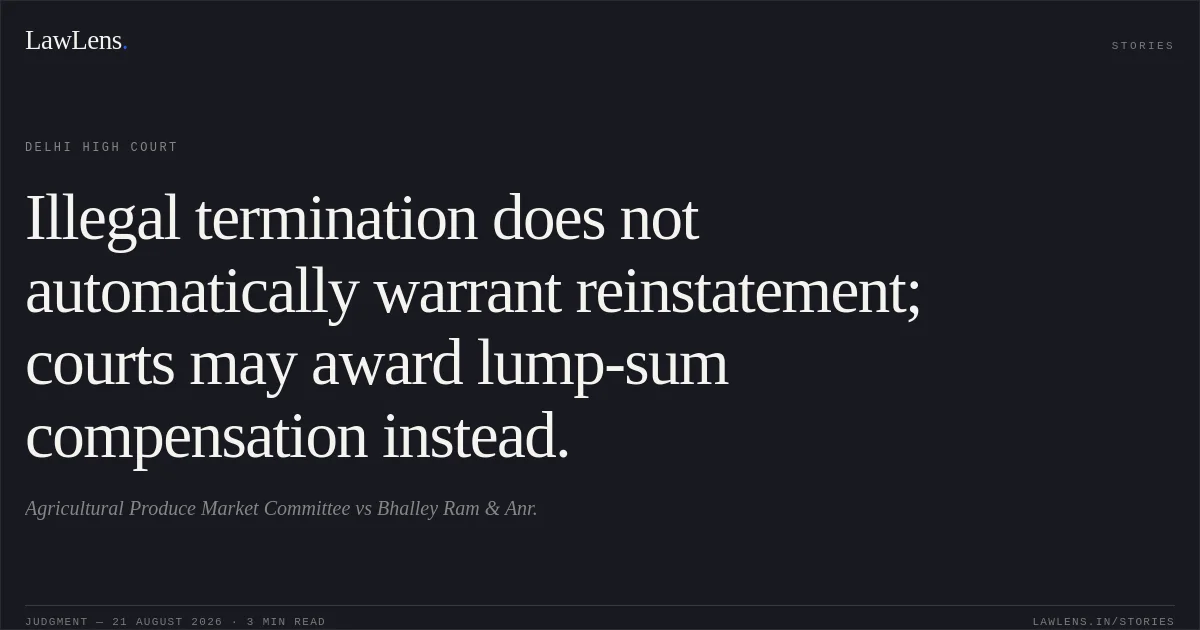
The High Court upheld the Labour Court’s finding that Bhalley Ram’s termination was illegal and unjustified.
However, it modified the relief of reinstatement, continuity of service, and 70% back wages, substituting it with lump-sum compensation of ₹4,00,000.
Source reference: para.25The Agricultural Produce Market Committee was directed to pay the amount within eight weeks from the date of the order, and the writ petition was disposed of accordingly.
Source reference: paras.25–26Acts & Sections Cited
1 provisions across 1 statute referred to in this judgment. Linked provisions open on LawLens.
Industrial Disputes Act, 19471
Original Court PDF
Agricultural Produce Market CommitteevsBhalley Ram & Anr.
Click to open original judgment
Original judgment, available to read, download and summarize on LawLens.in