Facts
The respondent worked for the petitioner as a helper/machine man.
Source reference: p.1–2; paras. 2–3On 25 October 2009, he sustained serious injuries while operating a kharad machine during employment and thereafter remained under medical treatment and prescribed rest.
Source reference: p.1–2; paras. 2–3Upon being declared fit, he reported for duty on 7 April 2010, but alleged that the petitioner refused to reinstate him and informed him that his services had ended from 26 October 2009.
Source reference: p.1–2; paras. 2–3The petitioner contended that the respondent had voluntarily abandoned employment, relying on alleged letters calling upon him to resume duty.
Source reference: p.2–4; paras. 2, 9–11The Labour Court rejected the plea of abandonment, held the termination illegal for non-compliance with procedural and retrenchment requirements, and awarded reinstatement with continuity of service, full back wages and consequential benefits.
Source reference: p.2–3; paras. 4–6During the writ proceedings, the petitioner offered reinstatement, but the respondent declined it on the ground that he was employed elsewhere.
Source reference: p.3; para. 8The High Court consequently considered only the legality of termination and the appropriate monetary relief.
Source reference: p.3; para. 8Issues
Whether the respondent had voluntarily abandoned his employment or had been illegally terminated by the petitioner.
Source reference: p.5–8; paras. 21–25Whether the Labour Court’s findings warranted interference under Articles 226 and 227 of the Constitution.
Source reference: p.5–6; para. 20Whether reinstatement with full back wages was appropriate when the respondent was employed elsewhere, and what alternative relief should be granted.
Source reference: p.3, 8–9; paras. 8, 26–29Law Applied
The Court applied the limited scope of judicial review under Articles 226 and 227, holding that interference with a Labour Court’s factual findings is justified only where the findings are perverse, based on no evidence, founded on irrelevant evidence, or affected by patent illegality or jurisdictional error, relying on International Airport Authority of India v. International Air Cargo Workers Union, (2009) 13 SCC 374.
Source reference: p.5–6; para. 20It further applied Section 25-F of the Industrial Disputes Act, 1947, under which retrenchment requires compliance with prescribed notice, notice-pay and retrenchment-compensation requirements.
Source reference: p.2–3, 7–8; paras. 5, 25The Court also applied the principle that abandonment of service must be established through reliable evidence and cannot be inferred merely from absence, particularly where the employee’s absence is medically supported.
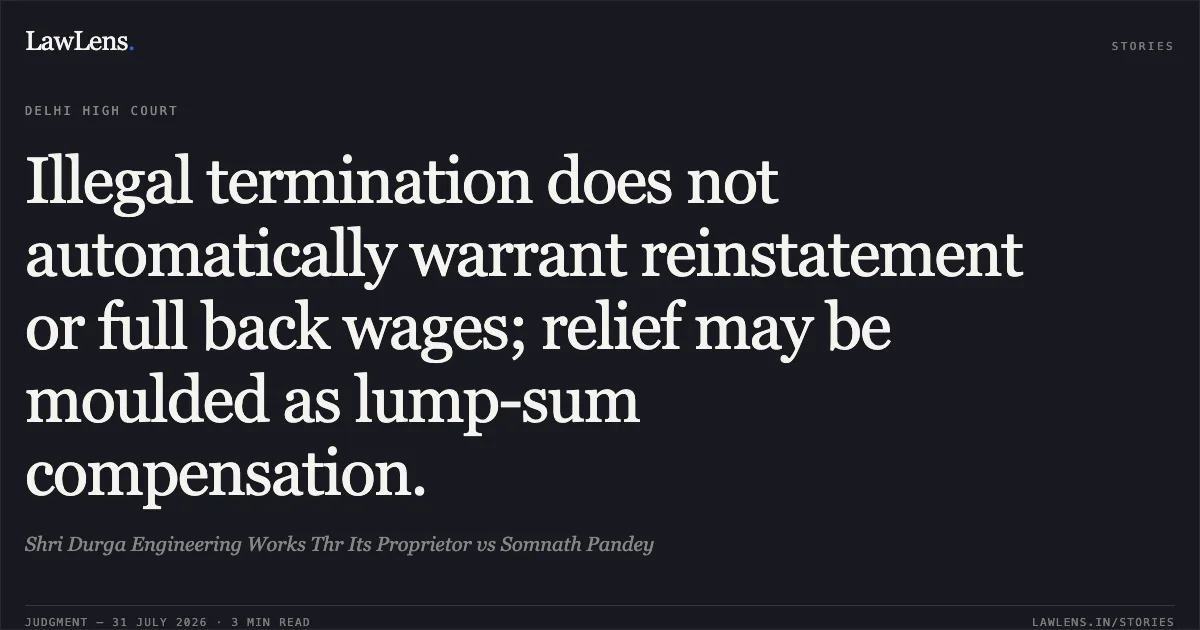
Source reference: p.6–8; paras. 21–24Finally, relying on Allahabad Bank v. Krishan Pal Singh, (2021) 19 SCC 227, the Court held that reinstatement with full back wages is not automatic upon a finding of illegal termination and that relief may be moulded according to the facts and circumstances.
Source reference: p.8–9; para. 28Reasoning
The Court declined to interfere with the Labour Court’s factual findings because they were supported by the record.
Source reference: p.6–7; para. 22The petitioner produced no resignation letter, full-and-final settlement, contemporaneous record of cessation of employment, or evidence that the respondent’s name had been removed from the rolls; its plea that he had abandoned employment in 2007 was therefore unsupported.
Source reference: p.6–7; para. 22The alleged letters requiring the respondent to rejoin were sent through UPC, without proof of service, and the respondent was not confronted with them in cross-examination.
Source reference: p.7; para. 23The workplace accident was admitted, the medical records supported the respondent’s treatment and prescribed rest, and the petitioner neither effectively challenged those records nor cross-examined him regarding the duration of his treatment.
Source reference: p.7–8; para. 24The ESI records also reflected leave during the relevant period.
Source reference: p.7–8; para. 24Since the petitioner neither issued a charge-sheet nor conducted a domestic enquiry and also failed to comply with Section 25-F, the termination was illegal.
Source reference: p.8; para. 25However, because reinstatement had been offered and the respondent was gainfully employed elsewhere, reinstatement was not granted.
Source reference: p.8–9; paras. 26–28In the absence of evidence establishing when the respondent obtained alternative employment, full back wages for the entire period could not be justified.
Source reference: p.8–9; paras. 26–28Holding
The High Court upheld the Labour Court’s finding that the respondent had not abandoned employment and that his termination was illegal.
Nevertheless, it modified the relief: reinstatement and full back wages were not granted because the respondent was employed elsewhere and had declined the offer of reinstatement.
Source reference: p.8–9; paras. 26–30In lieu thereof, the petitioner was directed to pay the respondent lump-sum compensation of ₹2,00,000 within eight weeks from the date of the order.
Source reference: p.8–9; paras. 26–30The writ petition and pending application were disposed of accordingly.
Source reference: p.9; paras. 29–31Original Court PDF
Shri Durga Engineering Works Thr Its ProprietorvsSomnath Pandey
Click to open original judgment
Original judgment, available to read, download and summarize on LawLens.in


