Facts
The dispute concerns "Laxmi Bhuvan," a property in Jamnagar originally owned by Vallabhdas Kanji. Following a 1934 suit in the Bombay High Court, a consent decree was drawn in 1937 settling the share of a deceased son, Ramji, while specifying the shares of the remaining partners in the firm M/s. Vallabhdas Kanji & Company, which held the Jamnagar property as an asset.
Source reference: p. 6, 64-65Another son, Lalji, had relinquished his rights in 1916 for consideration.
Source reference: p. 6, 81In his 1937 Will, Vallabhdas Kanpur conferred a limited right of residence in "Borivali Ni Chawl" (part of the Jamnagar property) to Lalji’s widow, Bai Vali, and her son.
Source reference: p. 9, 83In 1943, an agreement for closure of certain business shops was executed, but the firm itself remained for winding-up purposes.
Source reference: p. 70-71The Trial Court in 1985 declared the property as "co-ownership" property (granting 1/12th share to the plaintiff) rather than partnership property, and ordered Bai Vali's heirs to vacate the Chawl upon payment of ₹8,000.
Source reference: p. 3-4, 21Issues
1. Whether the suit properties were partnership firm assets or co-ownership properties.
Source reference: para. 16(1)2. Whether the partnership firm stood dissolved by the death of a partner or by the 1937/1943 documents under the Indian Partnership Act, 1932.
Source reference: para. 16(2-3)3. Whether the limited right of residence of widow Bai Vali in "Borivali Ni Chawl" translated into absolute ownership under Section 14(1) of the Hindu Succession Act, 1956.
Source reference: para. 16(5-6)Law Applied
Section 14 of the Indian Partnership Act, 1932, stipulating that property thrown into the "hotchpot" of a firm becomes a partnership asset without a registered conveyance, relying on Addanki Narayanappa v. Bhaskara Krishnappa.
Source reference: p. 29, 76Sections 46-48 regarding the winding up and settlement of firm accounts, noting assets remain firm property until final distribution.
Source reference: p. 71-72Section 14(1) of the Hindu Succession Act, 1956, and V. Tulasamma v. Sesha Reddy, which protects a widow's pre-existing right to maintenance.
Source reference: p. 46, 50Section 22 of the Hindu Adoptions and Maintenance Act, 1956, regarding the father-in-law's obligation to maintain a widowed daughter-in-law.
Source reference: p. 83-85Reasoning
The High Court found the Trial Court erred in labeling the property "co-ownership" based on colloquial terms like "Joint Maliki" in municipal records.
Source reference: p. 78-79The 1937 consent decree and 1928 partnership deed explicitly treated the property as a firm asset.
Source reference: p. 64, 81Under Section 47 of the Partnership Act, the firm continues for winding-up purposes; thus, the 1943 closure of shops did not automatically convert firm assets into co-ownership property.
Source reference: p. 71, 72Regarding First Appeal 924/1986, the Court noted that Vallabhdas Kanji, as head of the family, held a pious obligation to maintain his widowed daughter-in-law, Bai Vali.
Source reference: p. 83While the Court refrained from declaring her an absolute owner in the absence of a cross-objection, it held the Trial Court had no jurisdiction to order her eviction, especially since the plaintiff had not specifically prayed for recovery of possession.
Source reference: p. 87-88Holding
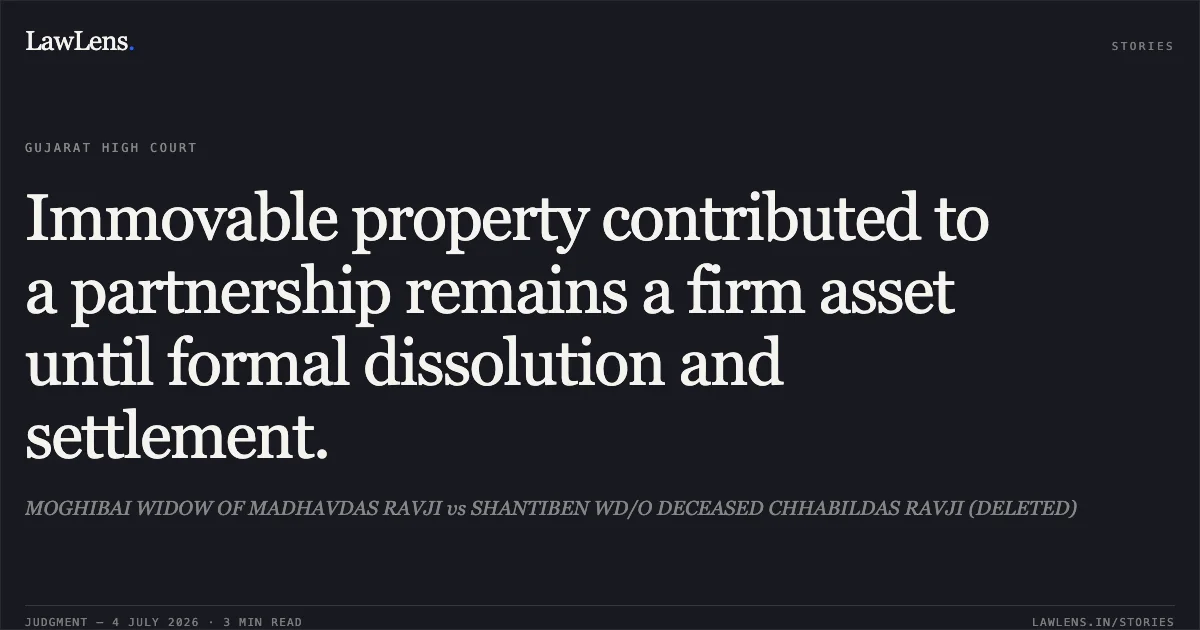
The High Court allowed First Appeal 1313/1985, setting aside the preliminary decree and holding that the suit property is a partnership firm asset, not co-ownership property.
First Appeal 924/1986 was partly allowed, quashing the direction for the heirs of Bai Vali to hand over possession of "Borivali Ni Chawl". Civil Revision Application 747/1992 was allowed, quashing subsequent orders for demarcation by a Court Commissioner.
Source reference: p. 88-89, 90The status of the property as a partnership asset remains until formal winding up and settlement of accounts under the Indian Partnership Act. The judgment was stayed for six weeks to allow for an appeal to the Supreme Court.
Source reference: p. 80, 103Acts & Sections Cited
25 provisions across 4 statutes referred to in this judgment. Each provision opens on LawLens.
Code of Civil Procedure, 19081
Indian Partnership Act, 1932
Hindu Succession Act, 19561
Hindu Adoptions and Maintenance Act, 1956
Original Court PDF
MOGHIBAI WIDOW OF MADHAVDAS RAVJIvsSHANTIBEN WD/O DECEASED CHHABILDAS RAVJI (DELETED)
Click to open original judgment
Original judgment, available to read, download and summarize on LawLens.in