Facts
Pradeep Suresh, proprietor of M/s. King Snacks, instituted a commercial suit seeking recovery of amounts allegedly arising from detention of a consignment against the existing defendants, including M/s. Yang Ming Line (India) Private Limited.
Source reference: paras. 1–7; pp. 2–6The plaintiff initially alleged that the existing defendants, who had acted as agents, were solely liable. Subsequently, the defendants contended in their additional written statement that they were merely agents of a disclosed foreign principal and were protected from liability under Section 230 of the Indian Contract Act, 1872. During the proceedings and cross-examination, the petitioner, M/s. Yang Ming Marine Transport Corporation, was identified as the principal named in the Bill of Lading. The plaintiff therefore sought to implead the petitioner as a defendant. The Principal Commercial Court, Egmore, allowed the impleading application in I.A.No.8 of 2025 in C.O.S.No.204 of 2024 on 27.02.2026. The proposed defendant challenged that order under Article 227 of the Constitution.
Source reference: paras. 1–7; pp. 2–6Issues
Whether the High Court could interfere under Article 227 of the Constitution with an interlocutory order allowing impleadment in a commercial suit, particularly in view of Section 8 of the Commercial Courts Act, 2015?
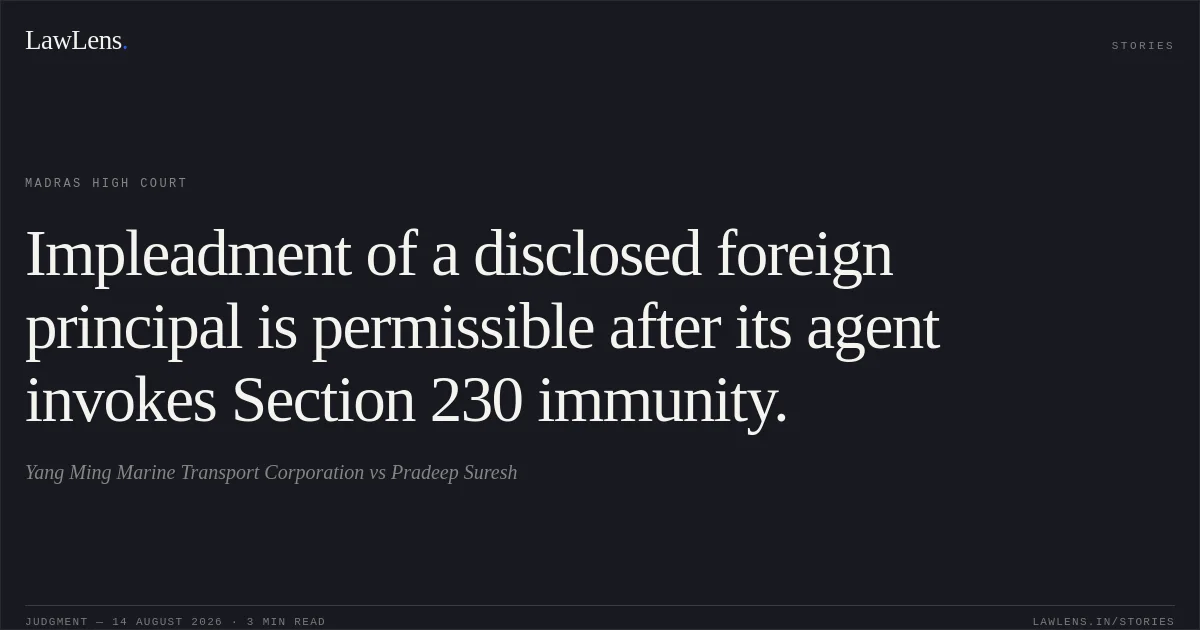
Source reference: para. 8; p. 6Whether impleading the foreign principal named in the Bill of Lading was justified when the existing defendants claimed that they were only agents of a disclosed foreign principal under Section 230 of the Indian Contract Act, 1872?
Source reference: paras. 9–10; pp. 7–8Whether the impleadment altered the character of the suit or otherwise prejudiced the petitioner’s right to defend the claim?
Source reference: paras. 4–6, 9–10; pp. 4–8Law Applied
The Court applied Section 8 of the Commercial Courts Act, 2015, which places a statutory restriction on challenging interlocutory orders in commercial suits through a civil revision petition.
Source reference: paras. 8–10; pp. 6–8It further applied the limited supervisory jurisdiction under Article 227 of the Constitution, holding that such jurisdiction must be exercised sparingly and only where the subordinate court has committed a glaring error that shocks the conscience of the High Court.
Source reference: paras. 8–10; pp. 6–8Section 230 of the Indian Contract Act, 1872, was also considered; under that provision, an agent of a disclosed foreign principal is ordinarily not personally liable on contracts entered into on behalf of the principal.
Source reference: paras. 8–10; pp. 6–8The Court also applied the procedural principle that a person whose presence may be necessary for effective adjudication can be impleaded, without thereby depriving that person of the opportunity to contest liability and maintainability.
Source reference: paras. 8–10; pp. 6–8Reasoning
The Court held that the Commercial Court had rationally allowed impleadment because the Bill of Lading visibly identified the petitioner as the principal and the existing defendants themselves asserted that they were only agents of that principal.
Source reference: paras. 8–10; pp. 6–8Their reliance on Section 230 of the Contract Act created a direct necessity for the plaintiff to implead the disclosed principal, particularly because the plaintiff stated that the petitioner’s full particulars became available only through the defendants’ pleadings and evidence. The Court rejected the argument that impleadment impermissibly altered the character of the suit. The petitioner’s substantive defences remained open: it could file a written statement, challenge whether it was a necessary party, contest the merits of the claim, and cross-examine the plaintiff’s witnesses. Since no right to defend had been defeated and no glaring jurisdictional or legal error was shown, Article 227 intervention was unwarranted.
Source reference: paras. 8–10; pp. 6–8Holding
The High Court dismissed the civil revision petition and upheld the Commercial Court’s order impleading M/s. Yang Ming Marine Transport Corporation as a defendant.
The petitioner and the second respondent were given liberty to raise all objections concerning the merits of the claim and the propriety of impleadment during cross-examination and final arguments. As the earlier stay was vacated, the petitioner was directed to file its written statement within four weeks from receipt of the order, with no further adjournment for that purpose. No costs were awarded, and the connected miscellaneous petition was closed.
Source reference: para. 11; pp. 8–9Acts & Sections Cited
2 provisions across 2 statutes referred to in this judgment. Each provision opens on LawLens.
Indian Contract Act, 18721
Commercial Courts Act, 20151
Original Court PDF
Yang Ming Marine Transport CorporationvsPradeep Suresh
Click to open original judgment
Original judgment, available to read, download and summarize on LawLens.in