Facts
The Petitioner, a trader of precious metals, imported Platinum Alloy Jewellery from Bangkok, Thailand via Airway Bills dated March 30 and 31, 2026
Source reference: p. 3-4On April 1, 2026, the DGFT issued Notification No. 02/2026-27, changing the import policy for such goods from "Free" to "Restricted"
Source reference: p. 4-5This notification was digitally timestamped in the e-Official Gazette at 20:52:28 hrs on April 2, 2026
Source reference: p. 4The Petitioner’s consignments reached Indian ports between April 1 and the early morning of April 2, 2026, roughly 20 hours before the notification's publication
Source reference: p. 8Customs authorities refused clearance, citing the new notification and an Office Memorandum claiming the policy applied to all goods not cleared before April 1, 2026
Source reference: p. 10Issues
1. Whether a subordinate legislation/notification published in the e-Gazette can be applied retrospectively to goods that arrived at the port prior to the date and time of its digital publication
Source reference: p. 11/132. Whether the Court can grant relief in the absence of a specific prayer challenging the validity of the notification itself
Source reference: p. 11-12Law Applied
Delegated legislation must be published in the Official Gazette to acquire the force of law, as established in Viraj Impex Pvt. Ltd. v. Union of India
Source reference: p. 13-14The "digital timestamp" rule from Union of India v. G.S. Chatha Rice Mills, which holds that in the era of electronic gazettes, a notification is effective only from the precise time it is uploaded
Source reference: p. 15-16Subordinate legislation cannot operate retrospectively unless the parent statute (Foreign Trade Development & Regulation Act, 1992) expressly confers such power, as per Director General of Foreign Trade v. Kanak Exports
Source reference: p. 16-17Ultra vires regulations can be ignored during enforcement even without a specific prayer to strike them down, per Shree Bhagwati Steel Rolling Mills v. Commissioner of Central Excise
Source reference: p. 12Reasoning
The Court reasoned that "law, to bind, must first exist" and only comes into existence upon publication
Source reference: p. 13Since the notification was digitally signed and uploaded on April 2, 2026, at 20:52:28 hrs, it could not govern transactions or arrivals completed prior to that timestamp
Source reference: p. 13, 19The Court rejected the Respondents' argument that import is only "complete" upon clearance, noting that the Petitioner’s last consignment arrived at 01:39 AM on April 2, nearly 20 hours before the notification attained legal force
Source reference: p. 19-20The Court also dismissed procedural objections regarding the lack of a prayer to strike down the notification, holding that since the notification was factually inapplicable to the Petitioner’s pre-existing imports, its validity did not need to be adjudicated
Source reference: p. 12-13Holding
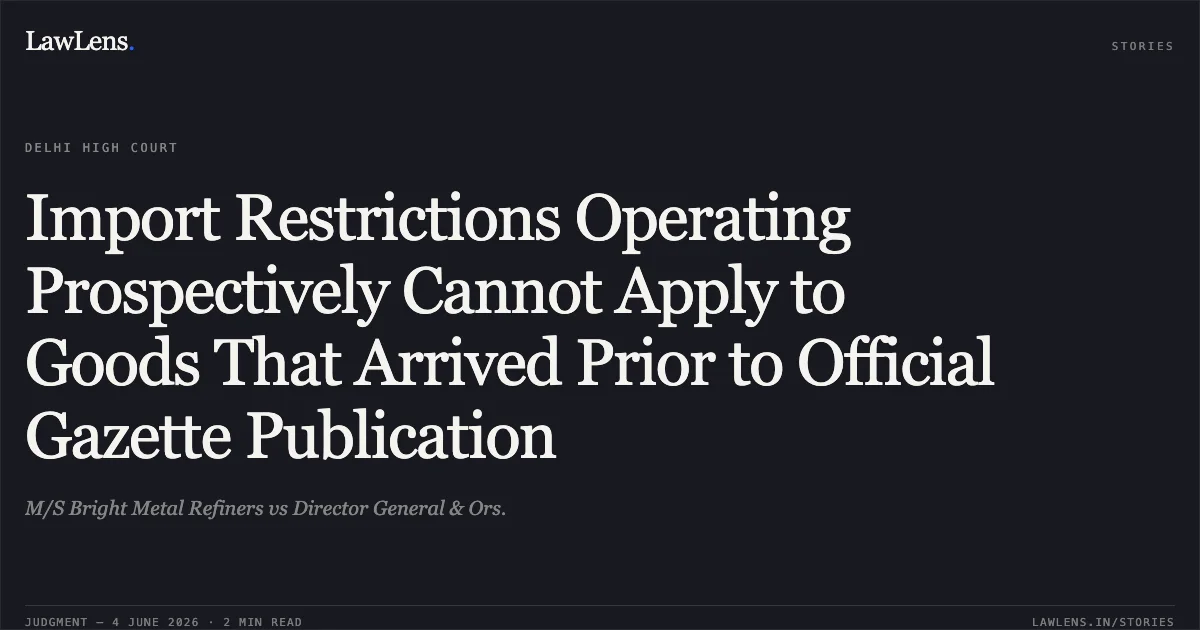
The Court held that the notification cannot travel retrospectively to goods that landed prior to its publication time
The relevant date for policy application is the time of publication, not the date of clearance
Source reference: p. 20The Court allowed the petition and directed the Respondents to immediately process and release the Petitioner’s consignments without insisting on a restricted-category import authorization
Source reference: p. 20Acts & Sections Cited
5 provisions across 3 statutes referred to in this judgment. Each provision opens on LawLens.
Customs Tariff Act, 19751
General Clauses Act, 18972
Original Court PDF
M/S Bright Metal RefinersvsDirector General & Ors.
Click to open original judgment
Original judgment, available to read, download and summarize on LawLens.in


