Facts
The batch comprised six Customs Appeals challenging orders of the Customs, Excise and Service Tax Appellate Tribunal and 41 writ petitions challenging Orders-in-Original passed by the Commissioner of Customs, ICD, Tughlakabad.
Source reference: para. 1; pp. 21–22The proceedings arose from alleged large-scale evasion of customs duty between 2011 and 2015 through forged, manipulated, inflated, exhausted or fictitious transferable duty-credit scrips issued under schemes including DFIA, FPS, FMS, VKGUY and DEPB.
Source reference: paras. 2, 4–8; pp. 22–24Show-cause notices were consequently issued proposing recovery of short-paid duty and interest, confiscation of goods, and penalties under Sections 112(b)(ii), 114A and 114AA of the Customs Act, 1962.
Source reference: para. 10; p. 24The importers contended that the original scrips, Bills of Entry and related documents were not supplied, that the alleged manipulation was confined to the Customs-controlled EDI system, and that cross-examination of Customs officers was wrongly denied.
Source reference: paras. 11, 17.1–17.11; pp. 24, 26–30The record also contained admissions that the importers had not independently verified the genuineness, validity or available balance of the scrips and had relied on their customs broker.
Source reference: paras. 22, 56–70; pp. 33–58Issues
Whether an importer who has used forged, fabricated or manipulated transferable scrips can avoid liability by claiming to be a bona fide purchaser or by relying on the principle of caveat emptor?
Source reference: paras. 20, 23–54; pp. 32, 42–53Whether the non-production of the original scrips and allied documents, together with the denial of cross-examination of Customs officers, vitiated the adjudication for breach of natural justice or caused demonstrable prejudice?
Source reference: paras. 20, 55–71; pp. 32, 53–58Whether penalties under Sections 112(b) and 114A of the Customs Act, 1962 were legally sustainable where the importer claimed absence of actual knowledge of the manipulation?
Source reference: paras. 20, 72–77; pp. 32, 58–59Whether the connected writ petitions ought to be dismissed for failure to pursue the statutory appellate remedy, or could be disposed of on the basis of the findings in the Customs Appeals?
Source reference: paras. 78–80; pp. 60–61Law Applied
The Court applied Sections 28(4), 28AA, 46(4), 111(d), 111(o), 112(b), 114A, 114AA and 147 of the Customs Act, 1962: an importer is responsible for truthful declarations in the Bill of Entry, duty short-paid through fraud or suppression may be recovered within the extended limitation period, and acts of an authorised customs agent are presumed to have been done with the importer’s knowledge and consent unless the contrary is proved.
Source reference: paras. 10, 28, 46, 73–77; pp. 24, 43–44, 50, 58–59Sections 182, 186 and 226 of the Indian Contract Act, 1872 establish the relationship of agency and attribute acts performed within an agent’s authority to the principal.
Source reference: paras. 26–27; pp. 43–44Although Section 41 of the Transfer of Property Act, 1882 directly concerns transfers by an ostensible owner of immovable property, its underlying requirements of good faith, reasonable care and verification were applied analogically to the bona fide-purchaser claim; the Court relied on Hardev Singh v. Gurmail Singh, (2007) 2 SCC 404, for those requirements.
Source reference: paras. 32–36; pp. 45–47The maxim nemo dat quod non habet prevents transfer of an entitlement greater than that lawfully possessed, while caveat emptor requires a purchaser of transferable licences to undertake reasonable enquiries; the Court relied on Commissioner of Customs (Preventive) v. Aafloat Textiles India Pvt. Ltd., (2009) 11 SCC 18.
Source reference: paras. 37–54; pp. 47–53On evidentiary matters, Section 119 of the Bharatiya Sakshya Adhiniyam, 2023 was invoked regarding discretionary presumptions and adverse inference, with reliance on Pandurang Jivaji Apte v. Ramchandra Gangadhar Ashtekar, (1981) 4 SCC 569, that non-production of a document does not automatically warrant an adverse inference where the relevant facts are otherwise independently established.
Source reference: paras. 58–61; pp. 54–55Natural justice requires proof of actual prejudice, and denial of cross-examination is not by itself fatal.
Source reference: paras. 55, 64; pp. 53, 56Reasoning
The Court held that Sharafat Hussain was not an unrelated intermediary but an authorised representative entrusted with customs-clearance documents, preparation and processing of Bills of Entry, communication of duty liability and utilisation of scrips.
Source reference: paras. 24–31; pp. 42–45Under Section 147 of the Customs Act and the law of agency, his acts within the scope of that authority were attributable to the importers.
Source reference: paras. 24–31; pp. 42–45The importers had obtained the direct benefit of the manipulated scrips but had not verified their genuineness, DGFT entitlement, available balance or the authority of the entity undertaking clearance.
Source reference: paras. 40–48; pp. 48–51Accordingly, the genuine origin of a scrip did not validate an inflated entitlement recorded in the EDI system, and the importers could not claim bona fide-purchaser protection or rely on caveat emptor.
Source reference: paras. 37–54; pp. 47–53The Court further found that the Department’s case did not depend exclusively on the physical production of the original scrips.
Source reference: paras. 56–71; pp. 53–58DGFT records, EDI/ICES data, electronic transaction trails, the investigation into the modus operandi, and statements under Section 108 independently established the manipulation and short payment.
Source reference: paras. 56–71; pp. 53–58The importers’ own admissions showed that they had never undertaken the verification they claimed was denied to them; hence, they failed to demonstrate actual prejudice from non-production of documents or denial of cross-examination.
Source reference: paras. 56–71; pp. 53–58As to penalties, the Court reasoned that the absence of proof that the importers personally manipulated the EDI records did not eliminate the statutory consequences of filing Bills of Entry containing incorrect declarations and obtaining a duty benefit through invalid entitlements.
Source reference: paras. 72–77; pp. 58–59Since Section 114A applied, the statutory bar against a separate penalty under Section 112 operated; therefore, the Section 114A penalty was sustained but the separate Section 112(b) penalty was set aside.
Source reference: paras. 72–77; pp. 58–59Holding
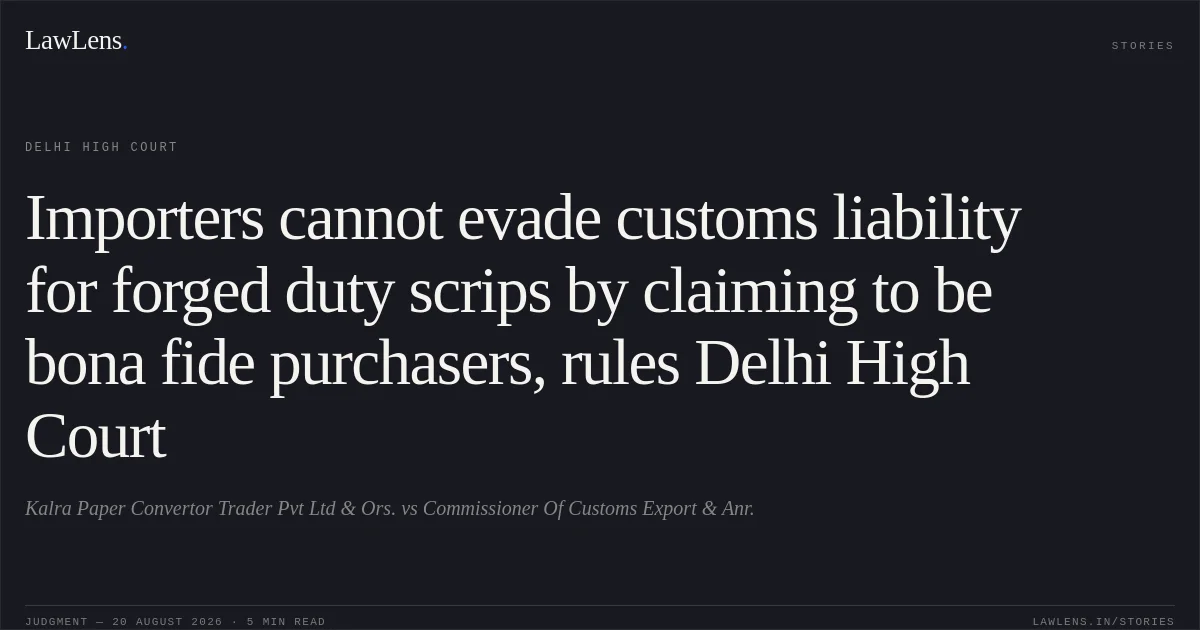
The Court held that the importers were not bona fide purchasers, could not invoke Section 41 of the Transfer of Property Act or the principle of caveat emptor, and remained liable for the consequences of using manipulated or invalid scrip entitlements.
The adjudication was not vitiated by non-production of the original scrips or denial of cross-examination because no demonstrable prejudice was established and the Department had produced substantial independent evidence.
Source reference: para. 81(b); p. 61Penalties under Section 114A of the Customs Act, 1962 were upheld, while the separate penalties under Section 112 were set aside.
Source reference: paras. 74, 77, 81(c); pp. 59, 61The Court disposed of the Customs Appeals and connected writ petitions.
Source reference: paras. 80–82; p. 61The same findings and directions were directed to apply mutatis mutandis to the connected writ petitions, and all pending applications were closed.
Source reference: paras. 80–82; p. 61Acts & Sections Cited
15 provisions across 5 statutes referred to in this judgment. Each provision opens on LawLens.
Customs Act,19628
Indian Penal Code, 18602
Transfer of Property Act, 18821
Indian Contract Act, 18723
Bharatiya Sakshya Adhiniyam, 20231
Original Court PDF
Kalra Paper Convertor Trader Pvt Ltd & Ors.vsCommissioner Of Customs Export & Anr.
Click to open original judgment
Original judgment, available to read, download and summarize on LawLens.in