Facts
On November 23, 1996, Amolak Ram Anand went missing along with his Maruti car
Source reference: p. 2An FIR was registered under Section 365 IPC following suspicions raised by his wife, PW-7
Source reference: p. 2On January 31, 1997, the car was spotted being driven by a young man who fled the scene; subsequently, documents transferred the car's ownership to the appellant, Bhupinder Singh
Source reference: p. 3-4The prosecution alleged that the appellant, along with co-accused (some of whom were acquitted or declared Proclaimed Offenders), murdered the deceased, disposed of the body in Gang Nahar, and forged transfer documents
Source reference: p. 3-4The Trial Court convicted the appellant for murder, forgery, and destruction of evidence
Source reference: p. 5The appellant challenged the conviction on the grounds that the body was never recovered and the chain of circumstantial evidence was broken
Source reference: p. 6-7Issues
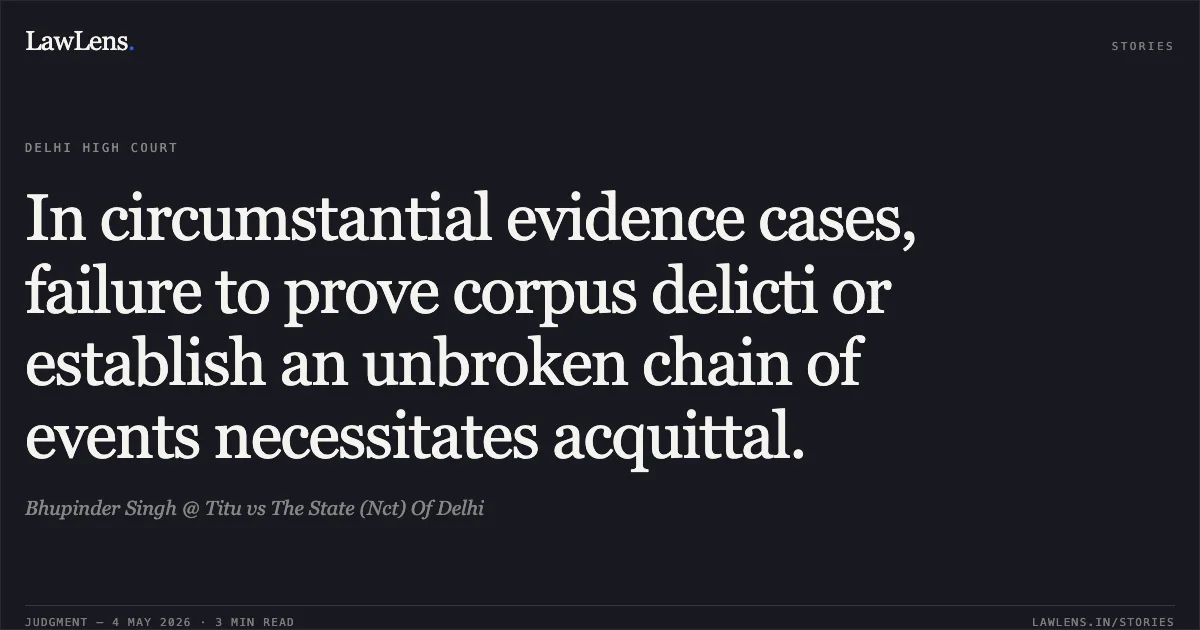
1. Whether a conviction for murder can be sustained in the absence of corpus delicti (the dead body) in a case based entirely on circumstantial evidence.
Source reference: p. 12 / para. 392. Whether the prosecution successfully established an unbroken chain of circumstances leading to the sole hypothesis of the appellant's guilt.
Source reference: p. 12 / para. 37-383. Whether the appellant’s conviction with the aid of Section 34 IPC is sustainable following the acquittal of co-accused persons.
Source reference: p. 19 / para. 51Law Applied
The court applied Section 302 (Murder), Section 365 (Kidnapping), Section 201 (Causing disappearance of evidence), and Sections 468/471 (Forgery) of the IPC
Source reference: p. 1, 5It relied on the evidentiary principle from Rama Nand v. State of Himachal Pradesh, establishing that while recovery of the body is not absolute, "homicidal death" must be proved through clinching and definitive circumstantial evidence in its absence
Source reference: p. 13-14It further applied Section 27 of the Indian Evidence Act, noting that information leading to a fact already discovered is inadmissible (Anand Jakkappa Pujari v. State of Karnataka)
Source reference: p. 16emphasized that motive is a vital link in circumstantial cases as per Indrajit Das v. State of Tripura
Source reference: p. 19Reasoning
The Court found the prosecution's chain of circumstances fundamentally flawed. First, there was no corpus delicti or scientific proof of death; the inference of murder was based on mere disappearance
Source reference: p. 18-19Second, material witnesses (PW-12, PW-14, PW-15) turned hostile and failed to identify the appellant in possession of the car
Source reference: p. 15Third, the "pointing out memos" for the crime scene were legally redundant as the locations were already known to the police through a co-accused’s prior disclosure
Source reference: p. 16Regarding forgery, while FSL confirmed the appellant's signatures on transfer forms, the forms were dated prior to the disappearance, contradicting the prosecution's theory of a post-murder cover-up
Source reference: p. 17-18Finally, the Court noted a complete lack of proved motive or "last seen" evidence, rendering the case one of suspicion rather than proof
Source reference: p. 19Holding
The Court held that the prosecution failed to establish the factum of death (corpus delicti) through cogent evidence and failed to complete the chain of circumstantial links
The Court further ruled that Section 34 IPC was inapplicable due to the lack of evidence regarding a common intention and the acquittal of co-accused
Source reference: p. 19The High Court allowed the appeal and set aside the conviction and sentence. The appellant was acquitted of all charges under Sections 302, 365, 468, 471, and 201 of the IPC
Source reference: p. 20Acts & Sections Cited
1 provisions across 1 statute referred to in this judgment. Each provision opens on LawLens.
Code of Criminal Procedure, 19731
Original Court PDF
Bhupinder Singh @ TituvsThe State (Nct) Of Delhi
Click to open original judgment
Original judgment, available to read, download and summarize on LawLens.in